The Central Board of Secondary Education’s (CBSE) shift to competency-based exams under the 2026–27 framework marks a clear departure from India’s long-standing rote-driven assessment model. The focus is no longer on what students remember, but on how effectively they can apply what they know.
From Recall to Real-World Application
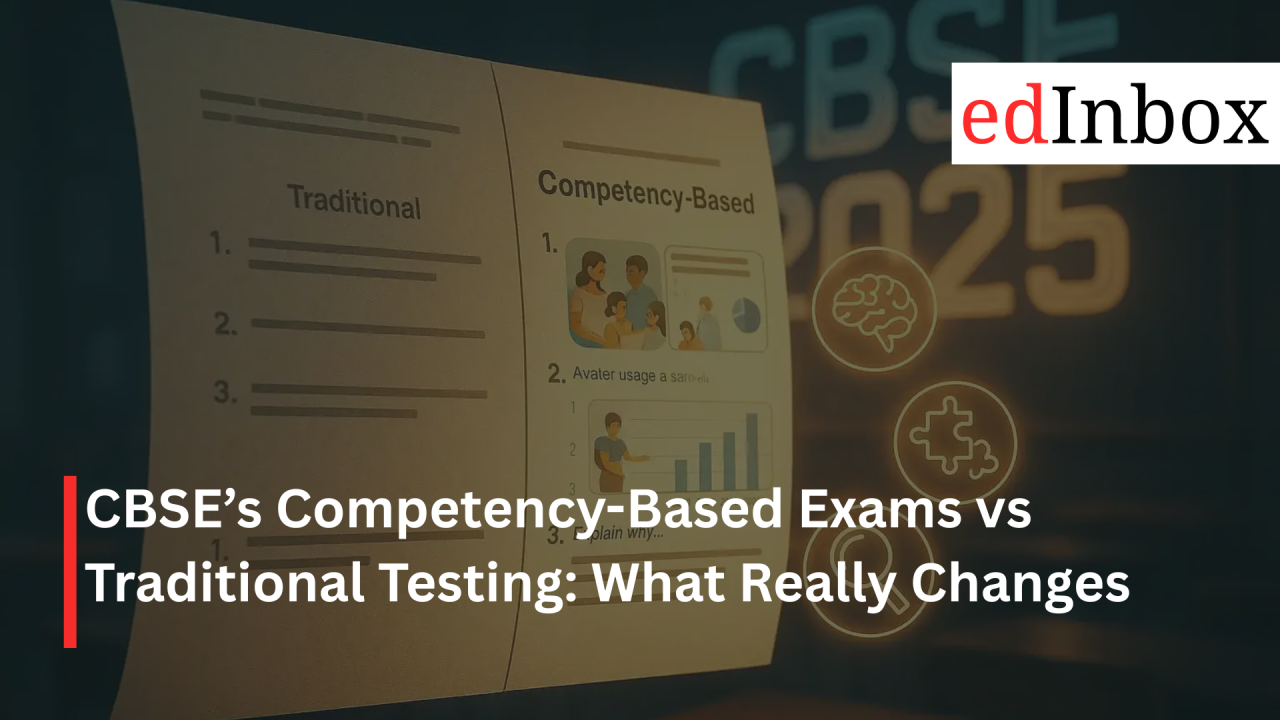
Traditional exams have historically measured memorisation—rewarding students who reproduce textbook content in time-bound settings. Errors are penalised, and feedback is largely limited to marks.
Competency-based assessments, by contrast, evaluate whether students can analyse, interpret, and solve problems in unfamiliar contexts. The emphasis is on mastery, with continuous feedback guiding improvement rather than merely judging performance.
How the Models Compare
Aspect
Traditional Exams
Competency-Based Exams (CBSE)
Core Measure
Recall of information, marks
Skill mastery, application, proficiency
Question Types
Descriptive answers, limited MCQs
Case studies, source-based, simulations (~50%)
Timing & Pace
Fixed schedule, one final attempt
Ongoing evaluation, multiple opportunities
Feedback Style
Marks-focused, error highlighting
Formative, improvement-driven
Progression
Uniform for all students
Based on demonstrated competency
What It Means in CBSE Classrooms
For Classes 9–12, CBSE has redesigned board exams to include:
- 40% objective questions (MCQs)
- 10% short/long subjective responses
- 50% competency-based questions
Additionally, internal assessments—such as projects, portfolios, and peer reviews—carry significant weight, reinforcing real-life application over theoretical recall.
The introduction of bi-annual board exams further reduces high-stakes pressure, allowing students multiple chances to improve performance.
The Big Shift
This transition signals a deeper philosophical change. Exams are no longer endpoints but part of a continuous learning process. Success is defined less by marks and more by the ability to think critically, solve problems, and adapt knowledge to real-world situations.
If implemented effectively, competency-based exams could address one of India’s most persistent education gaps: the disconnect between academic learning and practical capability.
CBSE’s Competency-Based Exams vs Traditional Testing: What Really Changes
Typography
- Smaller Small Medium Big Bigger
- Default Helvetica Segoe Georgia Times
- Reading Mode