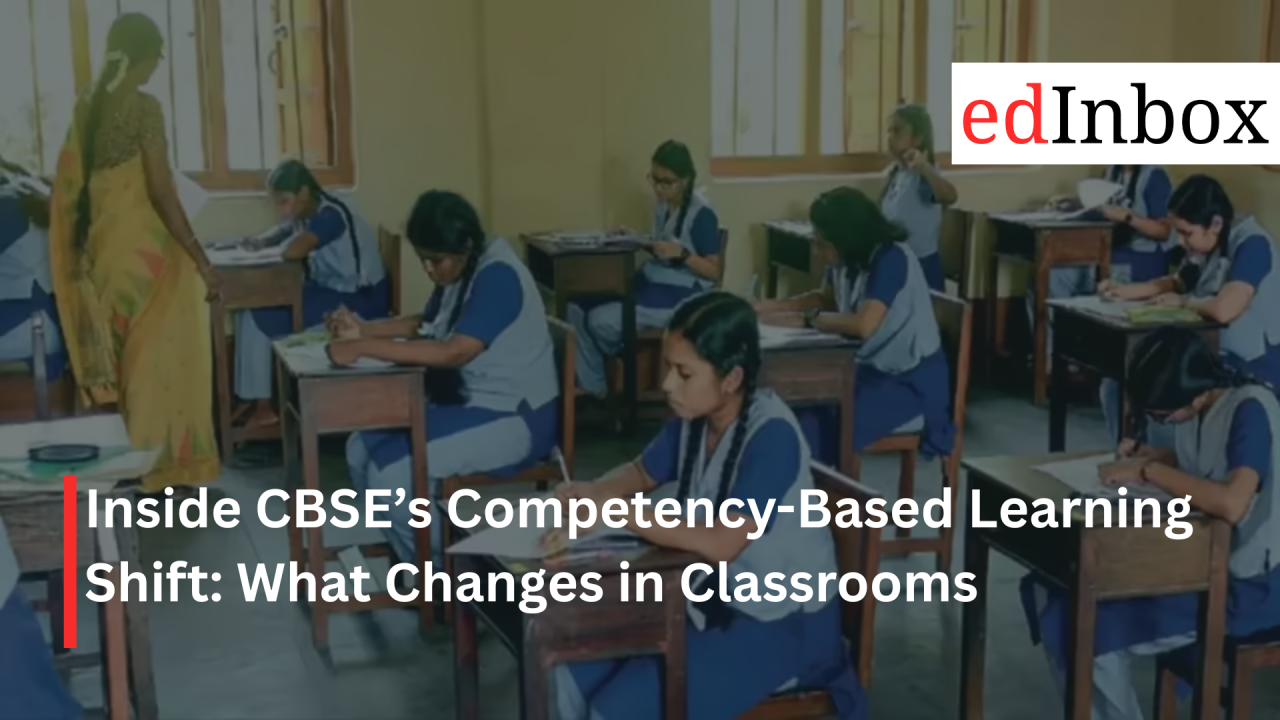
Competency-based learning under the Central Board of Secondary Education’s (CBSE) 2026–27 curriculum marks a fundamental shift from rote memorisation to real-world application. Anchored in the National Education Policy (NEP) 2020, the model prioritises what students can do with knowledge rather than what they can recall.
Learning Defined by Mastery, Not Marks
At its core, competency-based education focuses on measurable skills such as critical thinking, problem-solving, collaboration, and communication. Students are expected to demonstrate mastery through continuous assessments, projects, and applied tasks instead of relying solely on high-stakes exams.
Progression is increasingly linked to proficiency. This means students move forward only after demonstrating understanding through practical application—whether via portfolios, case studies, or problem-solving exercises. Classrooms are also becoming more personalised, with nearly half of instructional time dedicated to experiential learning, including group work and real-life simulations.
How It Plays Out Across Classes
In Classes 6 to 10, competency frameworks are embedded across core subjects like English, Mathematics, and Science. Assessments include case-based questions, MCQs, and lab-based activities that test students’ ability to apply concepts in unfamiliar situations.
For Classes 9 to 12, the shift becomes more visible in board examinations. Around 50% of questions are now competency-based, requiring students to analyse data, interpret scenarios, and design solutions. Alongside this, holistic report cards track not only academic progress but also cognitive and socio-emotional development.
Internal assessments—ranging from projects to peer reviews—carry significant weight (20–40%), often linked to practical themes such as financial literacy, sustainability, and AI ethics.
Rethinking Assessment
The assessment architecture itself is being redesigned. A typical question paper now balances:
- 40% objective questions (MCQs),
- 10% short/long subjective responses,
- 50% competency-based tasks such as source analysis and case studies.
Evaluation is increasingly formative, with regular feedback loops helping students improve continuously rather than preparing only for final exams. The introduction of bi-annual board exams further reduces pressure by offering multiple opportunities to perform.
The Larger Shift
This transformation is not merely academic—it is cultural. It redefines the role of teachers from content deliverers to facilitators, and students from passive learners to active problem-solvers.
If implemented effectively, competency-based learning could bridge India’s long-standing gap between schooling and employability—making classrooms more aligned with the demands of a rapidly evolving world.
Inside CBSE’s Competency-Based Learning Shift: What Changes in Classrooms
Typography
- Smaller Small Medium Big Bigger
- Default Helvetica Segoe Georgia Times
- Reading Mode