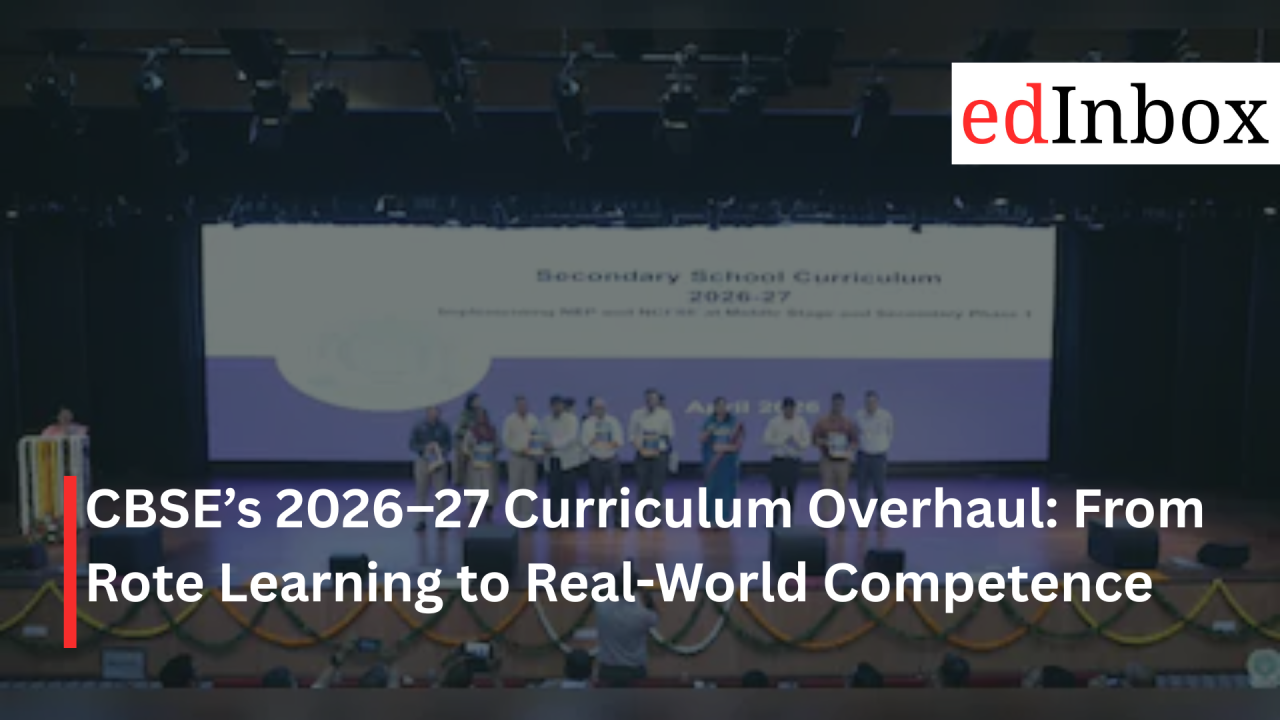
The Central Board of Secondary Education’s (CBSE) new curriculum for the 2026–27 academic session marks a decisive shift in India’s school education landscape. Aligned with the National Education Policy (NEP) 2020 and the National Curriculum Framework (NCF) 2023, the reforms move away from rote memorisation toward competency-driven learning.
Competency Over Content
At the heart of the reform is a structural pivot: nearly 50% of the curriculum now focuses on skill-building, application, and problem-solving. Traditional exam-centric learning is being replaced by project-based and experiential methods designed to mirror real-world contexts.
Assessment patterns are also evolving. Students will now face more multiple-choice and case-based questions, alongside stronger internal evaluation systems. Holistic progress cards will track not just academic performance, but also cognitive, social, and emotional development.
Reimagining Language Learning
The curriculum introduces a structured three-language framework, requiring students to study languages up to Class 10. Divided into advanced, intermediate, and basic levels, the system offers greater flexibility while encouraging the inclusion of regional languages—moving beyond the earlier, more rigid two-language approach.
Breaking the Stream Barrier
One of the most significant changes lies in subject flexibility. Students in Classes 9–12 will have access to a wider basket of electives, including emerging areas such as Artificial Intelligence, Design Thinking, and vocational disciplines like electronics and transportation.
The rigid separation between science, commerce, and humanities is being gradually dismantled, allowing interdisciplinary subject combinations. Additionally, the introduction of bi-annual board examinations aims to reduce high-stakes pressure and offer multiple opportunities for improvement.
Tech Integration and Structural Changes
Building on earlier syllabus rationalisation—where content was reduced by 25–30%—the new curriculum integrates contemporary skills such as coding and financial literacy. Examination systems are also being modernised through digital evaluation processes and enhanced security measures, including biometric verification.
The Big Picture
The CBSE’s 2026–27 reforms signal more than a curriculum update—they reflect a philosophical shift in Indian education. The focus is no longer on how much students can memorise, but on how effectively they can apply, analyse, and adapt.
If implemented effectively, this transition could redefine classrooms as spaces of inquiry and innovation rather than repetition—bringing India’s school education closer to global learning standards.
CBSE’s 2026–27 Curriculum Overhaul: From Rote Learning to Real-World Competence
Typography
- Smaller Small Medium Big Bigger
- Default Helvetica Segoe Georgia Times
- Reading Mode