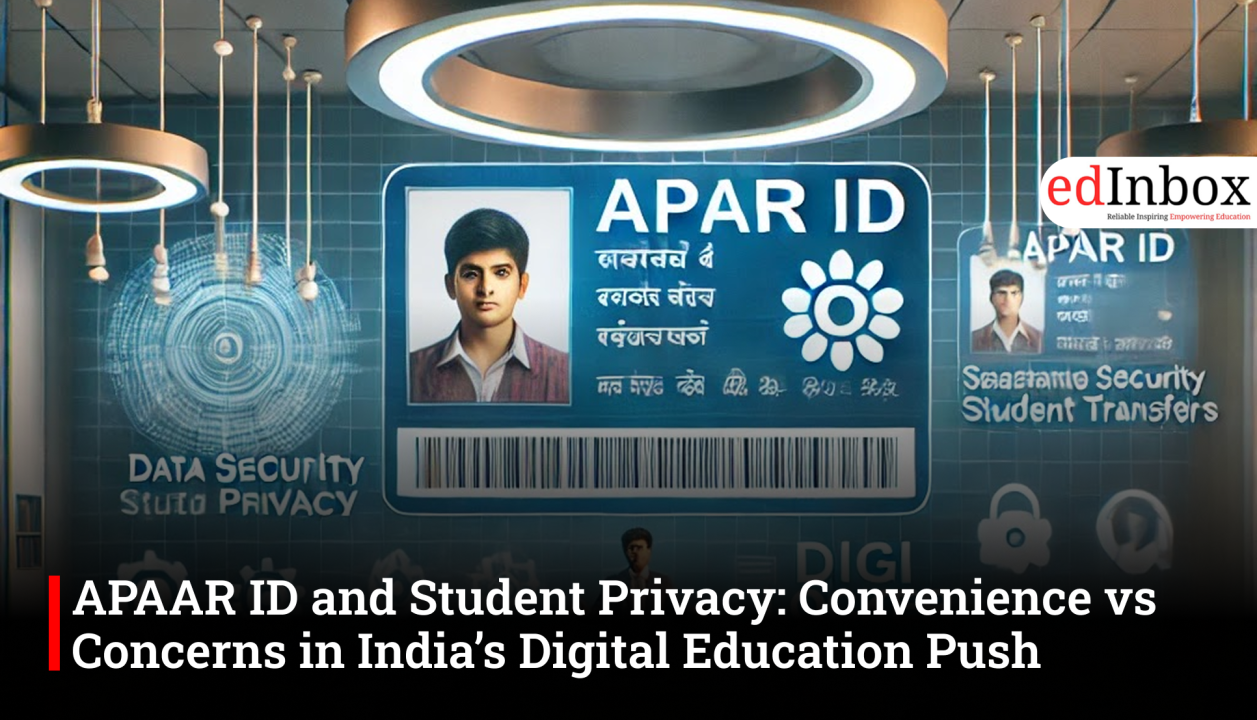
The Automated Permanent Academic Account Registry (APAAR), introduced by the Central Board of Secondary Education, represents a major step toward digitizing India’s education system. Designed as a 12-digit lifelong academic ID, APAAR aims to store a student’s complete academic journey—from marksheets and certificates to co-curricular achievements—in one centralized platform. While the idea promises efficiency and ease, it also raises serious questions about data privacy and long-term security.
At its core, APAAR offers clear advantages. By linking records digitally and storing them through platforms like DigiLocker, the system could eliminate paperwork, prevent document loss, and simplify processes such as school transfers, college admissions, and job verification. For students and institutions alike, it has the potential to reduce administrative burden and improve transparency.
However, the concerns surrounding APAAR are not without precedent. India’s experience with large-scale identity systems like Aadhaar has shown that centralized databases can become vulnerable to data leaks and misuse. APAAR similarly requires sensitive personal information, including Aadhaar-linked identity, parental details, and a long-term academic record. When such data is stored in one place, it creates an attractive target for cyberattacks and raises the stakes of any potential breach.
Beyond security risks, experts warn about the possibility of “function creep,” where data collected for one purpose gradually gets used for others. A system meant to simplify education could, over time, be used for profiling students, influencing admissions, or even shaping hiring decisions. This raises ethical concerns about fairness and the right of young individuals to grow, change, and redefine themselves without being permanently judged by records.
Legal safeguards do exist. Under the Digital Personal Data Protection Act, 2023, collecting and processing children’s data requires clear, informed parental consent. The law also places restrictions on tracking and the targeted use of minors’ data. Yet, the effectiveness of these protections depends heavily on how rigorously they are implemented and enforced.
Ultimately, the safety of APAAR cannot be judged by its intentions alone. Its success will depend on robust cybersecurity measures, strict access controls, transparent data usage policies, and independent oversight. Parents and students need clarity on who can access the data, for how long, and for what purpose, along with reliable mechanisms to address grievances.
APAAR has the potential to transform education in India by making academic records more accessible and reliable. But without strong safeguards, the same system could compromise privacy and limit future opportunities. In a system built around children, trust must be earned not just through promises, but through consistent and accountable action.
APAAR ID and Student Privacy: Convenience vs Concerns in India’s Digital Education Push
Typography
- Smaller Small Medium Big Bigger
- Default Helvetica Segoe Georgia Times
- Reading Mode