After years of administrative uncertainty and financial strain, the University of Calcutta is entering a crucial rebuilding phase under its new vice-chancellor, Ashutosh Ghosh. Rather than rushing into sweeping reforms, Ghosh is prioritising something more fundamental: stabilising the institution’s core systems before pursuing long-term transformation.
Taking charge in October after the university remained without a full-time VC for nearly three years, Ghosh faces a complex set of challenges. From severe faculty shortages to administrative gaps and financial irregularities, the issues run deep. His approach, however, is measured—focusing on fixing structural weaknesses step by step instead of attempting immediate large-scale changes.
At the heart of his agenda is faculty recruitment. Several departments are struggling with critically low staffing, while some, like Atmospheric Sciences, reportedly have no faculty at all. Even high-demand departments such as Bengali are operating with just a handful of teachers despite large student enrolments. Ghosh has made it clear that restoring academic functionality begins with ensuring that departments are adequately staffed, particularly in humanities and emerging fields.
Alongside recruitment, financial repair is another pressing concern. The university’s accounts, he acknowledged, have “lacunae” that need urgent attention. Limited funds not only affect daily operations but also restrict the university’s ability to attract research projects and keep faculty motivated. Without financial stability, broader academic ambitions remain difficult to achieve.
Accreditation is also on the agenda. Ghosh is pushing to secure an evaluation from the National Assessment and Accreditation Council, a key benchmark for institutional quality in India. Achieving this would not only improve credibility but also open doors to funding and collaborations.
Interestingly, while national conversations around the National Education Policy 2020 continue to shape higher education, Calcutta University is not rushing to adopt all its features. Ghosh has indicated that reforms like the multiple-entry/exit system are not an immediate priority. Instead, the focus remains on understanding student challenges—particularly dropout rates driven by socio-economic factors such as early employment or family responsibilities.
To expand research opportunities, the university is exploring a decentralised model by allowing affiliated colleges to offer PhD programmes, provided they meet necessary infrastructure and faculty requirements. This move could help widen access to research without overburdening the central campus.
On the administrative front, Ghosh is also addressing long-standing inefficiencies. Examination delays, for instance, have been tackled through practical changes such as reversing the order of practical and theory exams, giving students more preparation time while ensuring schedules are met.
What emerges from Ghosh’s strategy is a clear shift in tone: from ambition-driven reform to groundwork-driven recovery. Instead of headline-grabbing changes, the emphasis is on rebuilding trust, restoring functionality, and creating conditions where meaningful reforms can eventually take root.
For an institution with a legacy as significant as Calcutta University, this phase may prove critical—not for what changes overnight, but for how sustainably it can rebuild for the future.
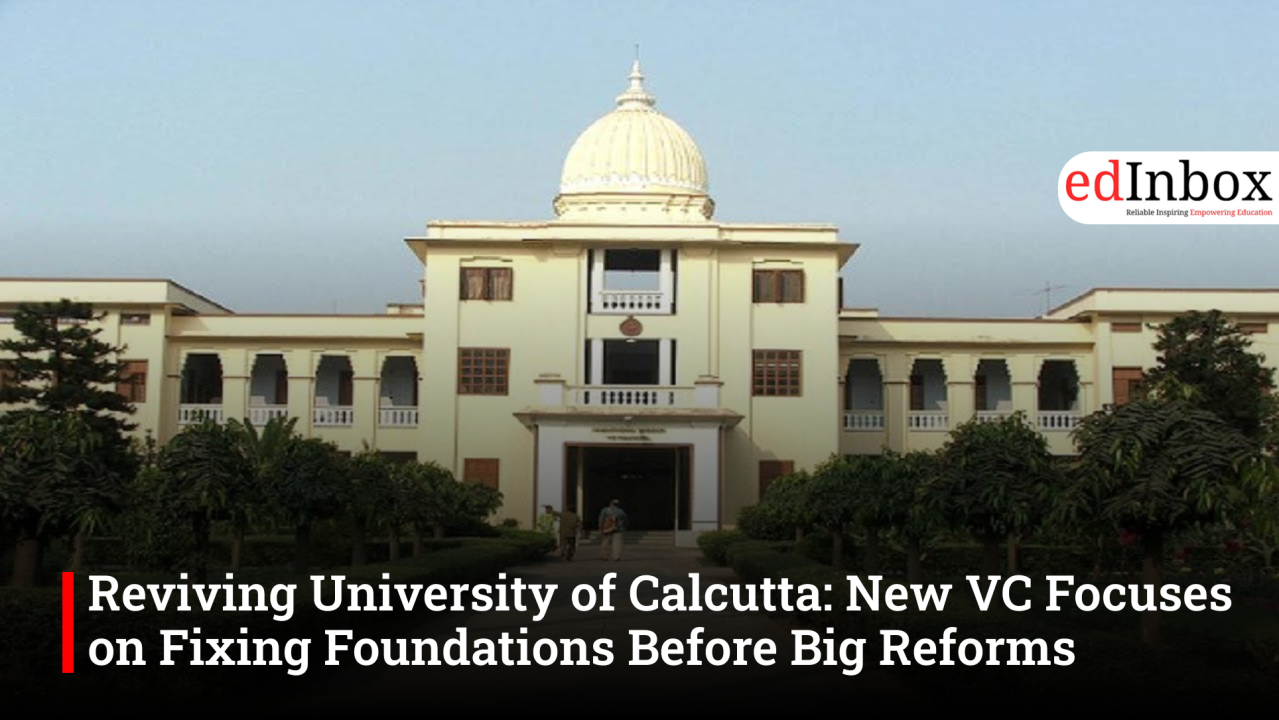
Reviving University of Calcutta: New VC Focuses on Fixing Foundations Before Big Reforms
Typography
- Smaller Small Medium Big Bigger
- Default Helvetica Segoe Georgia Times
- Reading Mode