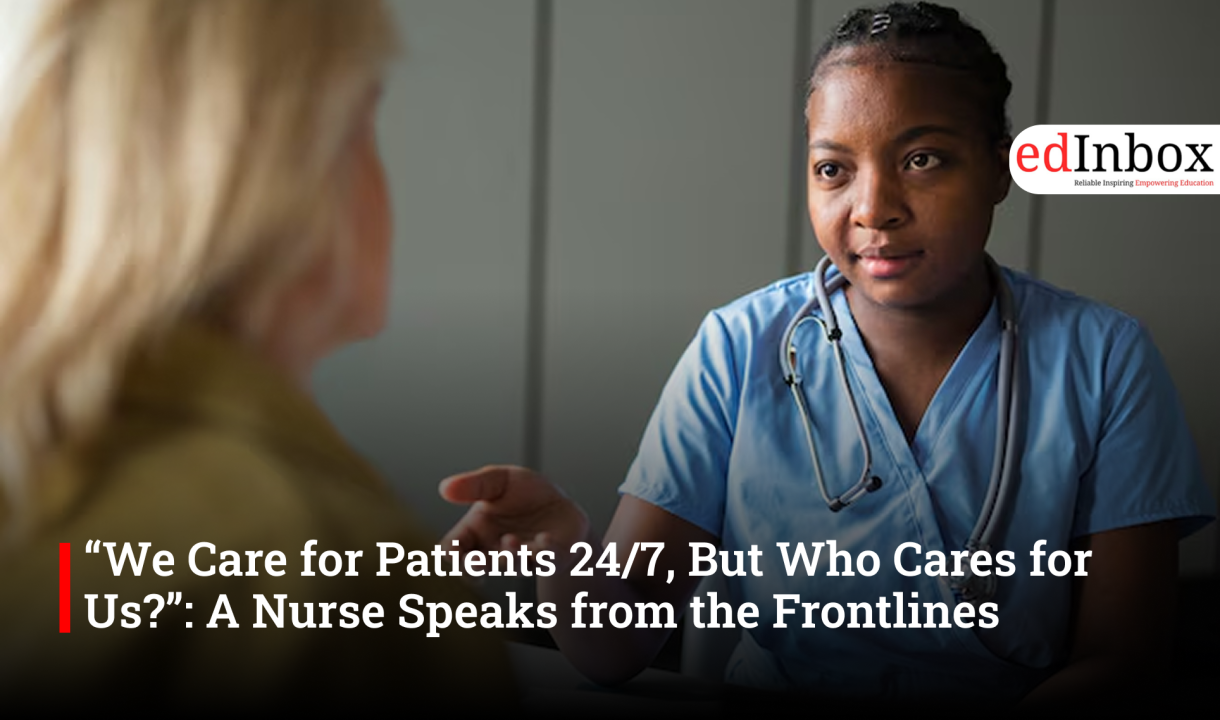
In an exclusive conversation, Madhurima Mukherjee, a nursing professional from the Calcutta School of Tropical Medicine, offers a stark, deeply personal account of the realities inside government hospitals—where relentless workloads, safety concerns, and a struggle for dignity continue to define the profession.
Madhurima begins by describing the exhausting routine that has become the norm. “We often work for 72 hours in prolonged stretches. There’s no fixed time for meals or rest. Sometimes, we don’t even get time to use the washroom,” she says. The issue, she explains, is rooted in an overwhelming patient load and a severe shortage of staff. Ideally, in a Critical Care Unit (CCU), the nurse-to-patient ratio should be 1:3 or 1:4. “But in reality, it’s far from that. In wards, it’s supposed to be 1:8, yet there are times when one nurse handles 30 patients alone. Sometimes even two nurses manage 30 patients,” she adds, highlighting the gap between policy and practice.
Night shifts, particularly in male wards, present another layer of challenge—one that goes beyond physical exhaustion. “We are female staff working through the night without proper security. There were no CCTV cameras or guards earlier. After the Abhaya incident, some changes have been made—like CCTV installations, door latches, and even fingerprint locks in certain on-call rooms. But these measures are still not uniformly implemented,” she points out, underlining the uneven pace of reforms.
The strain of the job, Madhurima admits, sometimes affects interactions with patients and their families. “It’s not that we want to be rude. But when you are overworked and the same question is asked repeatedly, it becomes difficult to stay calm,” she says. She also highlights a deeper social issue—lack of respect. “People often don’t see us as trained professionals. They call us ‘aya’ or ‘mashi’ and treat us like attendants. It’s disheartening.”
Even within the hospital hierarchy, challenges persist. “Doctors are respected, and rightly so. But they come during rounds and leave. We are the ones with patients 24/7—monitoring, caring, responding,” she says. Madhurima emphasizes that becoming a nurse is no easy feat. “We go through rigorous studies and now even CBT-based recruitment exams in West Bengal. It requires serious preparation and dedication.”
Reflecting on the post-pandemic shift, she acknowledges a slight improvement in public perception. “After COVID-19, people started recognizing our role more. But it’s still not enough. We need greater awareness that nursing is a skilled and noble profession.”
On infrastructure, however, she notes visible progress. “Things are improving. Earlier conditions were worse, but now there are cleaner wards, better toilets, no floor admissions, and grievance cells. Facilities like ‘May I Help You’ desks, Swasthya Sathi support, and monitored lifts have made a difference,” she says.
Yet, her closing words bring the focus back to the core issue: “We are always there for patients. But the system needs to ensure that nurses are supported, respected, and protected too.”
“We Care for Patients 24/7, But Who Cares for Us?”: A Nurse Speaks from the Frontlines
Typography
- Smaller Small Medium Big Bigger
- Default Helvetica Segoe Georgia Times
- Reading Mode