Bollywood's enduring action icon Akshay Kumar has sparked debate by criticising the heavy reliance on visual effects (VFX) and AI in contemporary action films. At 58, the martial arts maestro—who holds black belts in Karate and proficiency in Muay Thai, Taekwondo, and Kudo—longs for the raw excitement of practical stunts that defined his early career.
From Real Punches to Digital Illusions
Kumar contrasts the visceral action of his breakout hits like the Khiladi series, Mohra, Holiday: A Soldier Is Never Off Duty, Gabbar is Back, and Sooryavanshi with today's green-screen spectacles. "There is a huge difference in the way action films are being made today," he stated in a recent PTI interview. "Earlier, the action would be real; now, everything is done in VFX. It’s not fun as it feels fake." He vividly recalls leaping from helicopters or battling foes hand-to-hand, feats that demanded genuine athleticism rather than post-production polish.
This shift, Kumar argues, strips away the authenticity that audiences crave. Modern sequences, often crafted by teams of animators, lack the imperfections that make real stunts believable and thrilling. "I want to make a real action film," he declares, envisioning a project where he performs every jump and kick himself—without "15 people helping me kick people." His frustration peaks at the thought of actors merely mimicking exertion while VFX handles the spectacle.
AI's Intrusive Role in Filmmaking
In the burgeoning era of artificial intelligence, Kumar warns that over-perfection alienates viewers. Drawing a poignant analogy, he compares VFX-laden action to printed reproductions of paintings: flawless yet soulless. "A real painting might have slight flaws, but it feels alive," he explains. "The audience can feel how much effort is being put in." This critique comes amid Bollywood's VFX boom, seen in mega-hits like Stree 2 (2024), where Kumar himself ventured into supernatural universes, blending practical elements with digital wizardry.
Kumar's comments reflect broader industry tensions. While VFX enables impossible feats—think explosive set pieces or fantastical battles—it risks homogenising action cinema. Stars like him, who built legacies on physical prowess, champion a hybrid approach: technology as enhancer, not replacement. His track record, from 1990s adrenaline rushes to recent blockbusters, positions him as a voice of experience urging restraint.
A Call for Authentic Revival
This isn't mere nostalgia; it's a blueprint for reinvention. As Indian cinema competes globally, Kumar's plea could inspire producers to invest in stunt coordinators, wirework, and actor training over CGI budgets. Imagine a Khiladi 15 redux: no wires, no doubles, just Kumar flipping through flames. Fans, accustomed to his 150+ films spanning action, comedy, and drama, would relish the return to roots.
Yet challenges persist. Safety concerns, insurance costs, and younger actors' reluctance to risk injury favour VFX. Still, successes like RRR's practical choreography prove audiences reward grit. Kumar's stance might galvanise a "real action" wave, echoing Hollywood's John Wick or Mission: Impossible ethos.
Ultimately, Akshay Kumar embodies Bollywood's evolution—and resistance. His critique isn't anti-progress but pro-passion, reminding filmmakers that true heroism shines through sweat, not pixels. As he eyes future projects, the industry watches: will VFX dominate, or will real stunts stage a comeback?
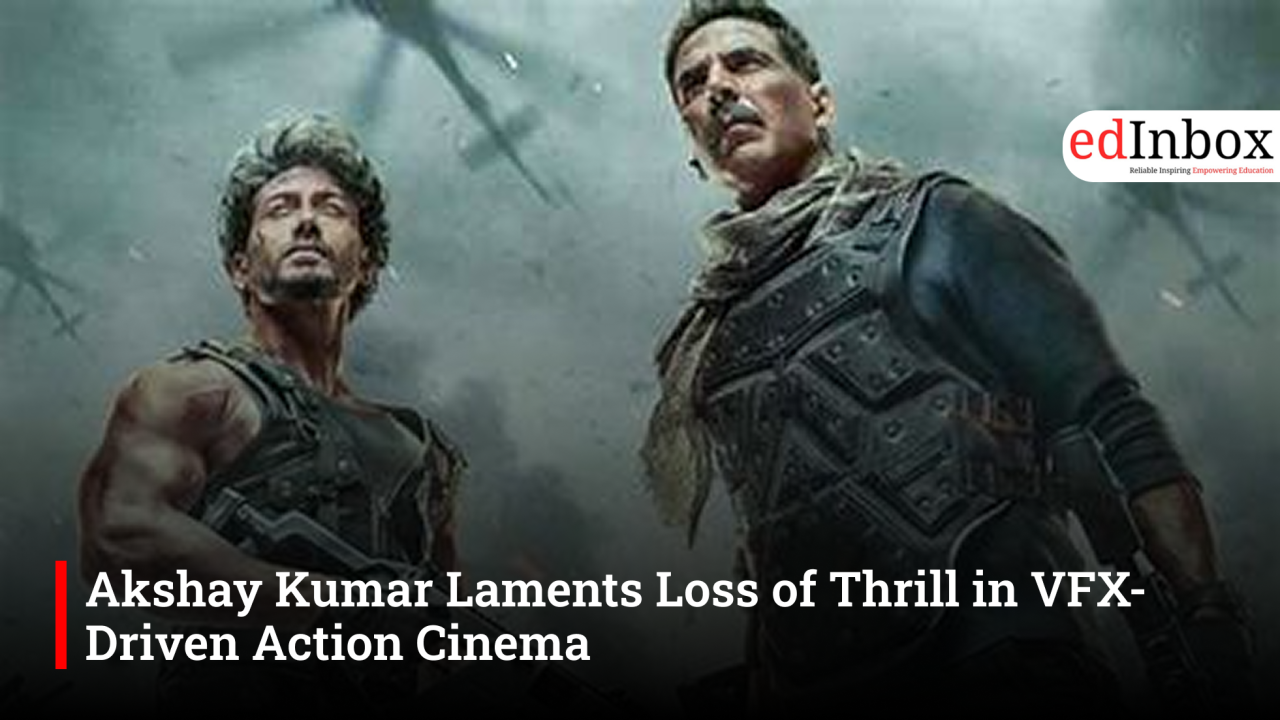
Akshay Kumar Laments Loss of Thrill in VFX-Driven Action Cinema
Typography
- Smaller Small Medium Big Bigger
- Default Helvetica Segoe Georgia Times
- Reading Mode