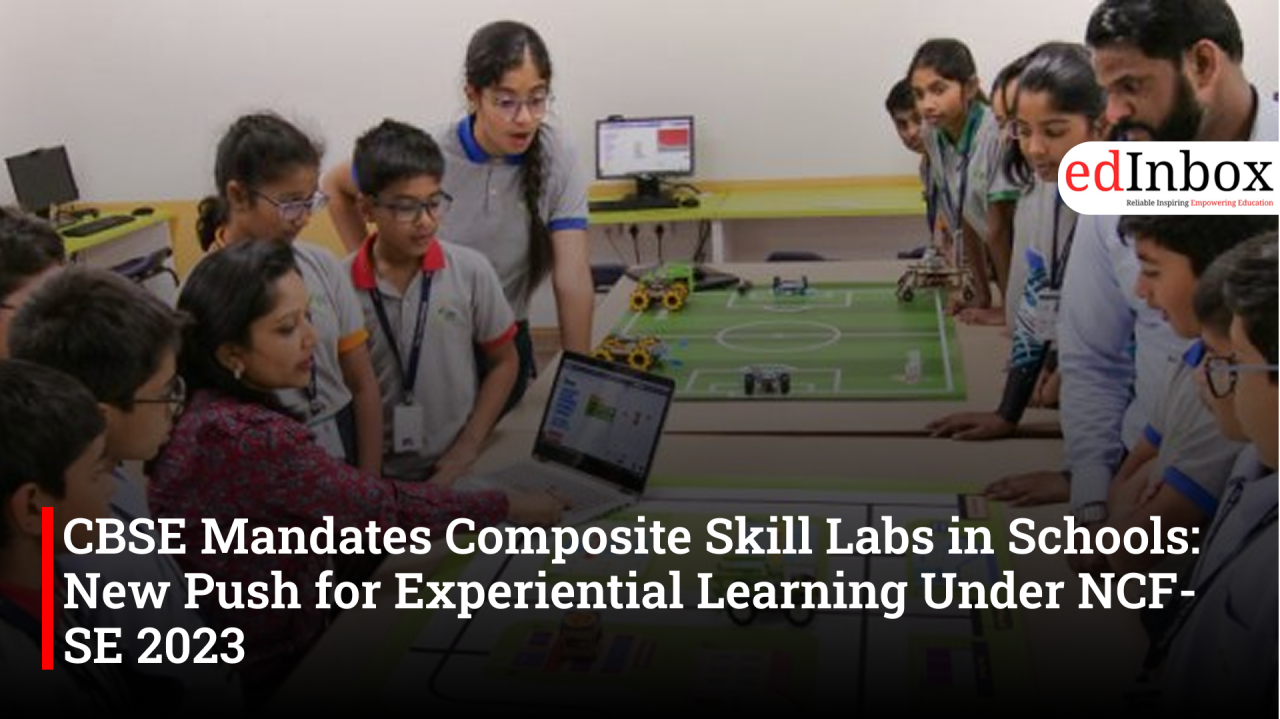
In a significant move to strengthen skill-based and experiential learning, the Central Board of Secondary Education (CBSE) has directed all affiliated schools to establish Composite Skill Labs in line with the National Curriculum Framework for School Education 2023 and the National Education Policy 2020. The initiative aims to integrate vocational education into mainstream schooling, making practical learning a core component of academic development.
Issued under Circular No. Skill-75/2024, the directive outlines detailed requirements for infrastructure, timelines, and implementation strategies, signalling a shift from theory-heavy instruction to competency-based education.
Infrastructure Norms and Lab Design
As per CBSE guidelines, schools must establish either:
One Composite Skill Lab of at least 600 sq. ft. catering to Classes VI to XII, or
Two separate labs of 400 sq. ft. each, with one dedicated to Classes VI–X and the other for Classes XI–XII
These labs are designed as flexible, multi-disciplinary spaces where students can engage in hands-on, activity-based learning across various skill sectors. Schools are required to ensure proper safety measures, accessibility, and adaptability to support diverse vocational subjects.
Timeline and Affiliation Requirements
The establishment of skill labs has been made mandatory for schools applying for new CBSE affiliation, where a fully equipped lab will be a key eligibility criterion.
Existing affiliated schools have been granted a three-year compliance window, with the deadline set for August 22, 2027. During this period, institutions must install the necessary infrastructure, tools, and machinery as per CBSE norms.
Bridging the Gap Between Theory and Practice
The introduction of Composite Skill Labs is expected to address a long-standing gap in India’s school education system—limited exposure to practical, real-world applications of classroom learning.
By enabling students to engage in hands-on activities, the labs will:
Strengthen conceptual understanding through application
Promote multidisciplinary learning approaches
Build essential life and workplace skills
Enhance employability and vocational readiness
This aligns with the broader vision of NEP 2020, which emphasises integrating academic knowledge with practical competencies from an early stage.
Flexible Implementation Framework
CBSE has provided detailed guidelines covering infrastructure, equipment, and safety standards. However, the board has also allowed flexibility—schools can customise lab setups and equipment based on their specific needs, available resources, and local skill demands.
School heads have been instructed to take proactive steps not only in setting up these labs but also in ensuring their effective utilisation as part of regular teaching-learning processes.
A Step Toward Future-Ready Education
The rollout of Composite Skill Labs marks a crucial step in transforming Indian classrooms into dynamic learning environments. As education systems globally move toward experiential and skill-driven models, CBSE’s initiative positions students to be better prepared for both higher education and the evolving job market.
By embedding vocational learning within the school ecosystem, this reform could redefine how students learn—not just for exams, but for life beyond the classroom.
CBSE Mandates Composite Skill Labs in Schools: New Push for Experiential Learning Under NCF-SE 2023
Typography
- Smaller Small Medium Big Bigger
- Default Helvetica Segoe Georgia Times
- Reading Mode