In a major push toward digital learning and assessment reform, the Central Board of Secondary Education (CBSE) has introduced the On-Screen Marking (OSM) system for Class 12 board examinations starting 2026. The move marks a significant shift in how answer sheets are evaluated, aiming to improve accuracy, speed, and transparency in one of India’s largest examination systems.
While students will continue writing exams in the traditional pen-and-paper format, the evaluation process will transition to a fully digital workflow—bringing CBSE in line with global trends in tech-driven education.
What is CBSE’s On-Screen Marking System?
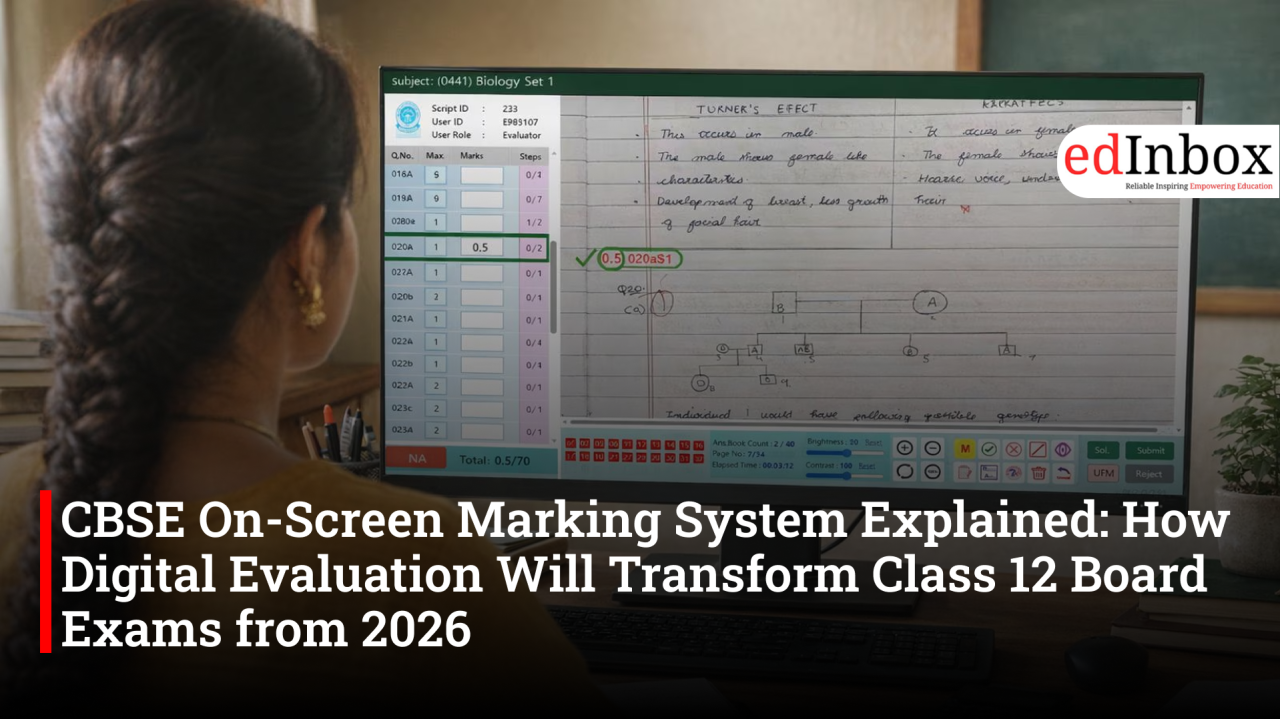
The On-Screen Marking (OSM) system is a digital evaluation method where answer sheets are scanned after the examination and converted into high-resolution digital copies. These scripts are then uploaded to a secure CBSE portal, allowing examiners to assess responses directly on computer screens instead of handling physical copies.
Each examiner logs in using authorised credentials and is assigned answer sheets through a controlled, randomised system. Marks are entered question-wise on screen, and totals are calculated automatically—eliminating manual errors in addition.
Importantly, the original answer sheets are preserved for verification, ensuring accountability in the evaluation process.
How the Digital Evaluation Process Works
After exams are conducted, answer sheets are transported to designated scanning centres. Every page is digitised carefully to capture handwritten responses, diagrams, and rough work with clarity.
These scanned scripts are uploaded to CBSE’s secure digital platform. The system then distributes them among trained evaluators. Using an interactive interface, teachers can zoom, navigate, and assess answers page by page.
Marks are awarded directly within the system, which automatically compiles total scores. Authorities can also monitor evaluation progress in real time, making the process more efficient and trackable.
Why CBSE Introduced OSM
CBSE’s decision to adopt On-Screen Marking stems from long-standing challenges in manual evaluation, especially given the scale of board exams involving millions of answer sheets.
The digital system is expected to:
- Reduce logistical delays in transporting and handling physical copies
- Improve consistency and uniformity in marking
- Minimise human errors in totalling marks
- Enable centralised monitoring of evaluation progress
By standardising the evaluation interface, CBSE aims to ensure fairer and more reliable assessment outcomes.
What It Means for Students
For students, there is no change in the exam pattern, syllabus, or marking scheme. They will continue writing answers as before. However, the shift to digital evaluation brings subtle but important implications.
Since examiners will read scanned copies on screens, clear handwriting and well-structured answers become even more critical. Illegible writing or poorly organised responses may be harder to interpret digitally.
On the positive side, automated totalling and uniform evaluation practices are expected to reduce discrepancies in marks and improve fairness.
The Bigger Picture: Digital Learning and Assessment
The introduction of On-Screen Marking reflects CBSE’s broader focus on integrating technology into education. As digital learning tools expand across classrooms, assessment systems are also evolving to match the pace.
With Class 12 as the starting point, OSM could soon reshape evaluation practices across other grades, setting a new standard for board examinations in India.
Ultimately, this reform is less about changing how students write exams—and more about transforming how their performance is assessed in a fast-digitising education ecosystem.
CBSE On-Screen Marking System Explained: How Digital Evaluation Will Transform Class 12 Board Exams from 2026
Typography
- Smaller Small Medium Big Bigger
- Default Helvetica Segoe Georgia Times
- Reading Mode