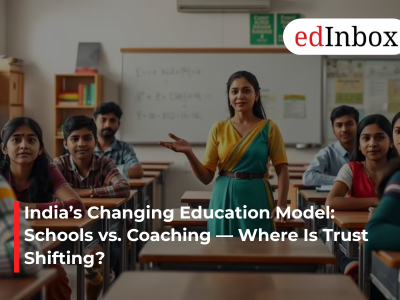
India’s education system is splitting into two parallel tracks — formal schools and a fast-growing coaching industry. Once seen as extra help, coaching is now the main route to success in competitive exams for many. For lakhs of students preparing for engineering, medical, and other entrance tests, coaching centers are often trusted more than school classrooms. This shift is changing not just where students study, but also how families spend and how success is defined.
*Schools Losing Ground*
According to Nirvaan Birla, Managing Director of Birla Open Minds Education, coaching’s rise has altered how schools are viewed. Many students now see school as a formality, while coaching institutes appear to deliver better results. He warns that schools risk losing their core identity as centers of holistic development. Instead of competing with coaching, schools must focus on critical thinking, experiential learning, and active student engagement.
The gap exists because coaching offers what many schools don’t: goal-based prep, regular performance tracking, and personalized exam strategy. When asked where they learn most, students increasingly point to coaching. Yet Birla stresses that schools must still provide deep, meaningful, lifelong knowledge.
*Collaboration or Competition?*
Not all experts see a rivalry. Modern Public School Principal Alka Kapur says coaching aids specialized exam prep, while schools build foundational knowledge, values, and overall growth. Together, they can create a balanced system where schools spark curiosity and coaching prepares for competition.
*An Economy of Aspirations*
This hybrid model reflects rising student and family ambitions. With limited seats and intense competition, families now view coaching fees as investment, not expense. EventBeep CEO Saurabh Mangrulkar says parents see coaching as a path to a better future, so they spend willingly. Digital platforms have accelerated this demand.
Dexian India Country Head Kumar Rajagopalan notes that fierce higher-education competition and families’ readiness to invest have expanded the market. But he cautions that over-dependence on private coaching could widen social and economic inequality. Rising fees in big cities and student migration from small towns have created a ‘shadow education’ system, forcing families to pay twice — for school and coaching.
*Why Schools Fell Behind*
Experts say schools didn’t adapt as fast as coaching did. Students naturally gravitate to what feels directly useful. Rajagopalan adds that while schools still drive social development, literacy, and certification, the center for competitive prep has shifted. Education now has two tracks: concept-based schooling and outcome-driven exam training.
*The Need for Reform*
Regulation alone won’t fix this. Structural change inside schools is key. Birla calls for curriculum updates, better assessment, and application-based learning. Kapur believes integrating exam-focused practice into classrooms can bridge the gap. Mangrulkar says schools must become more practical and results-oriented to match outside assessments.
Coaching’s rise signals market demand, institutional gaps, and changing consumer behavior. Until parents believe success comes from within schools, investment will flow outward. The institutions that survive will balance results with real learning. For schools, the challenge isn’t just staying relevant — it’s redefining relevance.
India’s Changing Education Model: Schools vs. Coaching — Where Is Trust Shifting?
Typography
- Smaller Small Medium Big Bigger
- Default Helvetica Segoe Georgia Times
- Reading Mode