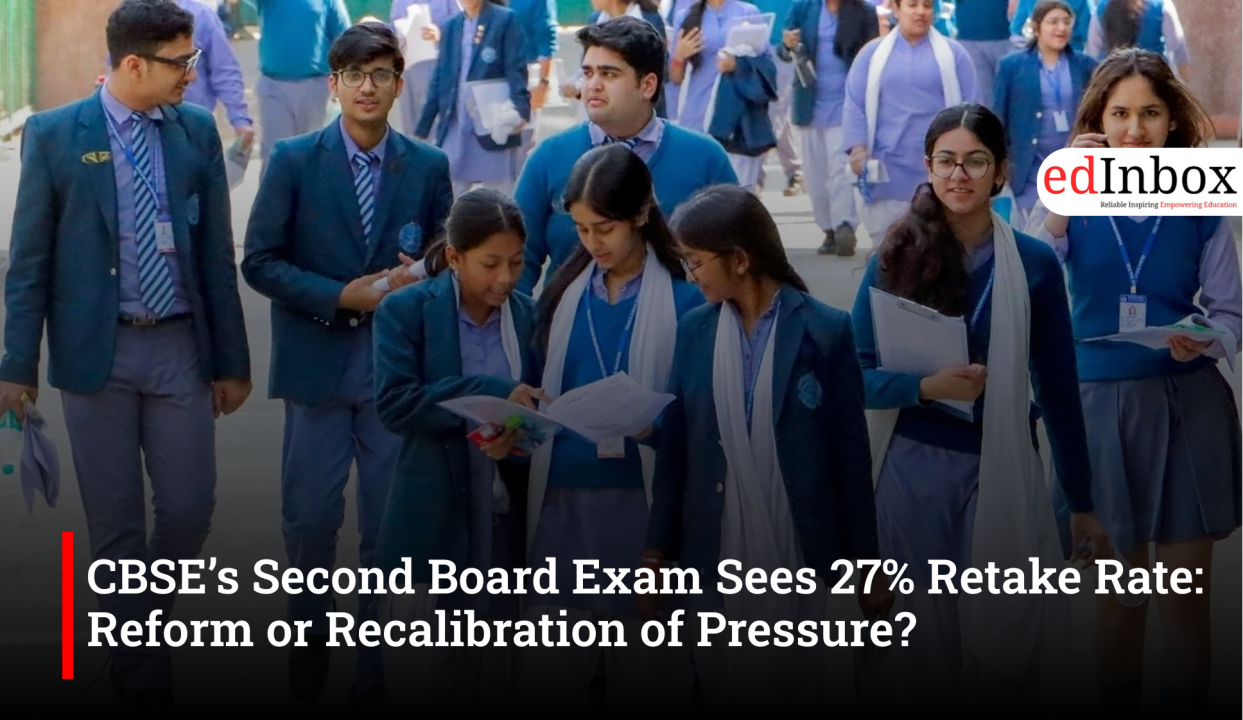
The introduction of a dual-board exam system by the Central Board of Secondary Education was meant to reduce stress and democratise performance. But the numbers emerging from its first full implementation in 2026 tell a more layered story. Over 6.78 lakh students—more than 27% of the Class 10 cohort—have opted to retake the exam.
At one level, this is exactly what the reform intended: a second chance. At another, it raises a more uncomfortable question—has the system reduced pressure, or simply redistributed it?
A Safety Net That’s Being Widely Used
Out of nearly 24.7 lakh students, more than a quarter choosing to reappear is not a marginal statistic. It signals that the second attempt is no longer an exception; it is fast becoming part of the mainstream strategy.
Students are not just retaking exams to pass. Many are optimising scores, attempting to push their percentages higher in a system where marks still dictate streams, schools, and in many cases, self-worth.
The Usual Suspects: Core Subjects
The subjects with the highest re-registration—Mathematics, Science, Social Science, and English—are predictable. These have always been high-stakes papers, often determining overall performance.
What changes now is the behaviour around them. Instead of a single decisive attempt, students are increasingly treating the first exam as a benchmark and the second as a correction mechanism.
Reform Meets Reality
The dual-exam system, aligned with the broader vision of the National Education Policy 2020, was designed to ease the burden of one-shot evaluation. By allowing students to retain the best score from two attempts, it introduces flexibility rarely seen in Indian school boards.
But flexibility has a paradox.
When improvement becomes an option, it can quickly turn into an expectation. Students who might have been satisfied earlier now feel compelled to attempt again—not out of necessity, but out of competitive pressure.
Exam Calendar and the New Academic Cycle
The second phase of exams is scheduled from May 15 to May 21, 2026, with final results expected by end of June. This extended evaluation cycle effectively stretches the academic year, delaying closure for students and complicating timelines for admissions and stream selection.
In trying to reduce stress, the system may be prolonging it.
The Bigger Shift: From Performance to Optimisation
What we are witnessing is a subtle but important shift—from performance-based evaluation to performance optimisation.
Students are learning to game the system in rational ways:
Attempt once to assess difficulty
Retake to improve weak areas
Maximise final scores through dual attempts
This is not misuse—it is adaptation.
The Question Ahead
The success of any reform lies not just in its design, but in its behavioural impact. CBSE’s dual-exam model is undeniably progressive. But its long-term effectiveness will depend on whether it truly reduces anxiety—or simply normalises repeated evaluation.
Because if every student begins to see two attempts as the default, the system risks recreating the very pressure it sought to dismantle.
Final Word
For now, the data tells us one thing clearly: students are embracing the second chance.
The real test is whether that second chance empowers them—or quietly raises the bar even higher.
CBSE’s Second Board Exam Sees 27% Retake Rate: Reform or Recalibration of Pressure?
Typography
- Smaller Small Medium Big Bigger
- Default Helvetica Segoe Georgia Times
- Reading Mode