In a significant ruling reinforcing the Right to Education (RTE) framework, the Supreme Court of India has directed schools not to deny admission to students from economically weaker sections due to ongoing disputes with government authorities. The verdict comes at a time when several underprivileged students continue to face barriers in securing seats in neighbourhood schools under the RTE Act.
A bench comprising Justices P. S. Narasimha and Alok Aradhe made it clear that disagreements between school managements and state authorities cannot become a reason to block admissions. The court emphasised that such conflicts must be resolved separately without compromising a child’s fundamental right to education.
“The schools may have grievances regarding the selection process or government lists, but they are obligated to grant admission to students whose names appear in the official list,” the bench observed. It further clarified that institutions can submit representations to the concerned authorities, but they must not delay or deny admission while awaiting a resolution.
This directive strengthens the implementation of Right to Education Act, which mandates that private unaided schools reserve 25% of seats for children from disadvantaged backgrounds. The ruling underscores that the intent of the law is not merely procedural compliance but the realisation of a broader social goal.
Central to the judgment is the constitutional guarantee under Article 21A, which ensures free and compulsory education for children aged 6 to 14 years. The court stressed that immediate admission is critical to fulfilling this constitutional promise, warning that delays caused by administrative or institutional disputes could irreversibly harm a child’s academic future.
Highlighting the larger vision behind the RTE Act, the Supreme Court described education as a “national mission” aimed at dismantling social inequalities. It noted that schools must function as inclusive civic spaces where barriers of caste, class, and gender are actively broken down. By facilitating access to quality education, the system can promote substantive social justice and equal opportunity.
The judgment is expected to have far-reaching implications across India, particularly in states where friction between private schools and government bodies has slowed RTE admissions. Education activists have long argued that bureaucratic delays and institutional resistance disproportionately affect children from marginalised communities, depriving them of timely access to schooling.
With this ruling, the apex court has sent a clear message: the rights of students must take precedence over administrative disagreements. Schools are now legally bound to comply with RTE admission lists without delay, ensuring that no child is left out of the education system due to procedural conflicts.
As India continues its push towards inclusive education, the Supreme Court’s intervention reaffirms that access to schooling is not a privilege but a constitutional right—one that cannot be compromised under any circumstances.
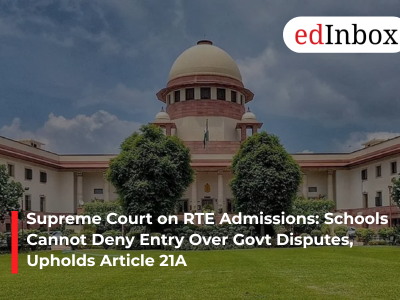
Supreme Court on RTE Admissions: Schools Cannot Deny Entry Over Govt Disputes, Upholds Article 21A
Typography
- Smaller Small Medium Big Bigger
- Default Helvetica Segoe Georgia Times
- Reading Mode