In a major push to strengthen India’s premium rice export ecosystem, the Agricultural and Processed Food Products Export Development Authority has partnered with the Uttar Pradesh government to establish the country’s first integrated Basmati and organic training-cum-demonstration farm in Pilibhit.
The project, announced by the Ministry of Commerce and Industry, is being developed on nearly seven acres at Tanda Bijaisi under a 70-year lease agreement with the state’s agriculture department. The initiative is expected to become a landmark in Basmati rice production, organic farming training, and agri-export development in India.
India’s first integrated Basmati organic training hub
Once operational, the Pilibhit centre will serve as a national hub for Basmati cultivation and organic agriculture training, combining both conventional and organic farming practices under one platform. This makes it the first facility of its kind in India, aimed at bridging the gap between traditional farming knowledge and modern agricultural technologies.
The centre will feature advanced infrastructure, including an auditorium, research laboratory, conference rooms, and dedicated storage for organic inputs. A key highlight is the proposed AI-powered interactive museum, designed to offer experiential learning for farmers, students, and agricultural researchers.
Boost for farmers, research and skill development
The training-cum-demo farm is expected to significantly benefit farmers in Uttar Pradesh and neighbouring Uttarakhand by offering hands-on training, capacity building programmes, and scientific advisory support. It will also function as a resource centre for agricultural experts and students, aligning with India’s broader push towards skill-based and technology-driven agriculture.
Union Minister of State for Commerce and Industry Jitin Prasada emphasised Pilibhit’s growing importance as a key Basmati-producing region, highlighting the need to expand organic cultivation and strengthen farmer engagement.
AI-driven Basmati survey to transform crop planning
In parallel, the government has unveiled an ambitious AI-based Basmati Paddy Survey (2026–2028), which will cover nearly 4 million hectares and engage over 500,000 farmers. The project will use data from more than 150,000 ground-truth points to enable accurate crop assessment, varietal identification, and scientific advisory services.
This data-driven approach is expected to improve agricultural productivity, export planning, and supply chain efficiency, reinforcing India’s position in the global Basmati market.
Strengthening India’s agri-export ecosystem
The upcoming facility has also been designated under the All India Coordinated Research Project (AICRP) framework, allowing it to conduct national-level trials for new Basmati varieties suited to different agro-climatic conditions.
With global demand for organic and premium rice rising, the Pilibhit initiative is seen as a strategic step to enhance India’s agricultural exports, farmer income, and sustainable farming practices.
As India moves towards integrating AI in agriculture, organic farming, and export-led growth, the Pilibhit Basmati training centre could emerge as a model for future agri-innovation hubs across the country.
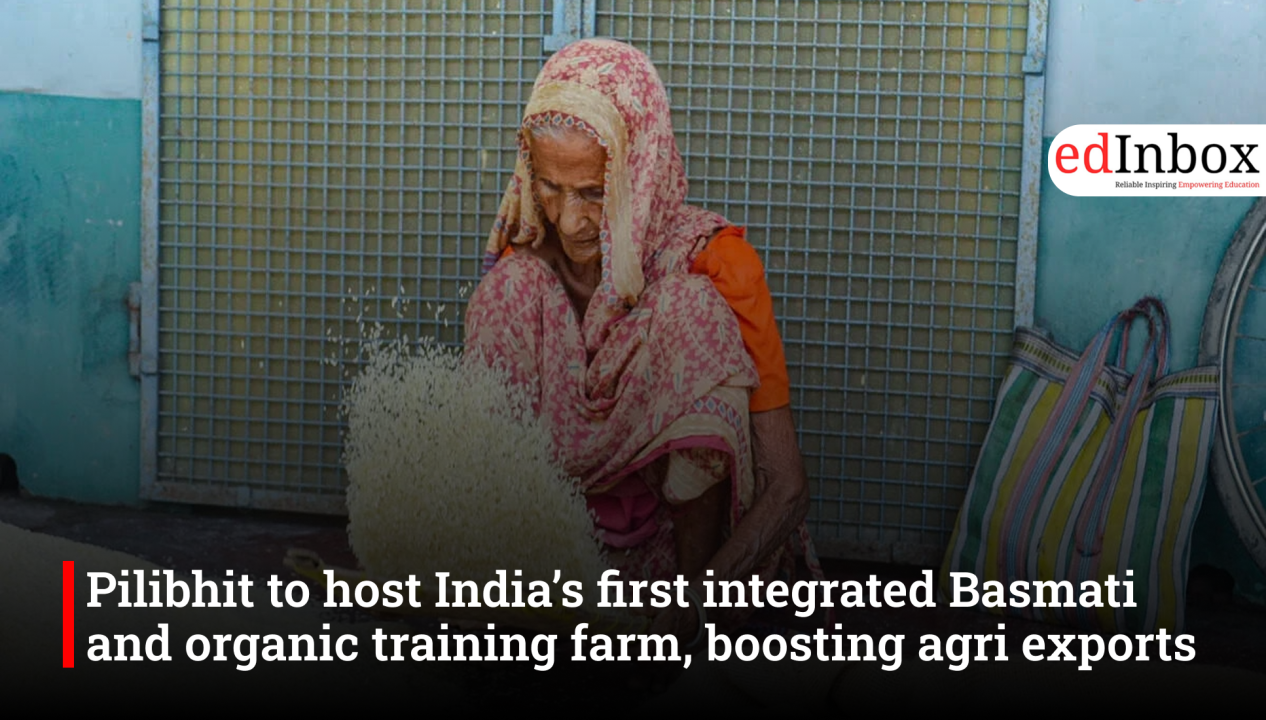
Pilibhit to host India’s first integrated Basmati and organic training farm, boosting agri exports
Typography
- Smaller Small Medium Big Bigger
- Default Helvetica Segoe Georgia Times
- Reading Mode