The debate over caste discrimination in higher education has returned to the forefront in Kerala, with activists, academics, and policymakers calling for urgent legislative intervention following the death of a dental student who has shaken the state’s academic community.
At the centre of the discussion is the growing demand for a dedicated legal framework—often referred to as the “Rohith Vemula Act”—to address caste-based discrimination, exclusion, and harassment on college campuses. The call has intensified amid concerns that existing safeguards remain inadequate, leaving students from marginalised communities vulnerable despite policy assurances.
Legislative gap in tackling caste discrimination
Experts argue that while India has constitutional protections and institutional guidelines, there is a critical legislative vacuum when it comes to preventing caste-based bias within universities and colleges. According to members of the Kerala State Higher Education Council, incidents of discrimination are often underreported, poorly documented, and inconsistently addressed.
Despite Kerala’s relatively high Gross Enrolment Ratio (GER) among Scheduled Caste (SC) and Scheduled Tribe (ST) students, concerns persist that access does not automatically translate into inclusion. Activists highlight that systemic bias can manifest in subtle yet damaging ways—from classroom exclusion and social isolation to verbal abuse and institutional neglect.
Rising pressure for Rohith Vemula Act implementation
The demand for a robust anti-discrimination law has gained momentum after Karnataka passed a version of the Rohith Vemula Bill aimed at ensuring dignity and equal access in educational institutions. Advocacy groups are now questioning why Kerala has yet to implement a similar framework.
Supporters argue that such a law could serve as a comprehensive mechanism—covering grievance redressal, accountability, and preventive action—thereby reducing the need for students to seek justice through prolonged legal battles.
However, experts caution that legislation alone cannot fully resolve deep-rooted social biases. “A law can act as a deterrent, but structural reform is equally important,” said a Dalit rights activist, emphasising the need for broader institutional change.
Beyond law: Representation and accountability
Activists stress that meaningful reform must go beyond legal provisions. One of the key recommendations is greater representation of marginalised communities across all levels of higher education institutions—not just among students, but also within faculty, administration, and governance bodies.
Such representation, they argue, can help create a more inclusive academic environment and ensure that decision-making reflects diverse perspectives. Additionally, experts have called for mandatory Students’ Grievance Redressal Cells and a Student Charter of Rights to strengthen institutional accountability.
Data gap raises concern
Another major challenge is the lack of reliable data on caste-based discrimination in higher education. Officials acknowledge that while student suicides are tracked at a national level, there is no comprehensive database documenting caste-related incidents on campuses.
This absence of data makes it difficult to assess the scale of the problem or design targeted interventions. Some organisations estimate that multiple cases of student deaths and dropouts linked to caste discrimination have occurred over the past decade, but these figures remain largely unverified.
A systemic issue demanding urgent attention
The renewed debate underscores a larger reality: India’s higher education system is still grappling with issues of equity and inclusion. While policies have expanded access, the challenge now lies in ensuring that campuses are safe, supportive, and discrimination-free spaces for all students.
As pressure mounts on the Kerala government, the question is no longer whether reform is needed—but how quickly and effectively it can be implemented.
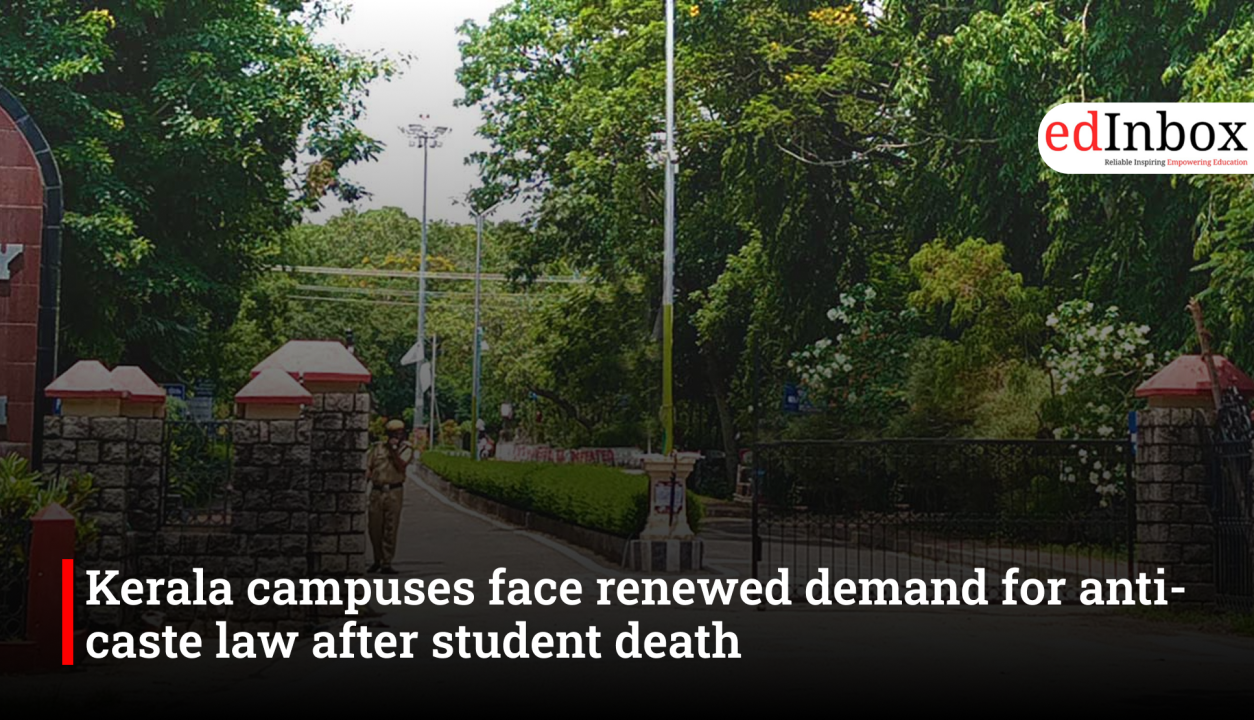
Kerala campuses face renewed demand for anti-caste law after student death
Typography
- Smaller Small Medium Big Bigger
- Default Helvetica Segoe Georgia Times
- Reading Mode