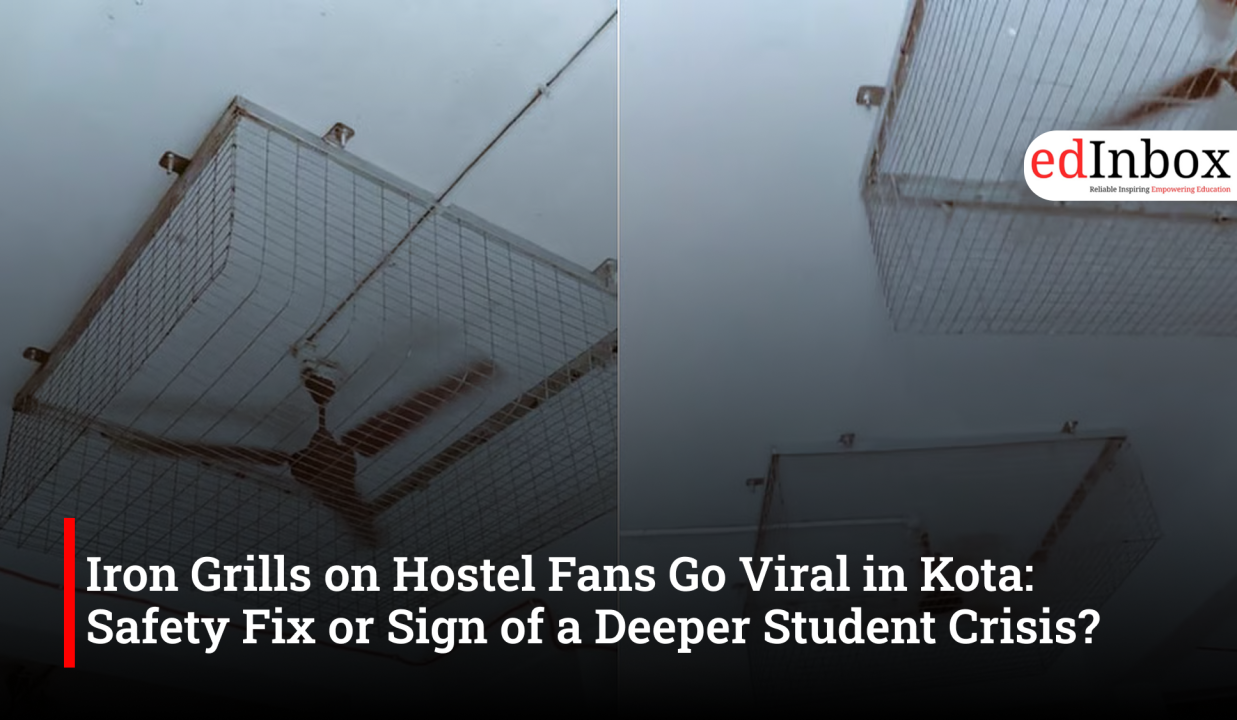
A viral video from Kota has reignited the national conversation on student well-being, showing hostel ceiling fans covered with heavy iron grills—an unusual intervention aimed at preventing suicides in India’s coaching capital. The footage, widely shared across social media, captures rows of modified fans inside student accommodations, a stark visual that has triggered both concern and debate.
Authorities and hostel operators say the measure is a preventive step in response to rising student deaths in the city, where thousands of aspirants arrive each year to prepare for competitive exams like Joint Entrance Examination (JEE) and National Eligibility cum Entrance Test (NEET). Over the years, Kota has become synonymous with intense academic pressure, long study hours, and high expectations—conditions that many believe contribute to deteriorating mental health among students.
The iron grills, designed to restrict access to ceiling fan blades, are being presented by some as a life-saving intervention. Officials argue that such modifications can act as immediate deterrents, buying crucial time in moments of distress. However, the move has also raised uncomfortable questions: can physical barriers truly address what is fundamentally a psychological and systemic issue?
Mental health experts and educators have been quick to point out that while such steps may reduce the risk of impulsive actions, they do little to address the root causes of student distress. The relentless competition, isolation from family, fear of failure, and lack of emotional support remain largely unaddressed. For many students in Kota, the pressure is not just academic—it is deeply personal, tied to aspirations, financial sacrifices, and societal expectations.
Online reactions to the viral video reflect this divide. While some users have welcomed the initiative as a necessary precaution, others have criticised it as a superficial solution that shifts focus away from more meaningful reforms. “You can grill a fan, but you can’t cage anxiety,” one comment read, capturing the sentiment of those calling for deeper intervention.
The incident has once again placed the spotlight on India’s coaching culture and its impact on young minds. Kota’s model—intensive preparation hubs designed to maximise exam success—has long been celebrated for producing top rankers. Yet, it has also been criticised for fostering an environment where failure feels catastrophic and support systems are often inadequate.
Education stakeholders argue that the way forward lies in a more holistic approach. This includes strengthening on-campus counselling services, normalising conversations around mental health, training faculty to identify early warning signs, and reducing the stigma associated with seeking help. Some coaching institutes in Kota have begun introducing wellness programmes, but experts say these efforts need to be scaled and standardised.
The viral video, in many ways, has become a symbol of a larger crisis—one where visible fixes are being applied to invisible wounds. As the debate continues, it serves as a reminder that student safety cannot be ensured through infrastructure alone. Without addressing the emotional and psychological realities faced by students, such measures risk becoming temporary shields rather than lasting solutions.
In a city built on dreams of success, the challenge now is to ensure that those dreams do not come at the cost of young lives.
Iron Grills on Hostel Fans Go Viral in Kota: Safety Fix or Sign of a Deeper Student Crisis?
Typography
- Smaller Small Medium Big Bigger
- Default Helvetica Segoe Georgia Times
- Reading Mode