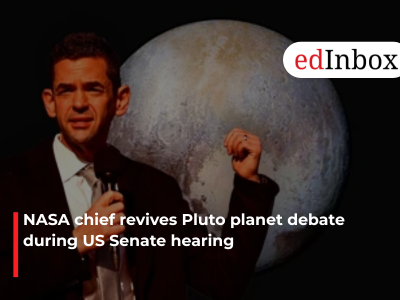
National Aeronautics and Space Administration Administrator Jared Isaacman has reignited the long-running debate over Pluto’s classification, publicly supporting efforts to restore its status as a full-fledged planet during a recent US Senate hearing on NASA’s 2027 budget.
Speaking before lawmakers, Isaacman said he was “very much in the camp of making Pluto a planet again” and revealed that NASA-backed scientific papers are being prepared to intensify discussions within the astronomical community. However, he acknowledged that the final authority on planetary classification rests with the International Astronomical Union.
The debate traces back to 2006, when the IAU formally reclassified Pluto as a dwarf planet after introducing a new three-part definition for planets. Under that definition, a celestial body must orbit the Sun, be nearly spherical in shape, and “clear its orbital neighbourhood” of other objects.
While Pluto satisfies the first two criteria, it fails the third because it shares its orbital region with icy objects in the Kuiper Belt. As a result, it lost its status as the Solar System’s ninth planet.
Isaacman’s remarks have gained attention partly because they come after major discoveries from NASA’s New Horizons mission, which flew past Pluto in 2015. The spacecraft revealed a surprisingly dynamic world with nitrogen-ice glaciers, mountain ranges, atmospheric activity, and possible evidence of a subsurface ocean.
These findings challenged earlier assumptions that Pluto was a frozen and geologically inactive body. Some planetary scientists now argue that Pluto’s complexity, atmosphere, moons, and active surface processes make it more planet-like than previously believed.
Scientists such as Bill McKinnon have questioned whether the IAU’s current definition is too restrictive, especially because it excludes bodies that share orbital regions in crowded parts of the Solar System.
Supporters of Pluto’s reinstatement also point to public sentiment and the historical significance of Clyde Tombaugh, who discovered Pluto in 1930. Isaacman referenced Tombaugh during the hearing, saying the astronomer deserved renewed recognition for his contribution.
However, many astronomers remain sceptical about changing Pluto’s classification. Critics argue that restoring Pluto as a planet could force scientists to recognise dozens or even hundreds of other icy Kuiper Belt objects as planets as well, dramatically expanding the Solar System’s official planet count.
The debate intensified after the 2005 discovery of Eris, an object initially thought to be larger than Pluto. Its discovery highlighted the growing number of Pluto-like bodies in the outer Solar System and prompted astronomers to reconsider what qualifies as a planet.
For now, the International Astronomical Union continues to recognise Pluto as a dwarf planet. Any formal reversal would require broad international scientific consensus — something that remains far from settled despite renewed interest from NASA leadership and planetary researchers.
NASA chief revives Pluto planet debate during US Senate hearing
Typography
- Smaller Small Medium Big Bigger
- Default Helvetica Segoe Georgia Times
- Reading Mode