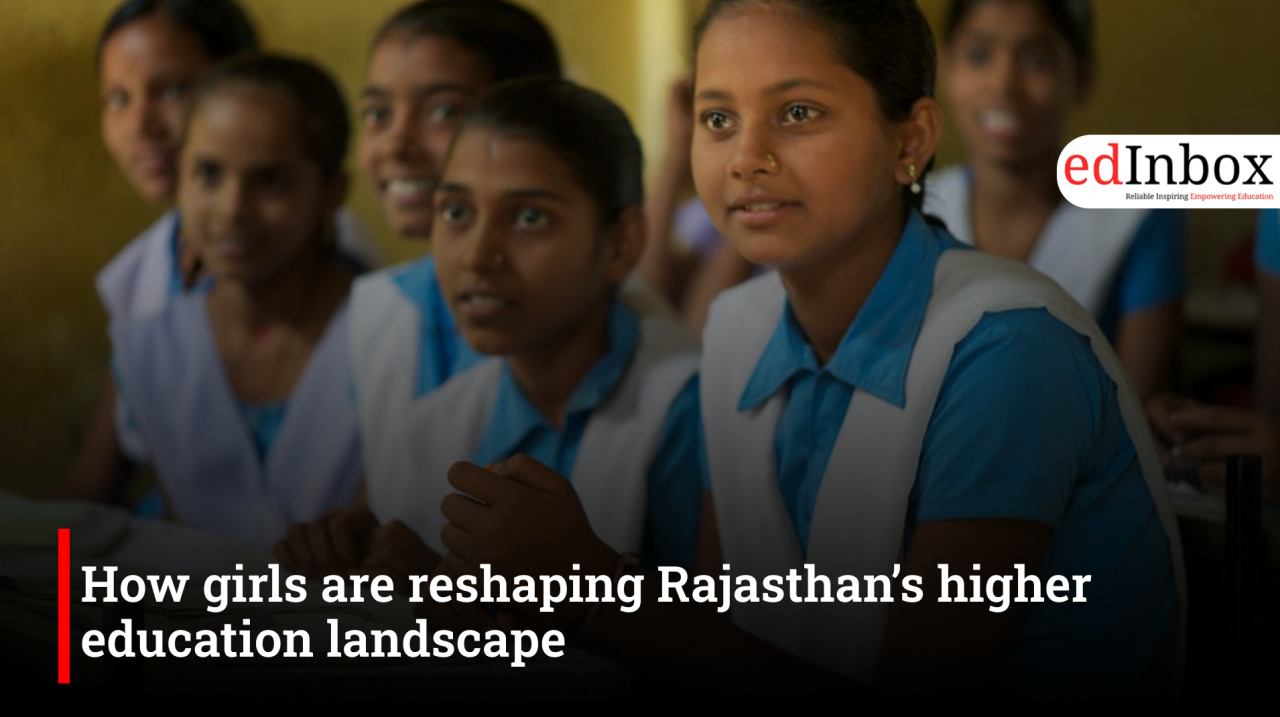
Across convocation stages in Rajasthan, a visible shift is unfolding: female students are increasingly outnumbering male students among gold medallists, toppers, and academic award winners. Behind these ceremonial moments lies a deeper transformation in the state’s higher education ecosystem driven by policy reforms, institutional expansion, and changing social attitudes toward women’s education.
According to the Annual Progress Report 2025–26 released by the state higher education department, female participation in higher education rose by 77 per cent between 2008 and 2026. The number of girls enrolled in colleges and universities increased from 1.63 lakh in 2008 to 7.02 lakh in 2026.
The gender balance in higher education has also shifted significantly. While there were 97 female students for every 100 male students during the 2015–16 academic session, the figure climbed to 127 female students per 100 male students in 2025–26.
Changing family attitudes driving enrolment growth
Sociologists attribute the rise not only to government schemes but also to changing household priorities.
Rashmi Jain said that while girls earlier enrolled in schools in reasonable numbers, dropout rates historically increased after puberty or completion of schooling.
She noted that scholarship schemes and educational incentives helped girls continue their studies, but a larger social shift occurred when families began recognising higher education as equally important for daughters and sons.
According to education experts, aspirations around women’s financial independence and professional identity have become more socially accepted in Rajasthan over the past decade.
Expansion of women’s colleges and policy support
The state also expanded educational infrastructure specifically for women. The number of women’s colleges in Rajasthan increased from 466 in 2015–16 to 801 in 2025–26, including B.Ed institutions.
Currently, two deemed-to-be universities and two private universities dedicated exclusively to women are operational in the state.
Several policy interventions targeted long-standing barriers such as affordability, distance, safety, and subject availability.
In 2016, the state government introduced a 3 per cent bonus marks provision for girls applying to co-educational colleges if their preferred subjects were unavailable in nearby government women’s colleges. The measure coincided with a 26.23 per cent rise in enrolment during the 2016–17 academic year.
In 2019, Rajasthan waived tuition fees for female students in universities and colleges, directly addressing financial constraints.
Later, in 2024, the government introduced horizontal reservation for women by earmarking 30 per cent of seats in government co-educational colleges for female students beginning with the 2024–25 academic session.
From the 2026–27 session onward, female students holding Black Belt qualifications will also receive 5 per cent bonus marks during admissions to government colleges, linking extracurricular achievement with admission incentives.
Safety and mobility emerge as key participation factors
Mobility and safety — often decisive factors in conservative social settings — became central to education policy planning.
From the 2023–24 academic session, the state extended its Transport Voucher Scheme to female students living more than 10 kilometres away from their colleges. Eligible students receive Rs 20 per day of attendance as transport support.
Puneet Sharma said that safer campuses, hostel facilities, and improved infrastructure significantly increased parental confidence in sending daughters for higher studies outside their hometowns.
He also observed that girls are increasingly entering fields once considered male-dominated, including engineering, finance, and law.
New institutions widen opportunities
Rajasthan’s higher education expansion also coincided with the establishment of nationally important institutions within the state.
Indian Institute of Technology Jodhpur was established in 2008, while Central University of Rajasthan was set up in 2009. All India Institute of Medical Sciences Jodhpur followed in 2012, strengthening medical education access.
Experts say the residential nature of these campuses addressed security concerns that traditionally discouraged families from sending daughters far from home.
Progress remains uneven across disciplines
Despite rising enrolment, academic distribution remains uneven. Humanities continue to dominate female enrolment at 41.8 per cent, while science accounts for 10.67 per cent of total female participation in higher education.
The trend suggests that although access has improved, diversification across disciplines still faces challenges related to school-level preparation, laboratory access, counselling, and availability of specialised faculty.
Private universities are also witnessing rising female participation. Niti Nipun Sharma said girls now constitute around 37 per cent of students at Manipal University Jaipur, compared to 26 per cent a decade ago.
He added that growth has occurred not only in humanities but also across engineering, law, and professional programmes, with campus safety and holistic development playing major roles.
The next challenge: from access to diversification
Rajasthan’s higher education transformation demonstrates how policy interventions — from fee waivers and reservation policies to transport support and institutional expansion — can reshape educational participation over time.
However, education experts believe the next phase will depend on whether rising enrolment can translate into broader academic diversification, stronger career outcomes, and equal participation across regions and disciplines.
The convocation stage may symbolise the shift, but the larger challenge remains ensuring that opportunities expand consistently across every district, subject stream, and social background without older barriers resurfacing in new forms.
How girls are reshaping Rajasthan’s higher education landscape
Typography
- Smaller Small Medium Big Bigger
- Default Helvetica Segoe Georgia Times
- Reading Mode