Centre considers major security overhaul, including hybrid exam model and on-site printing, after cancellation of medical entrance test affecting over 22 lakh students.
Dharmendra Pradhan chaired a high-level review meeting with senior education officials to finalise the roadmap for the NEET-UG 2026 examination re-exam as the Central Bureau of Investigation (CBI) widened its investigation into the alleged nationwide paper leak network.
The late-night meeting, held at the minister’s residence, reportedly lasted nearly two hours and included senior officials from the National Testing Agency (NTA), Central Board of Secondary Education (CBSE), and the education ministry.
The discussions focused on the timing of the re-examination, enhanced security mechanisms, and long-term reforms aimed at preventing future paper leaks.
Over 22 Lakh Students Await Fresh Exam Dates
The original NEET-UG examination conducted on May 3 was cancelled after investigators found evidence suggesting that leaked question sets substantially matched the actual examination paper.
The cancellation has left more than 22 lakh medical aspirants across India in uncertainty, triggering protests, legal challenges, and growing criticism over the integrity of large-scale entrance examinations.
Officials indicated that a fresh examination schedule could be announced within the next seven to ten days, with the re-exam likely to be conducted in late June or early July.
However, authorities are also assessing the broader impact on the medical admission calendar, which may face delays of up to two months if the process extends further.
CBI Calls Leak An “Organised Gang” Operation
The Central Bureau of Investigation has intensified its probe, describing the paper leak as the work of an “organised gang” operating across multiple states.
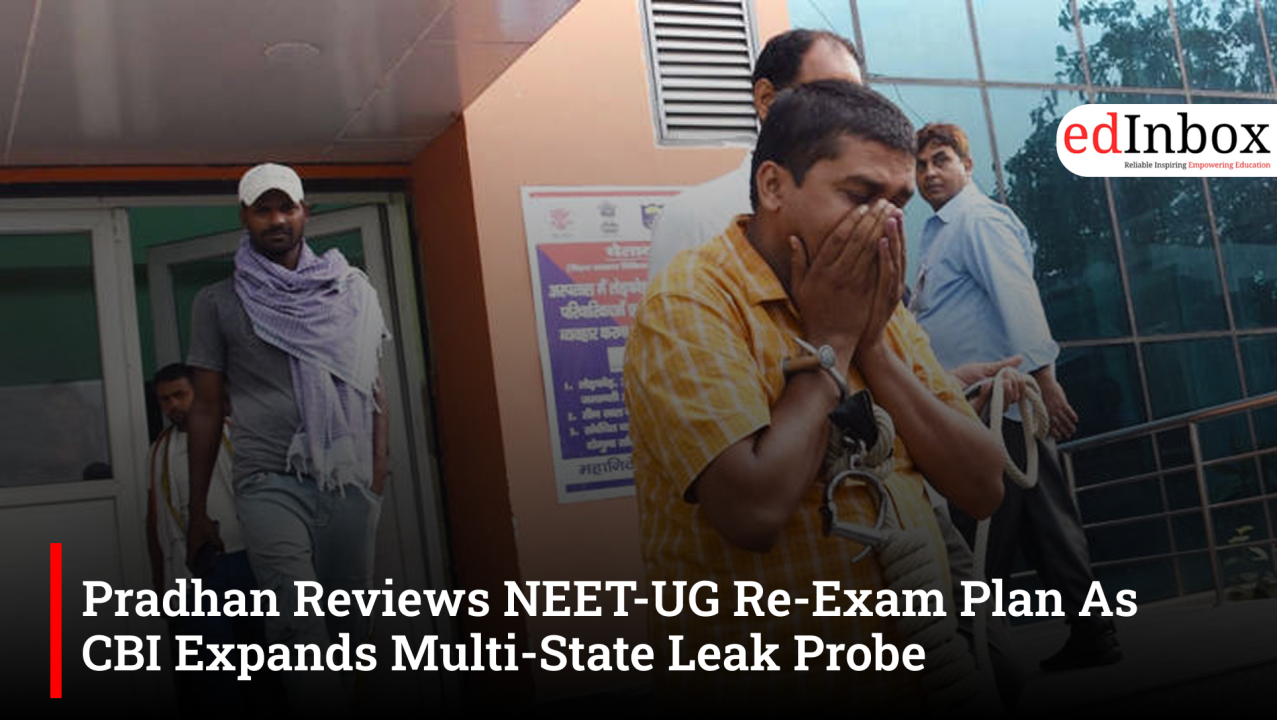
Investigators have so far arrested seven accused, including five individuals currently in seven-day custody.
According to officials, evidence suggests the conspiracy may have begun weeks before the examination through networks involving:
- Intermediaries
- Coaching-related contacts
- Digital document circulation
- Encrypted messaging channels
Investigators are reportedly examining leaked PDFs and communication trails shared through platforms such as Telegram.
The agency is also probing the possibility of insider involvement within the National Testing Agency, with officials stating that the role of public servants “cannot be ruled out.”
Security Reforms Under Active Consideration
In response to the controversy, the government is now considering a major overhaul of examination security systems.
Among the proposals under review is a “Computer-Assisted Secure Paper-Based Test” model, where encrypted question papers would be digitally transmitted and printed directly at examination centres shortly before the test begins.
Officials believe the system could significantly reduce risks associated with long-distance transportation and storage of printed papers.
The proposed model would combine:
- Digital encryption systems
- Secure on-site printing
- Controlled paper access
- Real-time monitoring protocols
Authorities are also exploring stronger confidentiality measures during paper preparation and distribution.
Pressure Mounts On NTA
The controversy has intensified scrutiny of the National Testing Agency, which conducts several of India’s largest entrance examinations.
Student groups, opposition parties, and medical associations have questioned the agency’s ability to safeguard exam integrity following repeated allegations of leaks and malpractice in recent years.
Some medical associations have reportedly approached the Supreme Court of India seeking judicial oversight of the re-examination process to ensure transparency and restore public confidence.
Growing Debate Over Exam Reforms
The NEET controversy has once again sparked broader debate around India’s highly centralised entrance examination ecosystem.
Education experts argue that repeated paper leak incidents are exposing structural vulnerabilities in large-scale offline examinations involving millions of candidates simultaneously.
Calls are growing for:
- Technology-driven exam security
- Encrypted paper delivery systems
- Decentralised printing mechanisms
- Stronger accountability measures
- Independent oversight structures
As the government prepares for the re-exam, restoring public trust now appears as important as conducting the test itself.
Pradhan Reviews NEET-UG Re-Exam Plan As CBI Expands Multi-State Leak Probe
Typography
- Smaller Small Medium Big Bigger
- Default Helvetica Segoe Georgia Times
- Reading Mode