At a time when much of India’s edtech sector is grappling with layoffs, funding slowdowns and profitability concerns, UNIVO Education is charting a very different path.
The company recently earned global recognition after being ranked among the top rising edtech firms in the TIME World’s Top EdTech Rising Stars 2025 rankings. Behind that momentum lies what the company calls a “high-scale, low-burn” strategy focused on university partnerships, employability and operational sustainability.
In an interview, Lalit Pruthi explained how the company achieved 7x revenue growth while many edtech startups continue struggling to break even.
According to Pruthi, UNIVO’s approach differs fundamentally from conventional edtech models because the company does not position itself merely as a content provider. Instead, it acts as a digital enabler for universities, managing the infrastructure, student support and technology layer required to deliver online degree programmes at scale.
He said the company works through long-term and exclusive collaborations with universities, while also integrating industry-focused partnerships with organisations such as TCS iON, HCLTech and KPMG to make programmes more aligned with workforce demands.
Pruthi emphasised that delivering online degrees involves far more than digitising classroom lectures. The process includes maintaining academic standards, ensuring regulatory compliance, designing digital learning experiences and offering continuous learner support through academic advisors, technology teams and mentors.
Today, the company claims to have crossed 200,000 learners across more than 135 countries, reflecting the growing global demand for flexible online education linked to employability outcomes.
Asked about profitability in the current edtech climate, Pruthi acknowledged the challenges facing the sector, particularly rising customer acquisition costs and shifting investor sentiment. However, he argued that sustainable growth depends less on aggressive expansion and more on retention, referrals and learner outcomes.
Rather than pursuing rapid scale through excessive spending, UNIVO focused on selective partnerships with UGC-recognised institutions and building long-term value. According to him, stronger student outcomes have helped improve retention and referrals, strengthening the balance between customer acquisition cost and lifetime value.
The company’s financial journey also reflects changing investor priorities within the edtech ecosystem. In 2022, UNIVO raised $76.6 million in Series-A funding led by Amity Promoters and AVENU Learning. Pruthi said the capital was primarily used to strengthen technology infrastructure and expand programme offerings.
Despite achieving rapid growth, he indicated that the company currently has no immediate plans for additional fundraising because operations are increasingly self-sustaining.
He believes this signals a broader transition within the edtech industry, where investors are becoming more cautious about unsustainable expansion models and are instead prioritising companies that demonstrate compliance, measurable outcomes and operational discipline.
Regulation, often viewed as a challenge by many startups, is seen differently by UNIVO. Pruthi described regulations as necessary safeguards that protect learners and maintain quality standards in higher education. He supported the growing recognition of online degrees by the University Grants Commission, calling it a critical step toward establishing parity between online and offline education.
Technology, meanwhile, remains central to the company’s strategy. UNIVO has introduced AI-driven systems such as Prof AMI 3.0, an AI-powered learning assistant designed to provide real-time academic support and personalised guidance to learners.
The company has also integrated AI into career services, offering tools such as resume builders, mock interview systems and access to more than 100,000 job opportunities.
As India’s edtech sector moves beyond the era of unchecked expansion, companies like UNIVO appear to be betting that the future of online education will belong not to the fastest-growing platforms, but to those capable of balancing scale, quality, employability and sustainability.
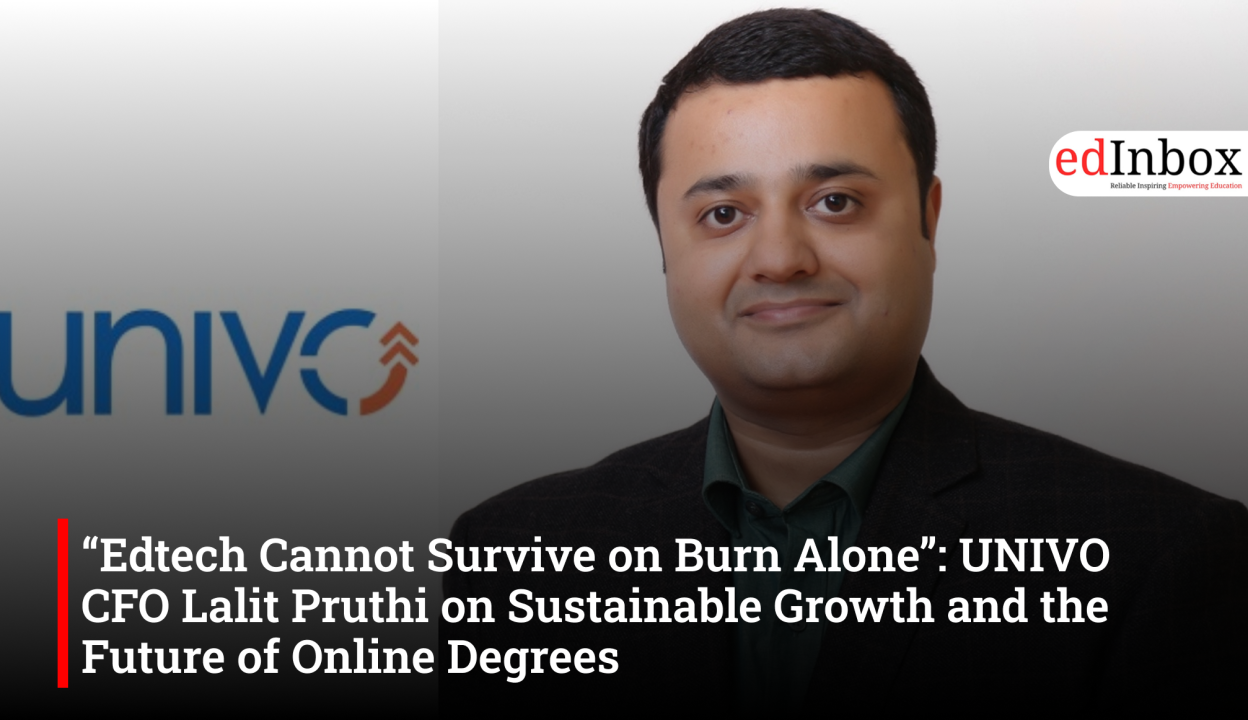
“Edtech Cannot Survive on Burn Alone”: UNIVO CFO Lalit Pruthi on Sustainable Growth and the Future of Online Degrees
Typography
- Smaller Small Medium Big Bigger
- Default Helvetica Segoe Georgia Times
- Reading Mode