The Madras High Court has come to the rescue of a BA LLB student after the Tamil Nadu Dr Ambedkar Law University abruptly barred him from appearing for supplementary examinations by enforcing new University Grants Commission guidelines limiting examination attempts.
In a significant order balancing regulatory compliance with student welfare, Justice L Victoria Gowri directed the university to reopen its online examination portal and allow the student to write pending supplementary examinations scheduled between May 13 and June 5, 2026.
What triggered the dispute?
The student had pursued a five-year BA LLB course between 2017 and 2022 and had only four papers left uncleared.
According to the plea:
- Neither the college nor the university had imposed any limit on examination attempts when he enrolled
- Even the examination notification issued on April 13, 2026, carried no such restriction
- A new instruction issued on April 22 suddenly barred students admitted before 2018–19 from further attempts
The university cited UGC norms stating that supplementary examinations can generally be attempted only within two years of completing the regular course.
However, the petitioner argued that these conditions were introduced retrospectively and without adequate notice.
When he attempted to pay examination fees online, the portal reportedly rejected his registration as invalid.
High Court prioritises fairness and legitimate expectation
The court observed that similarly placed students had already received relief in earlier orders.
Justice Victoria Gowri directed the university to:
- Reopen the online fee portal
- Accept examination fees
- Permit the student to sit for supplementary exams
The ruling effectively recognised the principle that institutions cannot abruptly alter academic conditions in ways that severely prejudice students who joined under different rules.
Student argued sudden rule change caused “irreparable injury”
The petitioner’s counsel, S R Sundar, argued that:
- The student had only four pending papers
- The sudden implementation caused serious academic harm
- Representations sent to the university received no response
- Examination dates were imminent, making judicial intervention urgent
The plea also highlighted that the student had already invested years in the law programme and faced the risk of losing his degree pathway due to a late-stage policy shift.
Bigger issue: retrospective enforcement in higher education
The case reflects a larger recurring tension in Indian higher education:
- Regulatory compliance versus student protection
- Institutional autonomy versus procedural fairness
- Sudden policy implementation versus legitimate student expectations
Courts have increasingly intervened where:
- Universities alter eligibility rules mid-course
- Students are denied opportunities without prior notice
- Administrative rigidity disproportionately harms academic futures
Legal experts note that retrospective application of academic regulations often becomes vulnerable to judicial scrutiny when it affects vested educational interests.
Separate relief for disabled law student
In another important ruling, the Madras High Court recently directed the same university to grant fee waiver benefits to a law student with benchmark disability.
Justice D Bharatha Chakravarthy held that welfare measures for persons with disabilities cannot be interpreted narrowly by linking them only to reservation quotas.
Court rejects narrow interpretation of disability benefits
The student, enrolled in a three-year LLB (Hons) programme, was initially admitted under the backward class category because his disability level at admission was assessed below 40%.
Later, his condition worsened and a revised medical certificate assessed his disability at 40%, qualifying him as a benchmark disability candidate under the Rights of Persons with Disabilities Act, 2016.
Due to financial hardship and inability to pay fees, he was reportedly prevented from attending classes and examinations.
The university argued that fee waivers were available only to students admitted through the specific disability reservation quota.
Rejecting this interpretation, the court observed that:
- Reservation and welfare benefits serve different purposes
- Persons with disabilities require broader support mechanisms
- Educational equality requires flexible implementation of welfare schemes
Wider message from the rulings
Together, the two judgments send a broader signal about judicial attitudes toward higher education governance:
- Student rights cannot be overridden mechanically
- Universities must implement regulations fairly and transparently
- Welfare measures should be interpreted purposively rather than rigidly
The rulings also highlight increasing judicial emphasis on balancing institutional discipline with constitutional principles of equality, fairness, and access to education.
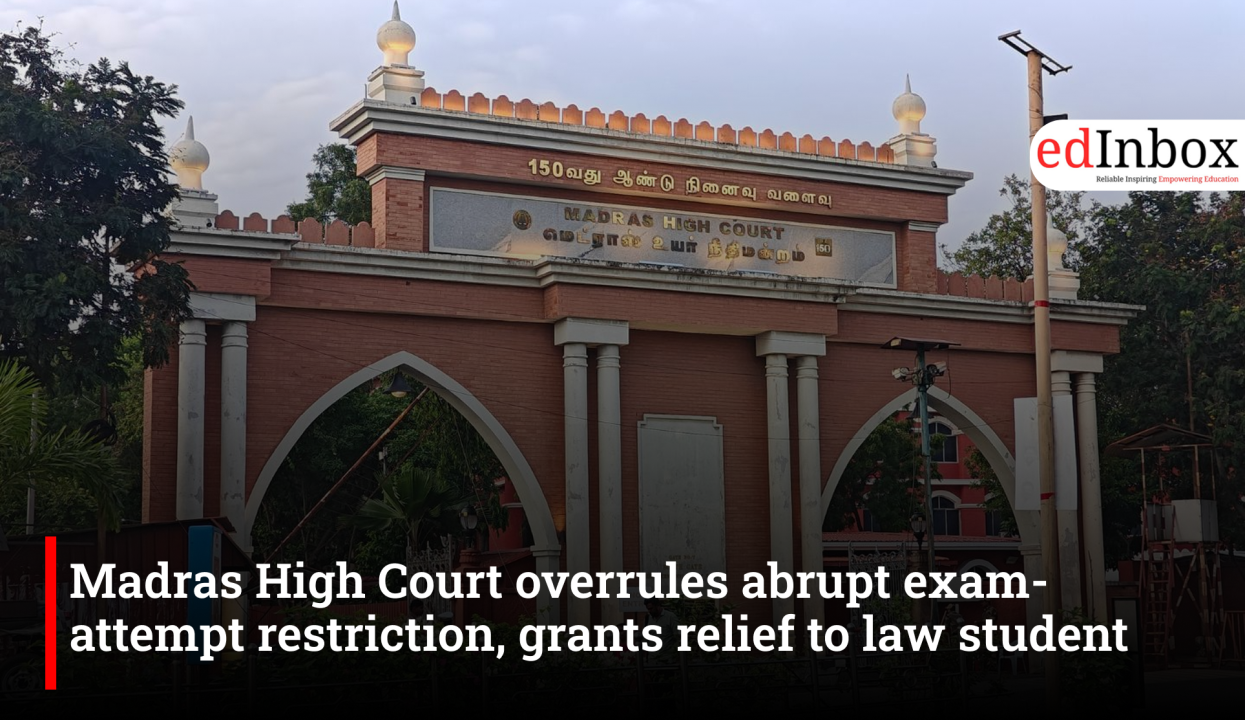
Madras High Court overrules abrupt exam-attempt restriction, grants relief to law student
Typography
- Smaller Small Medium Big Bigger
- Default Helvetica Segoe Georgia Times
- Reading Mode