A new book by development economists Santosh Mehrotra and Jajati Parida has raised serious concerns about India’s employment landscape, arguing that headline economic growth figures are masking a worsening jobs crisis, rising inequality, and shrinking opportunities for young people.
In their book India Out of Work, the authors challenge the narrative of strong economic recovery by pointing to what they describe as “structural retrogression” in the labour market. One of the book’s most striking claims is that nearly 80 million people moved back into agriculture between 2020 and 2024 — a trend the authors describe as unprecedented for a developing economy seeking industrial growth.
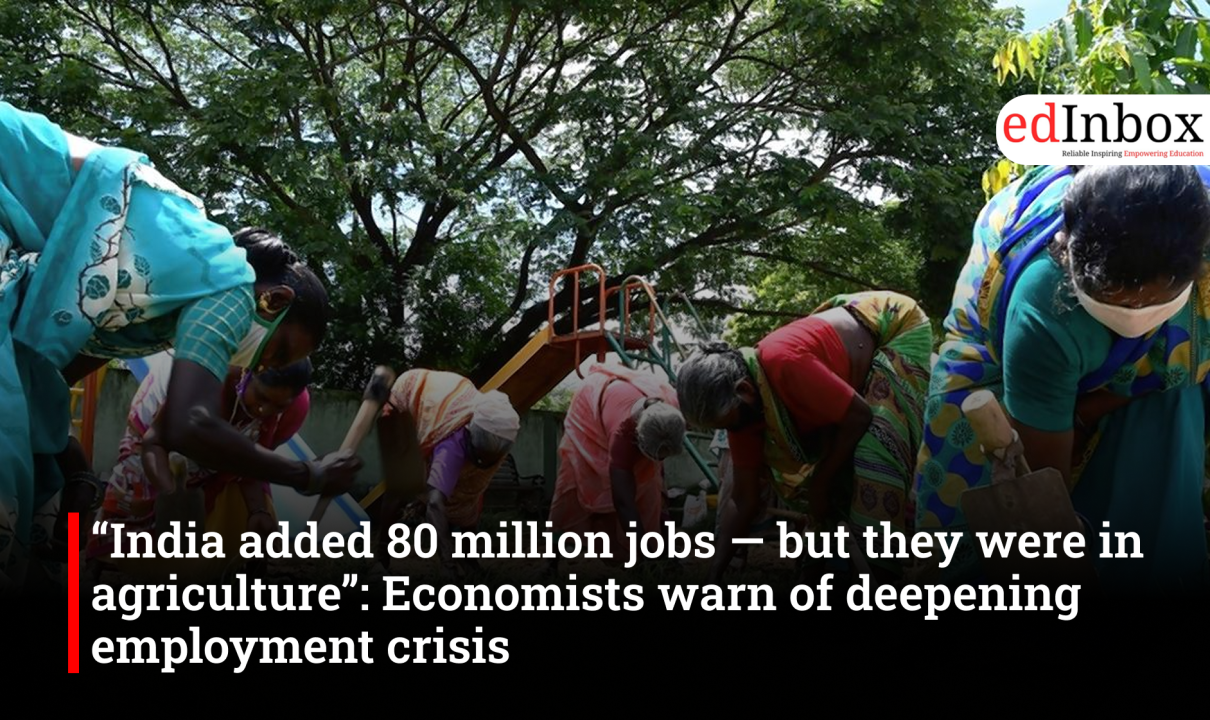
According to Mehrotra, government economists celebrated the addition of nearly 80 million jobs during this period, but most of those jobs emerged in agriculture — a sector already burdened by surplus labour and low productivity.
“Never in human history had 80 million workers been added to an already labour-surplus farm sector in just four years,” Mehrotra said in an interview discussing the book.
The economists argue that India’s growth has become increasingly “K-shaped,” where high-end services and capital-intensive infrastructure benefit upper-income groups while the bottom majority experiences stagnant incomes and declining employment quality.
The book warns that the country may be entering a “lost decade” for employment generation. The authors highlight that youth unemployment has tripled since 2012 while nearly 121 million young Indians are currently categorised as NEET — not in education, employment, or training.
Mehrotra argues that India still has a narrowing demographic opportunity window until around 2040, but insufficient non-farm job creation is rapidly eroding that advantage. He identifies three major groups struggling for employment: surplus agricultural labourers, unemployed youth, and nearly six million new entrants joining the workforce annually.
The book is also sharply critical of India’s manufacturing performance and industrial strategy. According to the authors, manufacturing’s share of gross value added has remained stagnant for decades and employment in the sector actually declined between 2012 and 2019 — an unusual development for a growing economy.
Mehrotra argues that without a strong manufacturing strategy supported by employment-focused industrial policy, India cannot generate large-scale non-farm jobs with rising wages. He points to East Asian economies and countries such as Vietnam as examples where manufacturing-led growth created broad-based employment opportunities.
The authors also raise concerns about women’s employment. While official data suggests female labour force participation has improved since 2020, Mehrotra argues much of the increase reflects women returning to unpaid agricultural and family work rather than entering stable, formal employment.
According to the book, nearly 96% of discouraged workers are women. Mehrotra believes expanding women’s participation in manufacturing and non-farm sectors is essential for India’s long-term economic transformation.
The economists further warn that rising educated unemployment, stagnant wages, exam paper leaks, and poor social security could intensify social tensions in the coming years. Mehrotra noted that worker protests and labour unrest have already begun appearing in industrial regions such as Gurgaon, Faridabad, and Noida.
The book also questions the credibility of India’s GDP growth narrative, arguing that the unorganised sector suffered major losses after 2016 while official economic estimates failed to fully capture those disruptions. Mehrotra pointed to the IMF’s recent concerns over India’s national accounts statistics as validation of long-standing critiques raised by economists.
Despite the bleak assessment, the authors argue that India still has an opportunity to reverse course through employment-driven industrial policy, expansion of manufacturing, improved education quality, and stronger support for women entering the workforce.
For the authors, the central message is clear: economic growth alone may no longer be enough unless it translates into meaningful, broad-based employment generation.
“India added 80 million jobs — but they were in agriculture”: Economists warn of deepening employment crisis
Typography
- Smaller Small Medium Big Bigger
- Default Helvetica Segoe Georgia Times
- Reading Mode