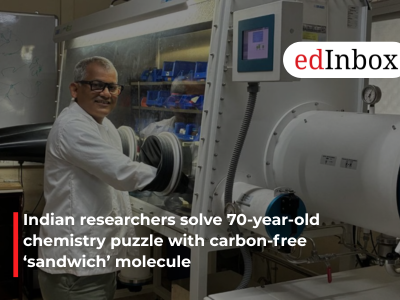
Researchers from Indian Institute of Technology Madras and Indian Institute of Science have achieved a major breakthrough in chemistry by creating a completely carbon-free molecule that mimics the famous “sandwich” structure of ferrocene, solving a scientific puzzle that had remained unanswered for more than 70 years.
The newly developed molecule places osmium at its centre, sandwiched between two boron-based rings, closely resembling the structure of ferrocene — a landmark compound discovered in the 1950s that contains an iron atom trapped between two carbon rings.
Ferrocene has long fascinated scientists because of its unusual geometry and stability. The compound is widely used in medicines, batteries, electronics and advanced materials. However, for decades, chemists worldwide struggled to recreate a similar structure without using carbon, raising a fundamental question about whether carbon alone possessed the unique capability to form such stable sandwich compounds.
The breakthrough research, led by scientists Sundargopal Ghosh and Stutee Mohapatra from IIT Madras in collaboration with Eluvathingal Jemmis from IISc Bengaluru, has now demonstrated that carbon is not essential for creating these structures.
Their findings were published in Science, one of the world’s most prestigious scientific journals.
According to the researchers, the discovery represents a major milestone in inorganic and organometallic chemistry. The newly synthesized molecule is structurally stable and exhibits strong bonding between osmium and the boron rings, which could potentially make it even more robust than ferrocene itself.
Speaking about the significance of the work, Ghosh said the breakthrough answers a long-standing scientific question while opening new possibilities for designing novel materials with unique chemical and physical properties.
Scientists believe the discovery could eventually contribute to the development of advanced functional materials, catalysts and electronic systems, though practical applications are still being explored.
The achievement also highlights India’s growing contribution to frontier scientific research, particularly in fundamental chemistry, where breakthroughs often lay the groundwork for future technological innovation.
Indian researchers solve 70-year-old chemistry puzzle with carbon-free ‘sandwich’ molecule
Typography
- Smaller Small Medium Big Bigger
- Default Helvetica Segoe Georgia Times
- Reading Mode