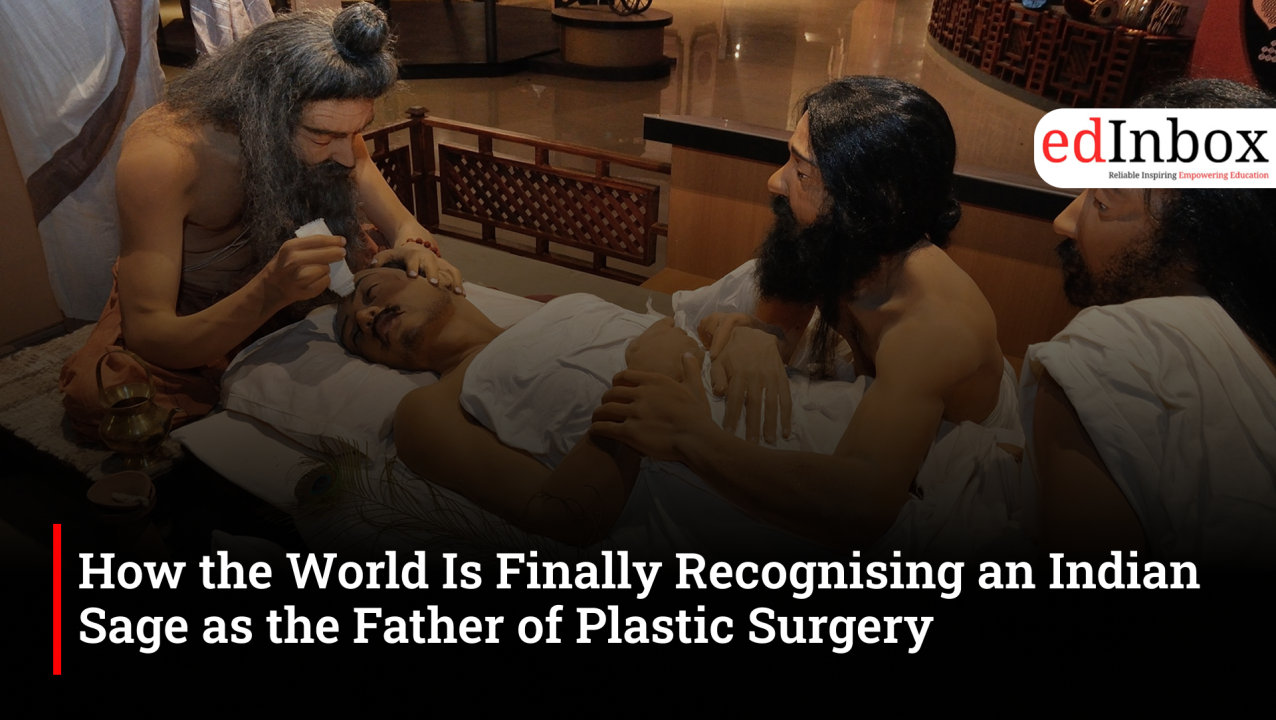
In a moment rich with symbolism and historical significance, the Royal College of Surgeons of Edinburgh, one of the world's oldest and most respected surgical institutions, unveiled a 90-kilogram bronze statue of Maharishi Sushruta on June 19, 2026.
For India, the event was more than the installation of a statue. It was the formal acknowledgement by the global medical community of a legacy that began over 2,600 years ago on the banks of the Ganga.
Often referred to as the "Father of Surgery," Sushruta lived around 600 BCE and authored the Sushruta Samhita, one of the world's earliest and most comprehensive medical treatises. Long before the rise of modern hospitals, anaesthesia or medical schools, Sushruta documented more than 300 surgical procedures and described over 120 surgical instruments, many of whose principles continue to influence medicine today.
Historians credit him with pioneering rhinoplasty, reconstructive surgery and cataract operations at a time when much of the world had yet to develop structured surgical knowledge. His emphasis on observation, anatomical study, hygiene and practical training established standards that remain central to medical education.
The bronze statue, crafted using the traditional lost-wax casting technique, was donated by the UK-based Cheruvu Family Foundation under the leadership of Professor Chandra VN Cheruvu. Installed at the Playfair Auditorium in Edinburgh, the sculpture now stands within an institution that has shaped generations of surgeons across the world.
The significance of the moment extends beyond medicine. It challenges a long-standing narrative that scientific and surgical advancements flowed predominantly from the West to the rest of the world. The recognition of Sushruta serves as a reminder that the foundations of global medical knowledge were built through contributions from multiple civilisations, including ancient India.
For centuries, India's medical heritage has often remained overshadowed in mainstream international discourse despite evidence of remarkable advances in surgery, mathematics, astronomy and philosophy. The unveiling of Sushruta's statue represents a growing willingness within global academia to acknowledge these contributions and place them within the broader history of human innovation.
There is also a deeper lesson for contemporary India. Recognition from prestigious international institutions often arrives only after a civilisation has preserved and celebrated its own intellectual traditions. Sushruta's work survived because generations safeguarded ancient manuscripts and knowledge systems despite invasions, colonialism and changing political eras.
Today, as India seeks to position itself as a global knowledge economy, the story of Sushruta offers both inspiration and responsibility. It demonstrates that innovation is not a new aspiration for India but part of a civilisational legacy stretching back thousands of years.
The bronze figure standing in Edinburgh is therefore more than a tribute to a surgeon. It is a bridge between ancient wisdom and modern science, between India and the world, and between a forgotten chapter of history and its long-overdue recognition.
From Kashi, where Sushruta once taught his disciples, to Edinburgh, where surgeons from around the world gather to advance medical science, the journey of his legacy has finally come full circle.
How the World Is Finally Recognising an Indian Sage as the Father of Plastic Surgery
Typography
- Smaller Small Medium Big Bigger
- Default Helvetica Segoe Georgia Times
- Reading Mode