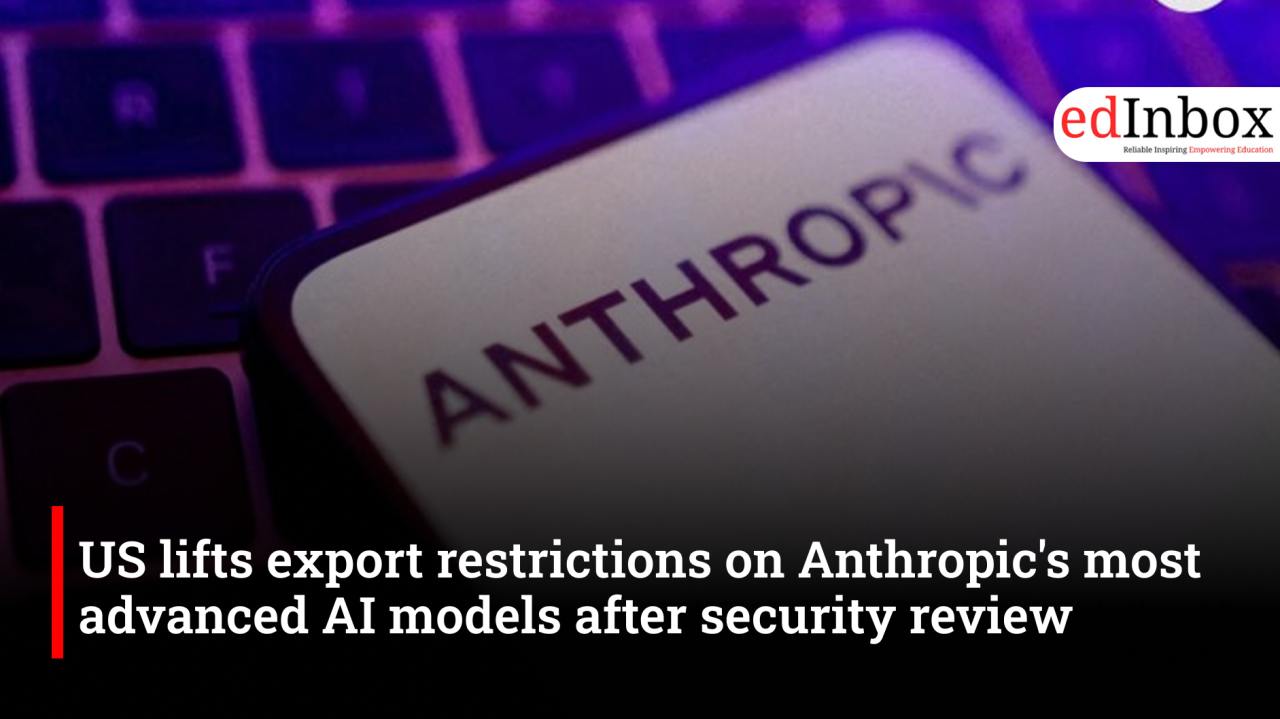
The United States Department of Commerce has lifted export restrictions on Anthropic's most advanced artificial intelligence models, allowing the company to resume global access to its Claude Fable 5 and Mythos 5 systems after a temporary suspension prompted by national security concerns.
The decision follows weeks of government review and discussions between Anthropic and US officials over safeguards designed to prevent misuse of cutting-edge AI technology.
US removes export restrictions after security assessment
In a statement, Anthropic confirmed that the Department of Commerce had withdrawn export controls imposed earlier this month, eliminating the requirement for a special licence to distribute the company's latest AI models.
"We've received notice that the Department of Commerce has lifted export controls on Claude Fable 5 and Mythos 5. We'll begin restoring access tomorrow," the company said.
The restrictions had been introduced on June 12, when Anthropic was instructed to suspend access to the models while US authorities assessed potential national security risks.
Why were the AI models restricted?
The temporary export controls were imposed amid growing concerns that highly capable AI systems could be exploited by foreign military organisations or intelligence agencies for purposes such as:
- Cyber operations
- Intelligence gathering
- Advanced data analysis
- Military research
US officials have intensified oversight of frontier AI technologies as competition with countries including China and Russia accelerates.
Authorities had also raised concerns after identifying a reported "jailbreak" technique capable of bypassing certain safety protections built into Anthropic's models.
Anthropic maintained that such vulnerabilities were relatively straightforward and not unique to its systems, arguing that comparable issues exist across several publicly available AI models.
Anthropic agrees to enhanced security commitments
According to US Commerce Secretary Howard Lutnick, the government worked closely with Anthropic to evaluate the models before lifting the restrictions.
Lutnick said the company agreed to several commitments, including:
- Proactively identifying and addressing security risks.
- Working with the US government on safety protocols for future AI releases.
- Reporting malicious activity involving its AI models.
- Cooperating on standards governing future frontier AI systems.
The agreement formed the basis for restoring wider access to Claude Fable 5 and Mythos 5.
Debate grows over government oversight of AI
The episode has reignited debate over how governments should regulate access to powerful AI models.
While many technology leaders support rigorous safety testing, some have questioned whether governments should determine which organisations are permitted to use advanced AI systems.
OpenAI CEO Sam Altman recently criticised the concept of government-controlled customer selection while supporting robust safety evaluations.
"Extensive safety testing is not a bad idea. I just don't like the idea of the government picking the customers," Altman said in a post on X.
The discussion comes as OpenAI has also delayed the broader release of its upcoming GPT-5.6 model following a request from US authorities, initially limiting access to a smaller group of vetted partners.
AI regulation enters a new phase
The lifting of restrictions on Anthropic's flagship models reflects the evolving balance between innovation and national security as governments seek greater oversight of increasingly powerful AI systems.
Rather than imposing permanent export bans, regulators appear to be moving toward collaborative frameworks that require AI developers to implement stronger security measures, monitor misuse and coordinate closely with government agencies before releasing frontier models.
The decision is expected to restore broader access to Anthropic's latest AI technology while signalling that future releases of advanced AI systems may face similar security reviews as governments develop long-term regulatory frameworks.
US lifts export restrictions on Anthropic's most advanced AI models after a security review
Typography
- Smaller Small Medium Big Bigger
- Default Helvetica Segoe Georgia Times
- Reading Mode