The world's largest particle physics laboratory, CERN, has begun a planned three-year shutdown of the Large Hadron Collider (LHC) to carry out one of the most ambitious upgrades in its history. The modernisation project will transform the facility into the High Luminosity Large Hadron Collider (HL-LHC), enabling scientists to generate up to ten times more particle collisions and significantly expand research into dark matter, the Higgs boson and the fundamental structure of the universe.
The upgraded collider is expected to resume operations by the end of 2029.
Why is CERN shutting down the Large Hadron Collider?
The shutdown is part of a scheduled long-term upgrade designed to dramatically increase the collider's luminosity—the number of particle collisions produced over a given period.
According to Indian-origin experimental physicist Archana Sharma, Principal Staff Scientist at CERN, the upgraded machine will generate approximately 10 times more collisions than the current LHC.
"The idea behind the shutdown is to increase the luminosity... by a factor of 10 compared to the LHC. Ten times more collisions means an increased production of particles that we are looking for," Sharma told ThePrint.
Once operational, the HL-LHC will produce 140–200 collisions every time two particle bunches meet inside the detectors, compared with about 60 collisions currently.
What is the High Luminosity Large Hadron Collider?
The High Luminosity Large Hadron Collider (HL-LHC) is the next-generation version of CERN's flagship accelerator.
Rather than building a completely new collider, CERN is upgrading the existing 27-kilometre underground ring with advanced technologies, including:
- More powerful superconducting magnets
- Improved accelerating cavities
- Enhanced beam-focusing systems
- Upgraded detector infrastructure
These improvements will allow scientists to collect far larger datasets and observe extremely rare particle interactions that are currently difficult to detect.
Why more particle collisions matter
Higher collision rates increase the likelihood of producing rare particles and previously unobserved physical phenomena.
Scientists believe the upgraded collider could help answer several of physics' biggest unanswered questions, including:
- The nature of dark matter, which makes up most of the universe's mass but has never been directly detected.
- More precise measurements of the Higgs boson, discovered at CERN in 2012.
- Better understanding of forces governing elementary particles.
- Insights into conditions that existed immediately after the Big Bang.
The increased data volume will also improve the statistical precision of particle physics experiments.
Studying the earliest moments of the universe
The upgraded collider will support advanced research into quark-gluon plasma, an extremely hot and dense state of matter believed to have existed microseconds after the Big Bang.
According to Tapan Nayak, Outreach Coordinator of the ALICE Experiment at CERN, the additional data will strengthen research into:
- Quark-gluon plasma
- Hadronic interactions
- Strong nuclear force
- Fundamental properties of matter
Scientists expect these studies to deepen understanding of how matter evolved in the early universe.
A $1.5 billion scientific investment
CERN estimates the upgrade will cost approximately $1.5 billion.
The project involves replacing components across nearly 1.2 kilometres of the collider's 27-kilometre underground tunnel, located around 100 metres below ground.
The new superconducting magnets will focus particle beams more tightly, increasing collision frequency while maintaining the collider's exceptionally high energies.
Research continues during the shutdown
Although the collider itself will remain offline until 2029, scientific work at CERN will continue.
Researchers will focus on:
- Installing and testing new equipment
- Upgrading detectors and accelerator systems
- Analysing enormous datasets already collected by previous LHC runs
- Preparing experiments for the High Luminosity era
Scientists expect the HL-LHC to usher in a new phase of particle physics, offering unprecedented opportunities to explore the fundamental laws governing the universe and potentially uncover discoveries beyond the current Standard Model of physics.
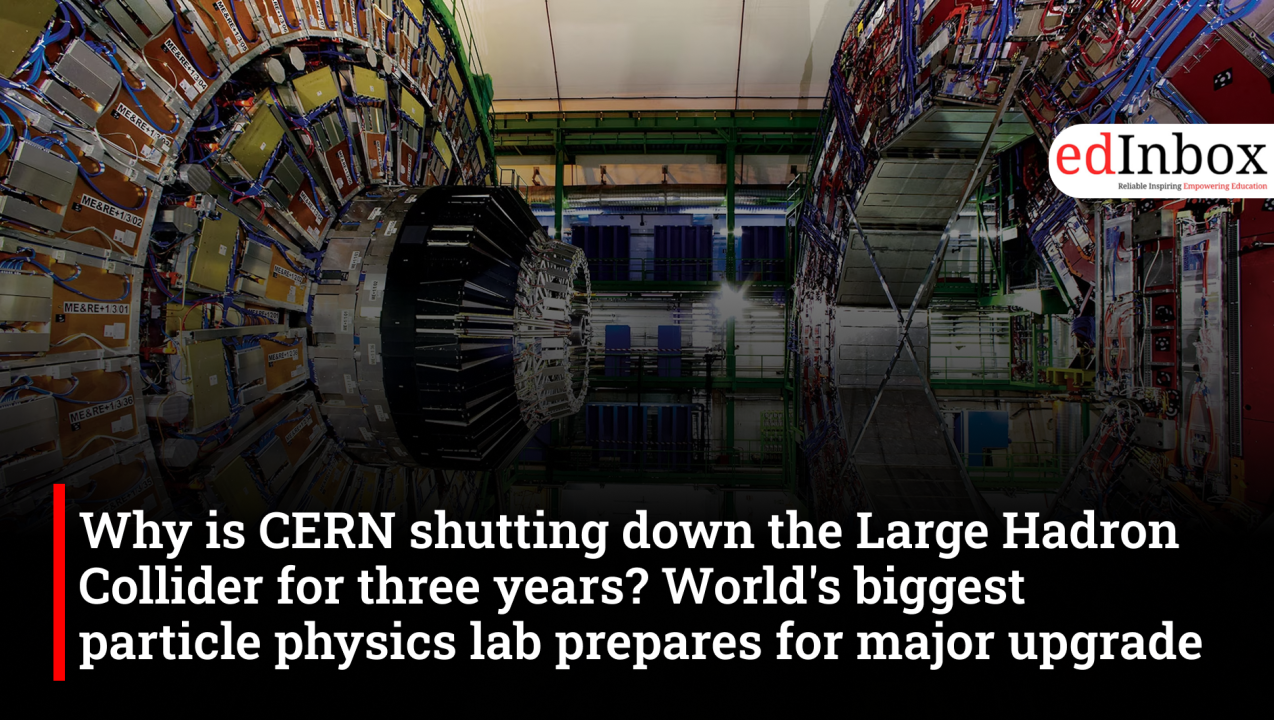
Why is CERN shutting down the Large Hadron Collider for three years? World's biggest particle physics lab prepares for major upgrade
Typography
- Smaller Small Medium Big Bigger
- Default Helvetica Segoe Georgia Times
- Reading Mode