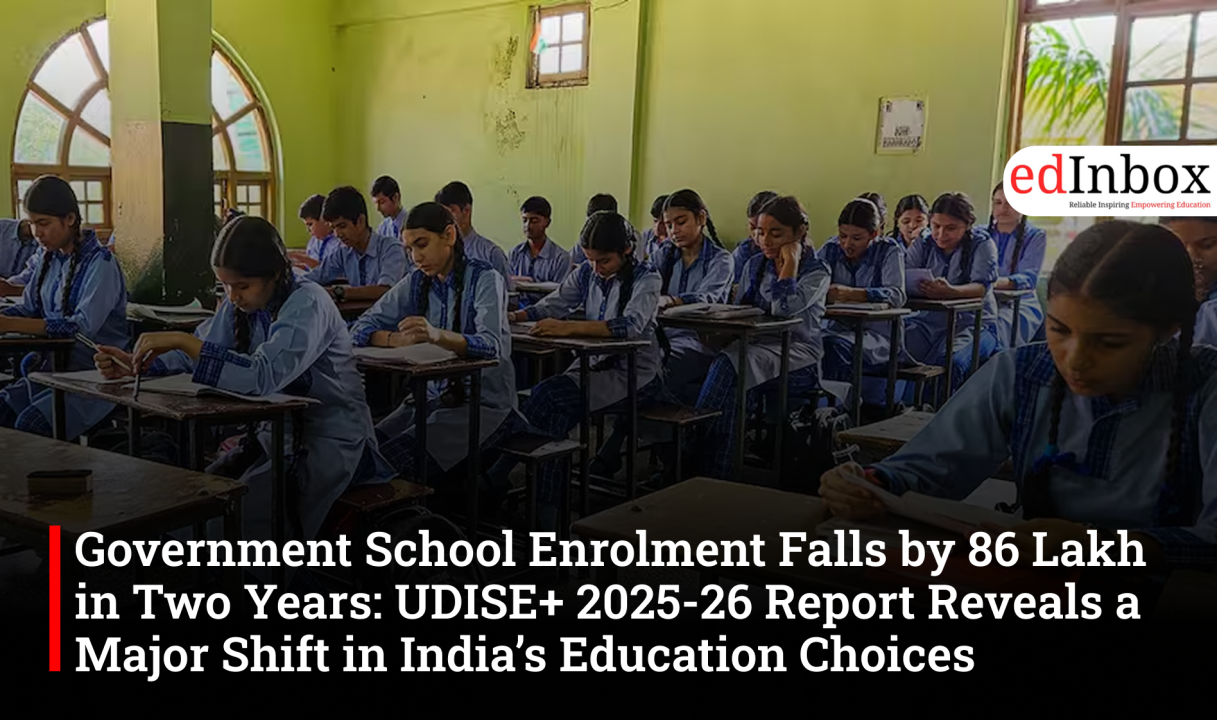
India’s school education landscape is undergoing a significant transformation, with families increasingly shifting towards private schools while government institutions witness a decline in student enrolment.
According to the latest UDISE+ 2025-26 Report released by the Ministry of Education, government schools have lost nearly 86 lakh students in two academic years, while recognised private unaided schools have recorded an increase of more than 88 lakh enrolments during the same period.
The figures highlight a changing pattern in school preferences across India. While overall school enrolment has remained relatively stable, the movement of students between government and private institutions signals growing parental demand for perceived better quality education, English-medium learning, digital facilities and improved career opportunities.
UDISE+ 2025-26 Report: Key Findings at a Glance
The latest education data presents a mixed picture of progress and challenges:
- Government school enrolment declined by around 86 lakh students over two years.
- Private unaided recognised schools gained over 88 lakh students during the same period.
- Total student enrolment across India saw only a marginal decline.
- Teacher strength crossed the one crore mark for the first time.
- School dropout rates continued to decline across different education levels.
- The total number of schools reduced slightly due to rationalisation and consolidation measures.
The report suggests that India has largely achieved broad access to schooling, but the next challenge is improving the quality of education and rebuilding confidence in public schools.
Why Are Parents Choosing Private Schools Over Government Schools?
The shift towards private education is influenced by several social and economic factors.
Growing Demand for Better Learning Outcomes
Many parents associate private schools with:
- Better classroom discipline
- Stronger English-language instruction
- Higher academic performance
- Greater preparation for competitive examinations
- More exposure to technology and extracurricular activities
Affordable private schools have expanded rapidly, including in rural and semi-urban areas, giving families more options than ever before.
Rising Aspirations Among Indian Families
As household incomes improve and employment opportunities become more competitive, parents increasingly view education as the most important investment in their children’s future.
Families are willing to spend additional money on schooling if they believe it can provide better skills, improved communication abilities and stronger career prospects.
Growth of Low-Cost Private Schools
The expansion of budget-friendly private schools has changed India’s education market. Many middle- and lower-income families are choosing private institutions despite additional expenses because of expectations around quality and outcomes.
Urbanisation and Changing Family Preferences
Rapid urban growth and migration have increased demand for private schools in many regions. Urban and semi-urban families often have easier access to a wider range of private education options.
Dropout Rates Continue to Decline: A Positive Development
Despite concerns over enrolment shifts, the UDISE+ report highlights encouraging progress in student retention.
School dropout rates have improved across multiple stages, indicating that more children who enter the education system are continuing their studies.
Experts link this progress to government initiatives such as:
- PM POSHAN (Mid-Day Meal Scheme)
- Free textbooks and uniforms
- Scholarships for students
- Digital learning programmes
- Improved school infrastructure
- Campaigns promoting education among girls and disadvantaged communities
These measures have helped improve attendance, reduce barriers and encourage children to remain in school.
India’s Teacher Workforce Crosses One Crore Milestone
One of the biggest achievements highlighted in the UDISE+ report is the crossing of the one crore teacher mark in India’s school education system.
The increase in teacher numbers reflects:
- Recruitment initiatives by states and the Centre
- Expansion of educational facilities
- Improved teacher availability
- Better pupil-teacher ratios in several regions
A strong teaching workforce remains essential for improving classroom learning and achieving better educational outcomes.
Government Schools Remain Critical for India’s Education System
Although government school enrolment has declined, these institutions continue to serve nearly half of India’s school-going population.
Government schools remain especially important for:
- Rural communities
- Economically weaker families
- Tribal and remote areas
- Children dependent on free education
- Students benefiting from welfare programmes
They continue to play a central role in ensuring educational access, social inclusion and equal opportunities.
Reasons Behind the Decline in Government School Enrolment
Education experts point to several possible reasons behind the changing enrolment pattern.
Changing Expectations of Parents
Modern families increasingly expect schools to provide:
- Digital education facilities
- Spoken English skills
- Career-focused learning
- Practical and vocational training
- Technology-based classrooms
Declining Birth Rates
Demographic changes may also be affecting school enrolment. Several regions are experiencing slower population growth and fewer children entering school-age groups.
School Rationalisation and Consolidation
Many states have merged or reorganised schools with very low enrolment to improve resource utilisation. While this can reduce the number of institutions, it does not always mean reduced access.
Migration Trends
Seasonal and permanent migration continues to influence enrolment patterns, particularly in rapidly urbanising districts.
India’s Education Challenge Is Now About Quality, Not Just Access
The latest UDISE+ findings show that India’s education challenge is entering a new phase.
The priority is shifting from simply bringing children into schools to ensuring meaningful learning outcomes.
Key focus areas include:
- Improving foundational literacy and numeracy
- Enhancing classroom teaching quality
- Expanding digital infrastructure
- Training teachers in modern teaching methods
- Strengthening accountability in schools
Parents are increasingly judging schools not only by availability but by the actual quality of education provided.
How Government Schools Can Regain Parent Confidence
Experts believe improving public trust in government schools will require long-term reforms, including:
Better Learning Outcomes
Greater focus on reading ability, mathematics skills, problem-solving and critical thinking.
Digital Transformation
Investment in smart classrooms, internet access and technology-enabled learning.
Teacher Training
Regular professional development programmes to help teachers adopt modern teaching approaches.
Stronger Community Participation
Greater involvement of parents and local communities in school management and decision-making.
Future-Ready Skills
Introducing vocational education, coding, entrepreneurship and career-oriented learning in line with the National Education Policy (NEP) 2020.
State-Level Differences Could Shape India’s Education Future
The national trend does not represent every state equally.
Some states continue to maintain strong government school enrolment due to effective welfare schemes and improvements in school quality. Others are seeing faster movement towards private institutions.
Differences in learning outcomes, infrastructure, teacher availability and retention rates show that education policies may need to be tailored according to state-specific challenges.
What the UDISE+ Report Means for India’s Education Policy
The latest report provides an important roadmap for policymakers.
Future priorities are likely to include:
- Improving government school quality
- Expanding early childhood education
- Strengthening foundational learning
- Increasing teacher accountability
- Expanding digital education
- Encouraging community involvement
- Ensuring equal access to quality education
The changing enrolment pattern does not simply represent a shift between government and private schools. It reflects a deeper transformation in what Indian families expect from education.
The next challenge for India is clear: ensuring that every child receives high-quality learning opportunities, regardless of whether they study in a government or private school.
Government School Enrolment Falls by 86 Lakh in Two Years: UDISE+ 2025-26 Report Reveals a Major Shift in India’s Education Choices
Typography
- Smaller Small Medium Big Bigger
- Default Helvetica Segoe Georgia Times
- Reading Mode