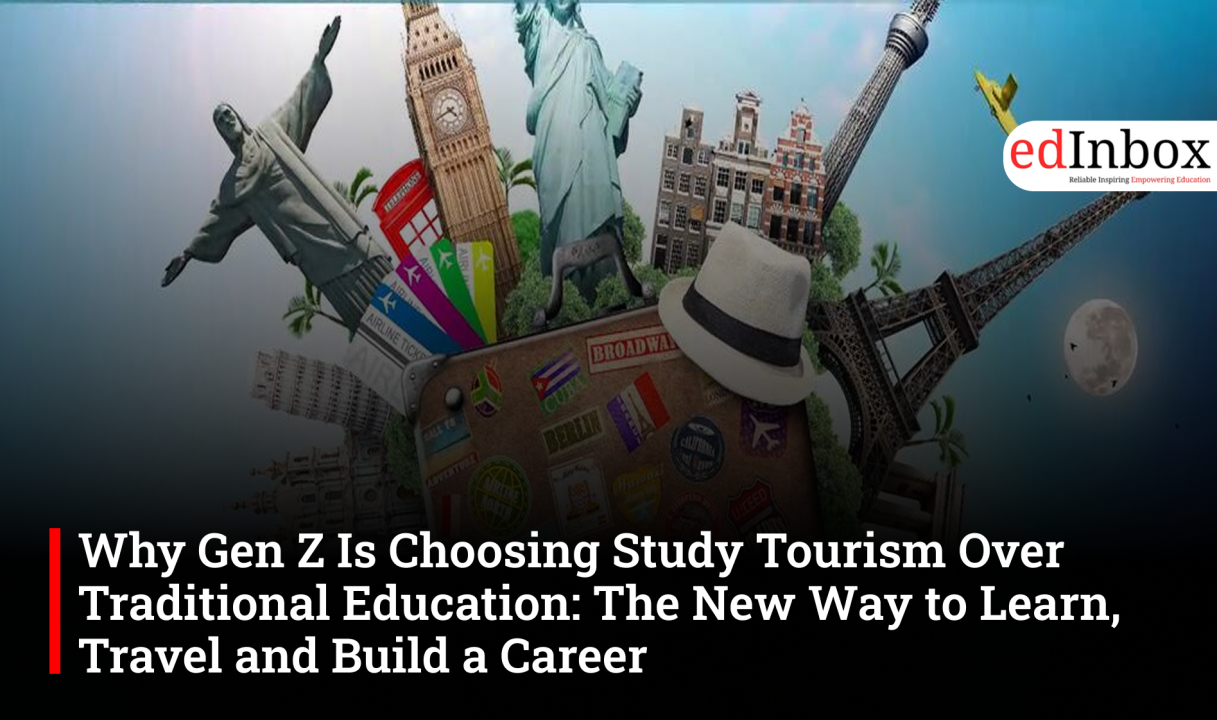
GenZ is using their free will to the fullest. They have realised not every lesson needs to begin with a textbook, sometimes it begins with choosing the next country to travel, exploring a centuries-old museum, visiting a technology hub, or learning a new language while living in a different culture. genZ is reviving the ancient method of experiential learning.
This change has led to the emergence of one of the fastest-growing trends in global education today– Study Tourism.
Study tourism for students aged 16 to 25 is a combination of tourism and studying, where students not only learn, but gain practical skills, cultural understanding and worldviews, through travelling. Study tourism is growing from being only an education option to a better preparation for the future, as universities and employers are recognizing the importance of experience in real life.
What is Study Tourism?
Study tourism is educational travel that allows students to learn through academic programmes, field visits, cultural experiences, research projects and industry exposure in another city or country.
The main goal is learning, which is not the case in traditional tourism. The journey becomes the learning experience, and not the holiday. Study tourism can include:
Type of Study Tourism
Example
University Exchange Programmes
Studying at a partner university abroad
Short-Term Study Tours
Academic visits lasting one to four weeks
Summer or Winter Schools
Intensive learning programmes during vacations
Cultural Immersion Programmes
Learning language, history and traditions
Research Visits
Fieldwork and academic projects
Industry Exposure Tours
Visiting companies, laboratories or innovation centre
Whether students spend two weeks in Japan studying robotics or participate in a sustainability programme in Europe, the goal remains the same, which is learning through experiencing the knowledge itself.
Study Tourism is Becoming a Trend
The students of today are preparing to meet the challenges of job opportunities that don't yet exist. Employers are seeking alternatives to grades, valuing skills in adaptability, communication, creativity and problem solving.
This is where study tourism comes in to develop these skills naturally. Changes in surroundings promote independence. Communication is enhanced when one meets with people of varied cultures. The confidence and adaptability gained through exploration of new environments that cannot be achieved in the classroom are valuable assets for students.
Traveling is also an experience that alters the perspectives of many students. History comes alive when it's seen in person. Engineering concepts come to life when seen at the advanced manufacturing facilities. Students gain knowledge of culture and culture perspectives that can't be fully understood in a textbook.
Learning Beyond Borders
One of the biggest advantages of study tourism is that every destination offers a different learning experience.
Destination
Popular Learning Areas
Japan
Innovation, Robotics, Entrepreneurship
Germany
Engineering and Manufacturing
Italy
Fashion, Art and Design
Singapore
Business and Technology
Australia
Environmental Science and Marine Studies
South Korea
Media, Entertainment and Digital Culture
Finland
Education Systems and Innovation
United Kingdom
History, Literature and Global Politics
Students frequently come back with more than just facts. They have a deeper insight into education, business, sustainability and innovation in various countries.
Is Study Tourism Boosting Job Opportunities?.
Increasingly, yes. Employers these days appreciate candidates who are willing to take initiative, adapt and have an understanding of people from diverse backgrounds. Students can share experiences during the study tour with experiences that are not related to the classroom.
Students may develop skills such as:
Experience
Skill Developed
International travel
Adaptability
Group projects
Teamwork
Cultural exchange
Cross-cultural communication
Research activities
Critical thinking
Industry visits
Professional awareness
Independent travel
Confidence and decision-making
These experiences can strengthen university applications, scholarships, internships and future job opportunities.
Is Study Tourism Only for Students Who Want to Study Abroad?
Not at all. The greatest misconception is that study tourism is only available for the students who are studying full-time in another country.
Educational programmes are now available at several universities/schools and other educational organisations, and vary from a few days to a few weeks. Workshops, academic conferences, cultural visits, innovation bootcamps and industry interactions are included in many of them.
Students may attend during the school holidays or school breaks, without impacting on their regular schooling.
Traditional Learning vs Study Tourism
Traditional Learning
Study Tourism
Classroom lectures
Real-world learning
Theory-focused
Practical experience
Local exposure
Global exposure
Textbooks
Cultural immersion
Fixed environment
New environments
What is the cost involved in Study Tourism?
The budget always comes into mind first, when considering college admission. Study tourism has become more than just a costly exchange programme; international programmes are no longer a large expense.
There are a lot of institutions that now provide:
- Short-duration academic tours
- International Immersion Programs led by Universities.
- Scholarship-supported exchanges
- Government-funded educational visits
- Summer and winter schools
With proper planning and information about the opportunities, study tourism can be accessible to students more than they think is possible.
Experiential Learning via Travelling
Study tourism promotes students' questioning rather than memorisation. A biology student that is learning about wildlife conservation in another country has something to learn more than just in labs. A student of design spends time visiting exhibitions around the world to find new ways to be creative. Entrepreneurship education for business students is not purely theoretical, it's a matter of conversation. This blend of education and experience provides a more engaging, memorable and practical learning experience.
Key Skills for Life Beyond the Journey
While academic learning prepares students for examinations, experiences can make an impact on careers. Students actively engaged in study tourism often acquire:
- Communication skills
- Cultural awareness
- Leadership qualities
- Problem-solving ability
- Confidence
- Global outlook
- Independent thinking
These skills are useful in any career path they may go down.
The Future of Education May Be Borderless
The world of education is evolving at a fast pace. While knowledge can be accessed virtually from anywhere, experience can't be downloaded. Study tourism is the perfect solution to this, offering academic learning alongside cultural understanding, and with practical exposure and personal growth. It promotes curiosity among students to become ‘curious learners' who are not only subject matter experts but are also aware of the surrounding world.
Gen Z defines success in new ways, beyond degrees, focusing on experiences, adaptability, and global perspectives. This shift in perspective is mirrored in study tourism, with young people having the chance to learn outside of the classroom whilst preparing for a career in a more globalized world.
With the changing nature of education, there is one clear message: sometimes, the best learning takes place when students are outside the classroom.
Why Gen Z Is Choosing Study Tourism Over Traditional Education: The New Way to Learn, Travel and Build a Career
Typography
- Smaller Small Medium Big Bigger
- Default Helvetica Segoe Georgia Times
- Reading Mode