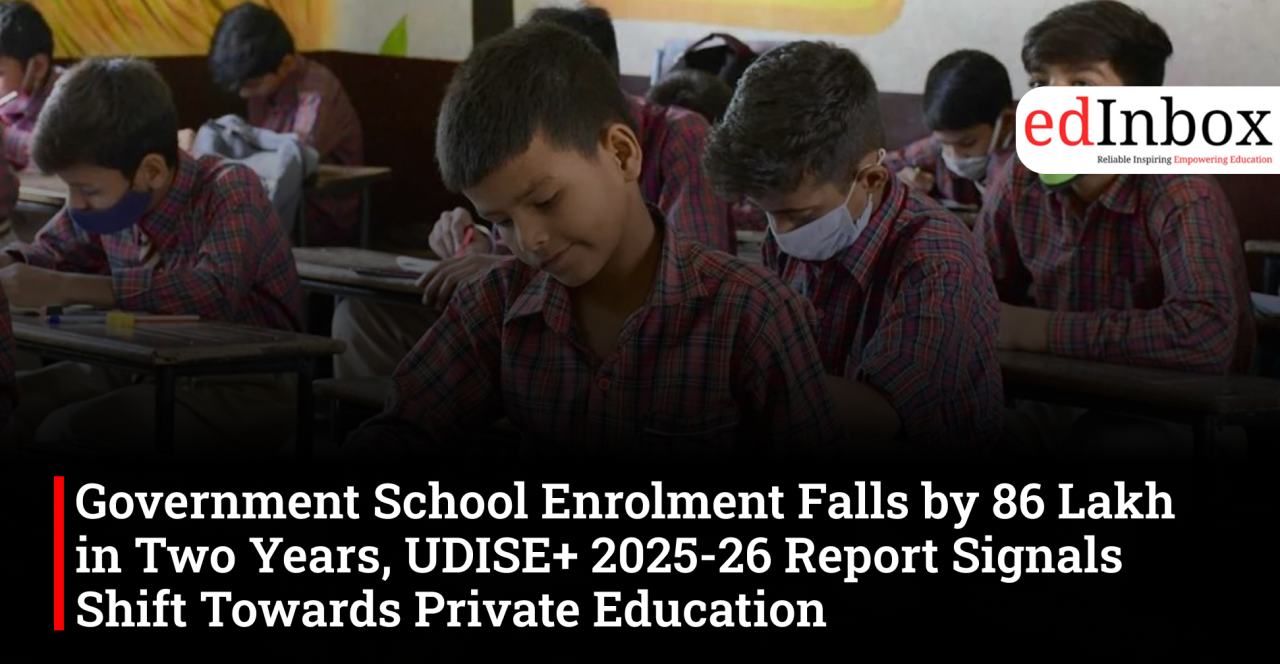
India’s school education landscape is undergoing a significant transformation, with parents increasingly opting for private schools over government institutions. The latest UDISE+ 2025-26 Report released by the Ministry of Education reveals that government school enrolment has declined by nearly 86 lakh students over the past two academic years, while recognised private unaided schools have added more than 88 lakh students during the same period. Although overall student enrolment across the country has remained largely stable, the data points to changing parental aspirations and growing demand for quality education, making the findings a key indicator of emerging trends in India’s education sector.
The report highlights a mixed picture. While enrolment in government schools has fallen sharply, the total number of teachers in the country has crossed the one crore mark for the first time, reflecting sustained recruitment efforts and improved pupil-teacher ratios. It also records a continued decline in school dropout rates, suggesting that once children enter school, they are more likely to complete their education than in previous years.
Education experts attribute the migration towards private schools to multiple factors. Parents increasingly perceive private institutions as offering better learning outcomes, stronger English-medium instruction, improved classroom discipline and greater preparation for competitive examinations. The rapid expansion of affordable private schools, particularly in rural and semi-urban areas, has further widened access to private education. Rising household incomes and growing awareness of education as a pathway to better employment have also encouraged families to invest in private schooling.
Despite the enrolment decline, government schools continue to educate nearly half of India’s school-going children and remain critical for ensuring equitable access to education. They continue to serve rural communities, economically weaker sections, tribal populations and children benefiting from flagship welfare initiatives such as PM POSHAN, free textbooks, uniforms and scholarship schemes.
The UDISE+ report also points to structural reasons behind the changing enrolment pattern. Falling birth rates in several states, school rationalisation and consolidation, urban migration and changing demographic trends have all contributed to shifts in school statistics. At the same time, improved infrastructure, digital learning initiatives and awareness campaigns have helped reduce dropout rates across multiple stages of schooling.
The findings underscore that India’s education challenge is gradually shifting from expanding access to improving quality. Policymakers are expected to focus on strengthening foundational literacy and numeracy, enhancing teacher training, expanding digital classrooms, improving accountability and introducing future-ready skills aligned with the National Education Policy (NEP) 2020.
The report also highlights significant state-level variations, indicating that while some states have strengthened public education through effective reforms and welfare programmes, others continue to witness faster migration towards private schools. As India aims to build a more inclusive and high-quality education system, the UDISE+ 2025-26 report reinforces that improving learning outcomes in government schools will remain central to restoring public confidence and achieving equitable educational development.
Government School Enrolment Falls by 86 Lakh in Two Years, UDISE+ 2025-26 Report Signals Shift Towards Private Education
Typography
- Smaller Small Medium Big Bigger
- Default Helvetica Segoe Georgia Times
- Reading Mode