CJP Protests made genZ mature. Take a moment to think, no child grows up dreaming of standing behind a police barricade or leading a students’ protest; they dream of standing on a college campus, seeing their parents smile after years of sacrifices, opening an exam result that changes their family's life forever. That is how millions of young Indians are raised.
“Study, work harder, believe that merit will reward you.” For years, that promise kept an entire generation going. Then something changed… When allegations of repeated examination paper leaks and irregularities began shaking the country's biggest competitive exams, students did not just feel cheated.
Many felt that the one thing they had always trusted, i.e. the idea that dedication is enough, was slowly slipping away. That is why what happened at Delhi's Jantar Mantar isn’t a random protest. It became something far bigger; it became a generation asking one question that nobody in power could ignore anymore. It proved the system was gravely defective and that the most unserious generation had to come down to streets for one of the most serious protests while the government only focused on saving its throne!
Neither Education Nor Government Stood For its Youth
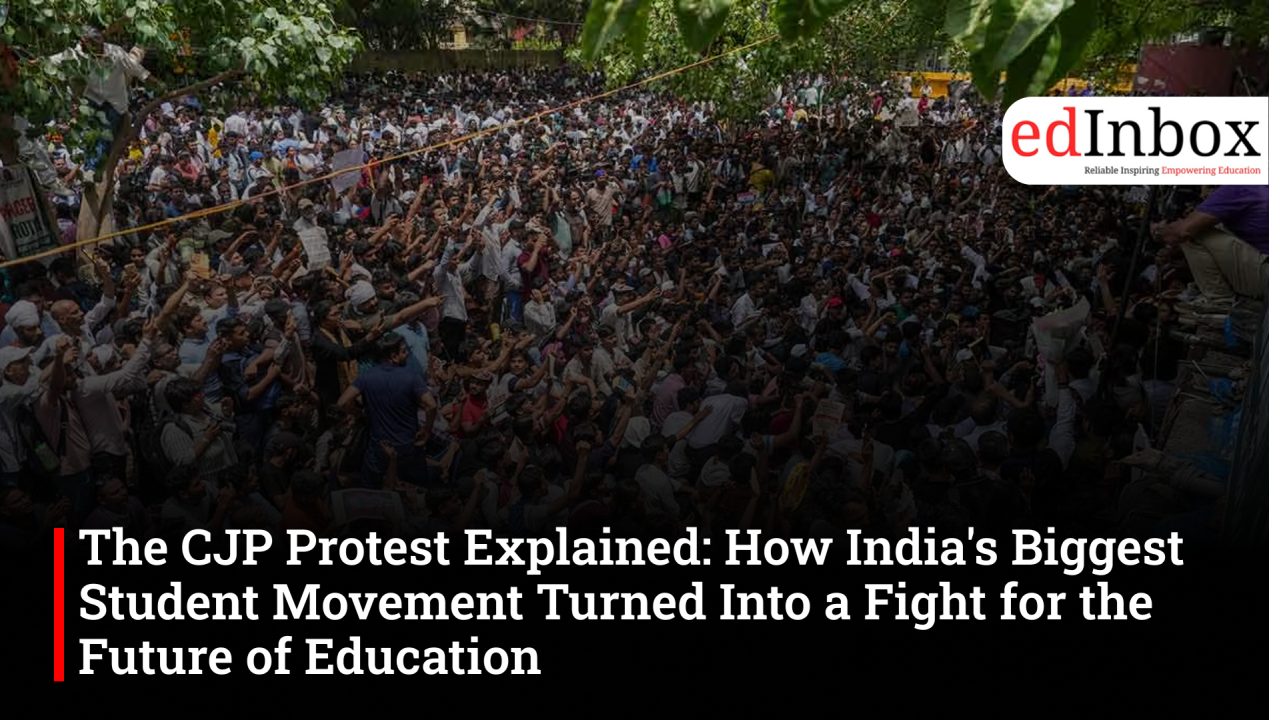
What started as a protest over exam irregularities and NEET paper leak turned into one of the country’s biggest youth-led movements in recent years. Thousands of students, job aspirants, parents and supporters gathered at Jantar Mantar with this simple message: if examinations decide a young person’s future then those examinations must be fair, transparent and accountable.
The movement was led by the Cockroach Janta Party (CJP), a youth organisation that pushed for the resignation of Union Education Minister Dharmendra Pradhan and also demanded broader reforms in India’s examination system. Over the next few days, the protest went way beyond one political demand. It became, somehow, a conversation about trust, and the biggest yet basic demand – accountability!
The youth demanded answers from the same government who is pushing to make India vishwaguru. However, with all the paperleaks, youths’ potential going to waste, a corrupted system and monarchy disguised as democracy, the protest that erupted in 2026 was NEEDED. Because it’s better to fight today than let our children fight later.
Also Read: The Rise of the ‘Cockroach Generation’: Young Indians Are Tired of Pretending Everything Is Fine
Vishwaguru? Let the Gurus be Educated First!
The matter might look trivial on papers reading as ‘yet another paper leak that caused distress and a few suicides’, but the ground reality is far beyond mere words inked down; it’s about the basic need from our education system.
From 2021, the government aggressively started to promote and persuade people to help India become Vishwaguru again. The students took it positively, genZ really set their minds into studying, which was clearly visible as instagram started flooding with memes that could only be understood by educated people. Yes, brainrot trended and cringe content still peaked but memes, phrases, and references that surfaced somewhere reflected how a generation was also focusing on studying.
However, in the 2026 NEET paper, one of India’s biggest exams, leaked, and when the students demanded answers, when they demanded the system to be fixed permanently so that such an incident never happens, the government ignored, AVOIDED its own youth. Students only yearned for fair exams, better systems, and unbiased education opportunities because corruption only leads to most undeserving people climbing the ladder and decaying the whole civilisation in the long-run.
NEET Paper Leak 2026
The initial cause for the protest was said to be irregularities in the competitive exams, but the discussion at Jantar Mantar soon shifted from a single examination or recruitment process. Students talked about years of preparation.
Parents shared their experiences of money spent on coaching. Repeated claims of paper leaks and examination failures had led to uncertainty about merit, many protesters said. It wasn't just about one result for them. It was a question of whether hard work still brought opportunity. This fear was not just felt in Delhi, but throughout young India.
Also read: Why NEET Is No Longer an Entrance Exam Students Can Trust Blindly
A Protest that Refused to Just Fade Away
The movement picked up speed as students from different states travelled to Delhi. Some had spent years preparing for competitive examinations. Others had watched the same kind of paper-leak allegations keep showing up on headlines. Many arrived with the sense that they had already tried everything else , so this was the last option.
The protest then leaned into something more moral when climate activist Sonam Wangchuk joined the movement and started an indefinite hunger strike, in solidarity with the students. His presence changed what had looked like yet another student demonstration into a wider national discussion about the future of education.
After 21 days of fasting, Wangchuk was removed from the protest site by Delhi Police and moved to Safdarjung Hospital. Police said the decision came after medical advice and instructions connected to matters before the Delhi High Court, once his health deteriorated. Protest organisers, however, described the removal as forcible , and the videos from the incident spread quickly across social media, sparking a lot of debate.
With Wangchuk hospitalized, CJP founder Abhijeet Dipke announced that he would continue the hunger strike, declaring that the movement would not stop and the Parliament March on 20th July;2026 was still on.
Also read: Indian Students Are Exhausted: How NEET 2026 Exposed a Growing Trust Crisis in Education
The turning point was the march of "Sansad Chalo"
Despite Delhi Police declaring the march unauthorised and tightening security across central Delhi, thousands gathered with the intention of marching (peacefully) towards Parliament.
What ensued was the most controversial period in the movement. Police deployed barricades, lathi-charge and tear gas when protesters tried to march towards Parliament. As per ground videos, the tear bombs used were expired (the most concerning part). Expired tear gas can become more unstable and potentially more harmful, causing intensified irritation, chemical burns, and unpredictable reactions.
Meanwhile, protest organisers and many participants alleged that police used excessive force against peaceful protesters and falsely accused the protestors of being violent. The internet was flooded with videos showing protestors trying to save themselves from police who started hitting in an attempt to provoke protestors to be violent, until the government decided to cut the internet.
In all of this, genz and gen alpha clearly saw one basic question arise: what’s something that the government is trying to save or hide? Because it was a peaceful protest for mere accountability. Moreover, if Dharmendra Pradhan took action or wholeheartedly claimed responsibility, things could have been very different.
The Images Of The Day Tell Two Stories Now
Some displayed injured police officers, broken barricades and roads strewn with stones. Others were seen carrying injured young protesters to safety, students sitting on roads with handwritten placards, and volunteers carrying the injured to safety while tear gas filled the streets around Parliament. The events were soon the topic of public discussion.
During the protest week, things took a turn as people from different communities started to join. However, because of massive headcounts it became difficult to differentiate between true students and goons disguised as protestors. There were fights, violence that started happening from the protestors’ end. This triggered speculations about conspiracies and ill intentions of an unknown group or party. Despite this, students kept flocking at Jantar Mantar and other districts for peaceful protest while the police allegedly continued provoking them and detaining them.
Public Voices Join In The Movement
The protests continued and public figures started to react. Actor Alia Bhatt applauded the bravery of the protesters. “Examination paper leaks are a serious matter,” Salman Khan said, adding his condolences to the students who were injured during the protests. He also said, "Sonam, it's done bro," that went viral.
Veteran actor Naseeruddin Shah, who peacefully went to Jantar Mantar to support the students’ protest, shared a video later questioning why other members of the film industry had not spoken up.
Singer Arijit Singh condemned the violence witnessed during the protests and later clarified that he was not in favour of the violent protesters or the CJP. He said that students' concerns should have been addressed before it got to this level.
Social activist Anna Hazare appealed to Prime Minister Narendra Modi to listen to the students' concerns and said that accountability makes the government stronger, not weaker. The movement was now a part of the public discourse.
Dhurandhar actress Ayesha Khan who participated in CJP Protest in Mumbai was detained. She shared a video claiming how police detained her and her friend, forced them into the police van and stopped them for joining the protest.
There were many other influencers who came forward to do what mainstream media refused to do. Big influencers did ground-reporting showing exactly what is happening while other micro influencers who had good followings contributed by choosing to be truthful despite knowing they could be detained or fined for speaking the truth against the government.
Few of them shared reels and claimed the government emailed them asking to make reels criticizing the movement while appreciating the government efforts, and to get compensation of 40-60 thousand rupees per reel. They also clarified that doing so could make them get arrested or liable to legal actions but are still doing it. They also urged the viewers to remember this as the videos could be taken down very soon. These claims aren’t independently verified, however, the screenshots they attached felt non-ai. Apparently, the credibility remains vague.
Politics, Accountability And Irony
The political debate on Education Minister Dharmendra Pradhan was one of the most talked about issues of the protest. The movement's supporters often cited reports from 1997, when Pradhan was allegedly involved in protests against a paper leak as a student leader.
Critics argued that students demanding accountability today deserved the same hearing that earlier generations had sought. But those who supported the government argued that the current movement had political elements and should not be directly compared with the previous student agitations. The debate was indicative of the extent to which the issue had become a part of the political discourse in India.
The Government's First Response
On 22nd July, Union Health Minister JP Nadda said the ongoing CJP protest and the issues raised by the students should be discussed in Parliament so that a solution can be found.
Speaking amid the continuing agitation over the NEET paper leak, Nadda said it is the responsibility of both the government and the Opposition to discuss the matter in Parliament and work towards resolving it in the interest of students. His remarks came as the protest at Delhi's Jantar Mantar continued to draw nationwide attention and political reactions.
Prime Minister Narendra Modi announced the government would set up fast-track courts to probe examination paper leak cases as pressure mounted. The Prime Minister said that the future of the youth of the country would not be jeopardised by those who would try to do so and added that the protection of students was a national priority.
The announcement was seen by many as a sign that the integrity of exams had become a national issue. But the announcement also left a bigger question unanswered. Does the swiftness of punishment alone restore public confidence?
Inside The Movement
As with any large-scale public protest, the demonstrations had their own internal issues. Online criticism was raised after videos were released of a CJP spokesperson visiting fast food restaurants during the protests. The organisation later dismissed him from his official role, stating that his actions were not in line with the values of the movement.
The decision was welcomed by some supporters as evidence that the organisation was willing to hold its own members accountable.
In the interim, the CJP broadened its demands to include the dropping of cases against protesters and action against police officers accused by the organisation of using excessive force. Despite detentions, police presence and repeated clashes, the protests persisted.
Sonam Wangchuk Ends Hunger Strike after 26 Days
On July 23, 2026, Sonam Wangchuk concluded his 26-day hunger strike after he met Union Ministers JP Nadda and Jitendra Singh at Medanta Hospital in Gurugram. He broke his fast in the presence of the ministers and senior leaders of Apex Body of Leh Ladakh. Wangchuk's choice was made after a long negotiation and fear of potential violence in the country. He thanked the Members of Parliament for their support, and called for caution against violence, which has been 65 in number. The government pledged to take no action against the protesters who were demonstrating peacefully and said it was discussing paper leaks and educational reforms.
PM Modi On NEET Paper Leak Released a Midnight Video
Later on 23rd July, PM Modi released a video at midnight addressing the heated topic of NEET Paper leak calling the issue "very painful" and acknowledging the concerns of students and parents. He assured that strict actions would be taken.
The Prime Minister said several accused in paper leak cases had been identified and arrested over the past two and a half months, and promised strict action against those responsible. He also said that re-examinations were held for almost 22 lakh students and results were declared on July 19 to ensure that their admissions were not delayed.
Modi also said the Union Cabinet would hold a discussion on a proposed anti-paper leak law that will be introduced in Parliament next week. The draft bill would also introduce tougher penalties for those involved in the examination malpractices and fast-track courts to speed up paper leak cases.
Congress leader Rahul Gandhi criticized the address by the Prime Minister for not responding to the demand for the resignation of Union Education Minister Dharmendra Pradhan. Gandhi restated the demands which included the removal of Pradhan, action against those who allegedly assaulted protesting students and an apology from the government.
The Prime Minister's message came before the nationwide protests against the alleged examination irregularities and just after the activist Sonam Wangchuk called off his 26-day hunger strike. The Centre said more legal and administrative changes may be implemented in the future to build trust in the competitive examination system in India.
On the 24th night again PM Modi shared a video to keep Genz engaged. In the reel he thanked them for their feedback on his earlier video and said that it was “good to interact”. In the caption of the reel said, “Thanks to the youngsters who watched my video yesterday and sent insightful suggestions.” GenZ apparently commented funny things but between the lines it reflected how frustrated they felt about the “illogical-reel” that had nothing to do with the trivial demand of students.
Also Read: PM Modi Releases Midnight Video on NEET Paper Leak as Sonam Wangchuk Ends Hunger Strike on day 26
Protest That Went Beyond Delhi
What happened in Parliament Street or Jantar Mantar was perhaps the most remarkable aspect of the movement. It was the same in households all over India. Parents who had never protested found themselves talking about examination reforms.
Teachers debated accountability. Students who were preparing for future exams were asking themselves if the system they believed in could ensure fairness. The protest wasn't about ideology for many of the young people. It was a question of certainty. The confidence that years of study should not be jeopardized by alleged corruption or administrative failures.
Dharmendra Pradhan Resigned
On 25th July, 2026, Union Education Minister Dharmendra Pradhan reportedly sent his resignation to Prime Minister Narendra Modi amid the ongoing Cockroach Janta Party (CJP) protests (students protest) in Jantar Mantar demanding his removal over NEET paper leak irregularities.
The development comes hours before the scheduled talks between the Centre and CJP representatives. The two-page letter, addressed to the country's youth and shared on social media, marks one of the biggest political fallouts yet from this year's NEET paper leak controversy..
Pradhan in the letter said, “I do not want any student’s future entangled in legal complications. I want our children to focus on studies and career building”.
He also mentioned that the last 10 days had been disturbing to him and that his choice was not based on his image but his conscience. He noted the rising discontent over the issue, including protests at Jantar Mantar, and said that people in power had deceived students during the crisis and that the situation was being politicized.
Also read: CJP Forces Historic Resignation: Education Minister Dharmendra Pradhan Resigns
A Generation Pleading To Be HEARD
Each generation has one question that it will leave behind. This is what it might look like for this generation: Can a nation be a global knowledge power (vishwaguru) if its students don't believe in the exams that define their future?
The CJP protest will be evaluated in a multitude of ways, from the number of people who participated, the debates it provoked, the political debates it created, and the changes it brought and did not bring.
However, its biggest legacy might be something much simpler. It brought India to the realization that every roll number has a name, every result has a family and every allegation of paper leak has the potential of ruining years of hard work.
Some may have agreed with all the memes, slogans, all the demands, all the methods, but the protest put the issue on the agenda that could no longer be ignored. For thousands of young Indians who stood in Delhi for not just an examination but the concept of accountability itself, that conversation could turn out to be the movement's greatest legacy.
In the words of Abhijeet Dipke: Jhukti hai duniya, jhukane wala cahiye
The CJP Protest Explained: How India's Biggest Student Movement Turned Into a Fight for the Future of Education
Typography
- Smaller Small Medium Big Bigger
- Default Helvetica Segoe Georgia Times
- Reading Mode