The resignation of Union Education Minister Dharmendra Pradhan marks more than the political fallout of a controversial examination. It represents a defining moment in the relationship between India's youth and the state. Whether viewed as an act of accountability, a strategic political concession, or a response to sustained public pressure, the episode underscores a larger truth: India's education system has reached a point where public trust can no longer be taken for granted.
The NEET-UG 2026 controversy was never merely about a paper leak. It evolved into a national conversation about fairness, institutional credibility, unemployment, and the aspirations of millions of young Indians. For students who had invested years of preparation, family savings, and emotional resilience into one examination, the cancellation of the test represented more than administrative failure—it felt like a breach of the social contract. The examination system had failed those who had done everything society had asked of them.
What transformed this grievance into a nationwide movement was the ability of Generation Z to redefine political participation. Often dismissed as distracted, screen-obsessed, or disengaged, young Indians demonstrated that social media can be the starting point—not the endpoint—of civic action. Memes evolved into mobilisation, online campaigns became street demonstrations, and digital communities translated into disciplined negotiations with the government. The movement challenged long-held assumptions that internet activism lacks endurance or organisational depth.
The emergence of the Cockroach Janta Party as a symbolic platform reflected this shift. By reclaiming a term perceived as derogatory and transforming it into an emblem of resilience, young protesters created a language that resonated with millions facing educational uncertainty and limited employment opportunities. Yet the movement was never confined to one organisation or personality. Independent students, social media creators, established student organisations, educators, and public intellectuals all contributed to a broad coalition that transcended ideological boundaries.
Among the movement's most influential voices was Sonam Wangchuk, whose hunger strike gave the agitation moral legitimacy beyond conventional politics. His insistence on non-violence, dialogue, and constitutional methods shifted public attention from partisan debate to ethical responsibility. Even when his deteriorating health became a matter of national concern, the focus remained on institutional reform rather than individual heroism. His eventual decision to end the fast after receiving written assurances reflected a belief that democratic negotiation remains preferable to permanent confrontation.
Equally significant was the turning point created by the July 20 march towards Parliament. While isolated incidents of violence require impartial investigation, the widespread images of police action altered public perception. The debate expanded beyond examination irregularities to include broader questions about the state's response to peaceful dissent. History repeatedly demonstrates that excessive force often strengthens rather than weakens public movements. According to the source document, attendance at protest sites increased after the crackdown, suggesting that coercion amplified public sympathy instead of discouraging participation.
The political opposition undoubtedly amplified the issue by raising it inside Parliament and demanding ministerial accountability. However, the movement's strength lay in the fact that it could not easily be dismissed as a partisan campaign. Students from diverse ideological, social, and regional backgrounds participated because examination integrity affects every aspirant regardless of political preference. The document further argues that attempts to communalise the protests failed because paper leaks and educational uncertainty cut across religious and party identities. Merit, anxiety, and career aspirations proved stronger unifying forces than identity politics.
The movement also exposed the evolving nature of information warfare. Competing narratives, manipulated visuals, and unverified allegations circulated on all sides. Yet misinformation struggled to overwhelm lived experience. Students did not require political narratives to convince them that an examination had been cancelled or that months of preparation had been disrupted. Their personal experience remained the movement's most persuasive evidence. This highlights an important lesson in the digital age: while misinformation can shape narratives, it cannot easily erase realities experienced by millions.
The government's eventual acceptance of the minister's resignation appears, in the document's analysis, to have been driven by converging pressures—continued protests, parliamentary disruption, expanding public support, and concern that a single examination controversy could evolve into a broader youth movement centred on unemployment, institutional credibility, and governance. The resignation thus served both as an acknowledgment of accountability and as an attempt to contain an escalating crisis.
Yet resignations alone do not repair broken institutions. Restoring confidence in India's examination system demands transparent investigations, stronger safeguards against paper leaks, faster prosecution of offenders, protection for whistle-blowers, and meaningful reforms to testing agencies. Most importantly, students must regain confidence that merit—not manipulation—determines opportunity.
The lasting significance of this episode therefore lies beyond one minister or one examination. It demonstrated that India's youth possess both the organisational capacity and democratic maturity to shape public discourse through constitutional means. They showed that digital mobilisation can coexist with peaceful protest, negotiation, and institutional engagement. Whether governments of the future choose confrontation or dialogue, one message is unmistakable: young citizens expect accountability, transparency, and respect.
India's demographic dividend will remain its greatest strength only if its institutions command the confidence of those who depend on them. The NEET crisis should therefore be remembered not simply as a political controversy, but as a reminder that the future of education rests as much on public trust as on policy itself.
Prof. Ujjwal Anu Chowdhury
The author is Vice President, Washington University of Science and Technology and Editorial Mentor, edInbox.com
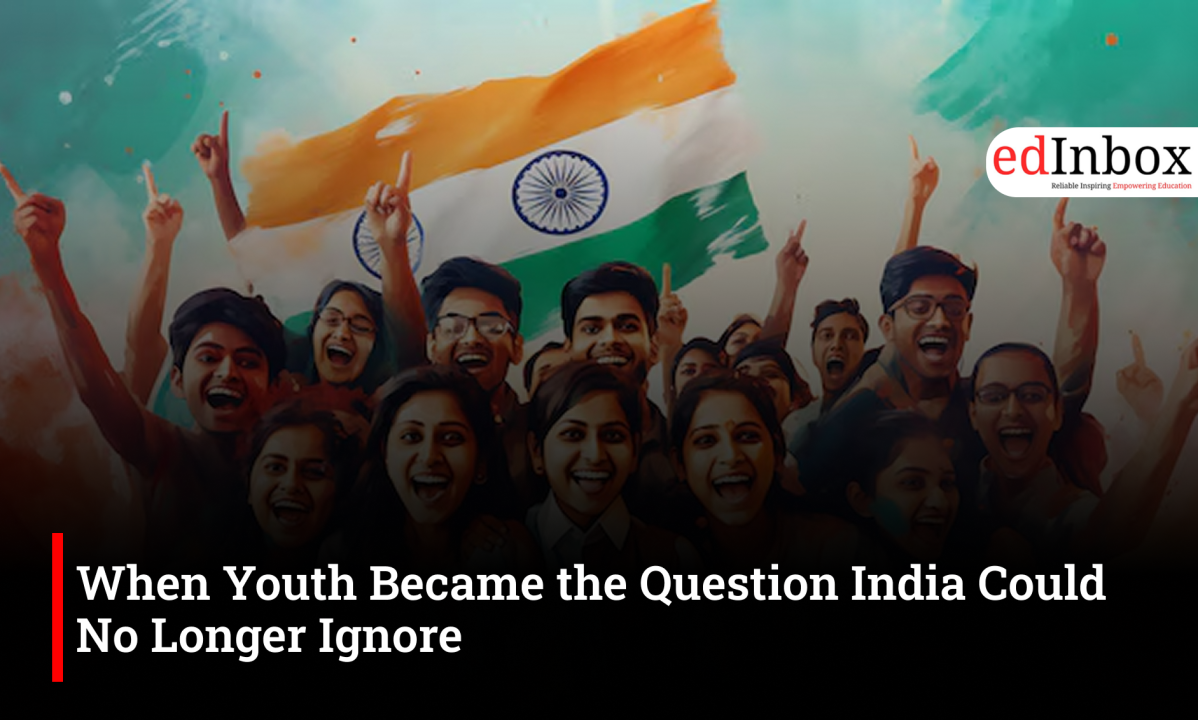
When Youth Became the Question India Could No Longer Ignore
Typography
- Smaller Small Medium Big Bigger
- Default Helvetica Segoe Georgia Times
- Reading Mode