The Supreme Court of India has reaffirmed that a person belonging to a Scheduled Caste (SC) community loses their Scheduled Caste status upon converting to a religion other than Hinduism, Sikhism, or Buddhism. In a significant ruling, the apex court dismissed a review petition challenging its earlier judgment, making it clear that the March 24, 2026 verdict will continue to remain in force.
The decision settles a key legal question surrounding SC reservation after religious conversion and clarifies who is entitled to claim Scheduled Caste benefits under the Constitution.
Supreme Court Dismisses Review Petition
A Bench comprising Justices Prashant Kumar Mishra and Manmohan rejected the review petition, observing that there was "no error apparent on the record" in its earlier judgment delivered on March 24, 2026.
In its order dated July 15, the Court also rejected an application seeking an oral hearing of the review petition.
The Bench stated that after examining the review plea and the earlier judgment, it found no grounds to reopen the matter. Consequently, the review petition was dismissed, leaving the original verdict unchanged.
What Did the Supreme Court Say?
The Supreme Court held that a person belonging to a Scheduled Caste community ceases to enjoy SC status from the date they convert to a religion other than Hinduism, Sikhism, or Buddhism.
The Court clarified that only individuals who continue to profess and practice Hinduism, Sikhism, or Buddhism are eligible to claim Scheduled Caste status under the existing legal framework.
The ruling upholds an earlier judgment of the Andhra Pradesh High Court, which had concluded that a person who converts to Christianity and actively follows that faith cannot continue to claim Scheduled Caste status.
Impact on SC Reservation and SC/ST Act
The judgment also has implications for the applicability of the Scheduled Castes and Scheduled Tribes (Prevention of Atrocities) Act.
According to the Court, an individual who has converted to Christianity and actively professes that religion cannot invoke protections available exclusively to members of Scheduled Castes under the SC/ST Act on the basis of their former caste identity.
The Andhra Pradesh High Court had earlier observed that the traditional caste system is not recognised within Christianity. Therefore, once an individual voluntarily adopts Christianity and practices that faith, they cannot continue to be treated as a Scheduled Caste under the law.
Legal Basis of the Verdict
The Supreme Court's ruling is consistent with the Constitution (Scheduled Castes) Order, 1950, as amended over time.
Under the current legal framework:
- Scheduled Caste status is recognised for persons professing Hinduism.
- It was later extended to Sikhs (1956) and Buddhists (1990).
- Persons converting to religions such as Christianity or Islam are not recognised as Scheduled Castes under the existing constitutional provisions.
The Court's judgment interprets and applies these constitutional provisions rather than creating a new rule.
Why the Case Matters
The verdict is significant because it provides legal clarity on a long-debated issue involving religious conversion and caste-based reservation benefits.
With the review petition now dismissed, the Supreme Court's March 24, 2026 judgment remains binding, reinforcing that conversion to a religion other than Hinduism, Sikhism, or Buddhism results in the loss of Scheduled Caste status under the present constitutional framework.
The ruling is expected to serve as an important precedent in future cases involving reservation benefits, caste identity, and the applicability of laws enacted for the protection of Scheduled Castes.
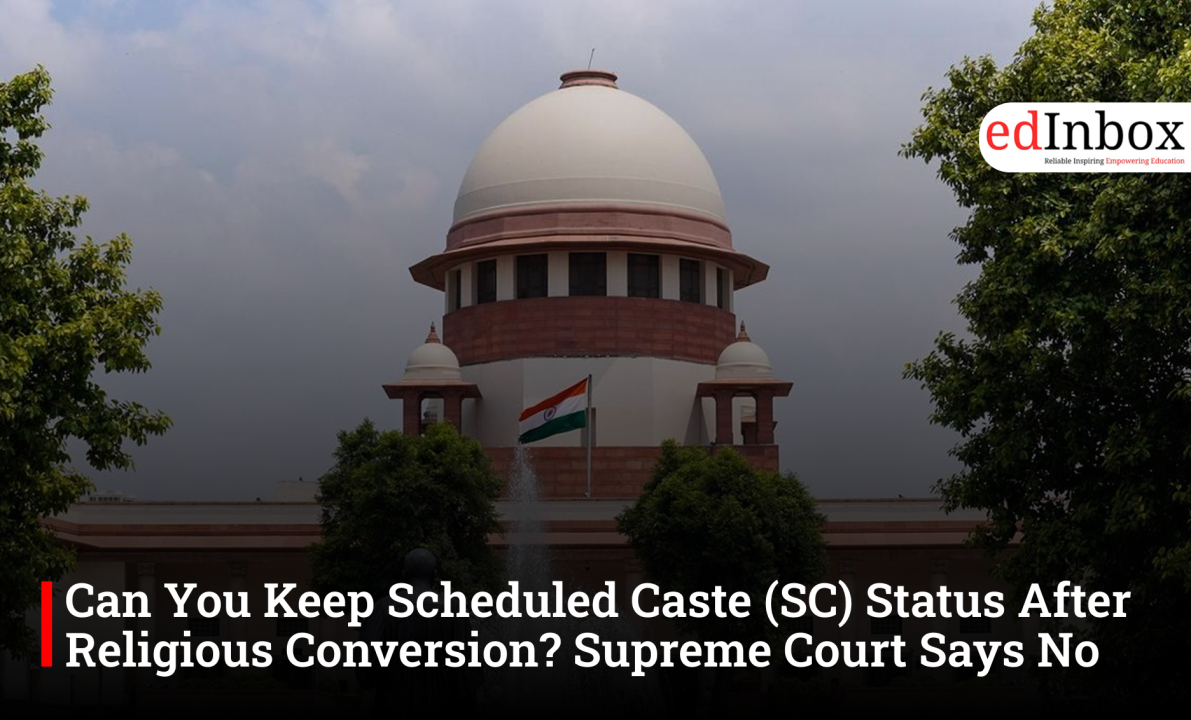
Can You Keep Scheduled Caste (SC) Status After Religious Conversion? Supreme Court Says No
Typography
- Smaller Small Medium Big Bigger
- Default Helvetica Segoe Georgia Times
- Reading Mode