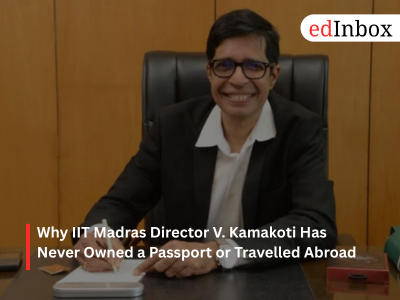
At a time when international collaborations, overseas conferences, and global research exchanges are considered integral to academic leadership, V. Kamakoti stands apart. The Director of Indian Institute of Technology Madras has never travelled abroad and, by choice, does not even own a passport.
Despite leading one of India's premier engineering institutions and serving on the Centre's high-powered task force on examination reforms, Kamakoti says he has never felt the need to leave the country. Instead, he believes that meaningful academic exchanges should happen in India, with global experts visiting the country rather than Indian scholars always travelling overseas.
No Passport by Choice
Kamakoti has publicly stated on multiple occasions that he does not possess a passport because he has never considered international travel essential to his work or mission.
While many academicians routinely attend overseas conferences, pursue international fellowships, or collaborate through foreign visits, Kamakoti has consciously built his academic career entirely within India. His belief is that India should become a destination where researchers from across the world come to exchange ideas.
His decision is unusual, particularly for someone who heads an IIT and is actively involved in shaping national education policy.
Rural Childhood Shaped His Worldview
Born in Chennai in 1968, Kamakoti grew up in a family with strong academic roots. His father was a Sanskrit professor at the University of Madras, but instead of beginning school in the city, his parents sent him to spend his early childhood with his grandparents in the villages of Mudikondan and Vishnupuram in Tamil Nadu.
Those formative years, he has often said, profoundly influenced his outlook on education, society, and Indian traditions.
Living in rural Tamil Nadu exposed him to farming, nature, and community life. He has frequently acknowledged that the experience taught him the importance of agriculture and reinforced his belief that farmers remain the backbone of the country.
These experiences continue to shape many of his public views on Indian knowledge systems, traditional practices, and education.
From Cricket Lover to Classical Music Student
Kamakoti's childhood was not defined solely by academics.
He was passionate about cricket until a turning point during Class 7, when a ball struck his spectacles while opening the batting for his school team. Concerned about his safety, his father reportedly threw away his cricket bat and discouraged him from playing the sport.
Although upset initially, Kamakoti soon discovered another lifelong passion—Carnatic violin. Learning classical music became an important part of his childhood, and he later reflected that, apart from the cricket incident, his parents never imposed career choices on him, allowing him to pursue his interests freely.
From Average Student to IIT Scholar
Contrary to the stereotype of an IIT topper excelling from an early age, Kamakoti describes himself as an average student during his school years.
After joining PS Senior Secondary School in Chennai, he fractured his hand shortly after admission and scored just 25 out of 100 in mathematics in one of his early examinations. Encouragement from his school principal proved transformative.
By the end of the academic year, he had scored 100 out of 100 in mathematics, significantly improving in physics as well. That turnaround eventually led him to IIT Madras, where he completed his BTech, MTech, and PhD before joining the institute as a faculty member.
Over the years, he built a distinguished academic career in computer architecture, embedded systems, cybersecurity, and computer science, eventually becoming Director of IIT Madras.
National Spotlight and Education Reforms
Kamakoti has frequently been in the public spotlight for his views on Indian Knowledge Systems (IKS), indigenous sciences, and traditional practices.
More recently, he was appointed to the Centre's high-level committee tasked with recommending reforms to India's examination system. The committee also includes S. Somanath, Nandan Nilekani, and Tapan Kumar Deka, among other experts.
His appointment drew political attention after Priyanka Gandhi Vadra criticised him during a parliamentary debate. Kamakoti has maintained that his focus remains on strengthening India's examination system and improving outcomes for students.
Choosing a Different Path
Whether or not one agrees with his public positions, Kamakoti's career is unusual in Indian academia. While many education leaders pursue global visibility through international travel, he has consciously chosen to remain rooted in India.
His decision not to own a passport reflects a personal philosophy rather than a professional limitation. For Kamakoti, the goal has always been to contribute to Indian education and research from within the country while encouraging the world to engage with India on its own soil.
Why IIT Madras Director V. Kamakoti Has Never Owned a Passport or Travelled Abroad
Typography
- Smaller Small Medium Big Bigger
- Default Helvetica Segoe Georgia Times
- Reading Mode