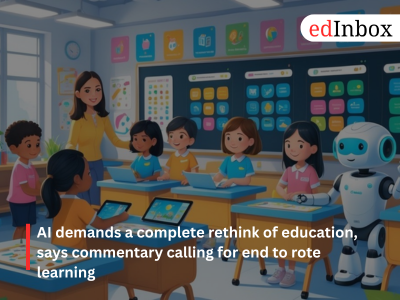
As artificial intelligence (AI) reshapes the way students learn, write and solve problems, India's education system must undergo a fundamental transformation that moves beyond rote learning and examination-centric teaching, according to a recent commentary advocating sweeping reforms.
The article argues that recurring concerns over examination leaks and academic misconduct should be viewed not merely as administrative failures but as an opportunity to redesign education for the AI era, where critical thinking, creativity and personalised learning become more valuable than memorisation.
AI is changing how students learn
The commentary notes that AI tools are already capable of generating essays, coding assignments, research papers and examination responses, making traditional assessment methods increasingly ineffective in measuring genuine understanding.
Rather than viewing AI solely as a threat, the article suggests that the technology can become a powerful educational tool by offering personalised learning experiences tailored to each student's pace, language and learning style.
AI-powered tutors, it argues, could identify learning gaps, provide instant feedback and make quality education accessible across different regions and languages. This, in turn, would allow teachers to shift their focus from repetitive tasks such as grading and drilling towards mentoring students, encouraging curiosity and developing critical thinking.
Call to move beyond colonial-era education
The commentary traces the origins of India's examination-focused education system to the colonial period, arguing that it was designed to produce clerical workers and administrators rather than innovators and independent thinkers.
According to the author, while India achieved political independence, many structural features of the colonial education model—including an emphasis on memorisation, conformity and high-stakes examinations—have continued to shape classrooms.
The article contends that India now has an opportunity to move beyond this legacy by fostering original thinking, entrepreneurship, scientific inquiry and leadership.
Reviving India's tradition of intellectual debate
As an alternative to rote-based assessment, the commentary highlights the revival of Śāstrārtha, the traditional Indian practice of structured scholarly debate, at Nalanda University.
Under this approach, students are expected to defend their ideas through logic, evidence and dialogue rather than relying solely on written submissions.
The process includes understanding opposing viewpoints (Pūrvapakṣa) before presenting a reasoned response (Uttarapakṣa), with evaluation based on intellectual honesty, reasoning and analytical ability.
The author argues that such oral examinations are particularly relevant in the AI era because they require students to explain and defend their understanding, making it difficult to rely on AI-generated content without genuine comprehension.
Rethinking classroom learning
The commentary proposes that schools should place greater emphasis on:
- Project-based and experiential learning
- Classroom discussions and structured debates
- Scientific experiments and real-world problem-solving
- Oral presentations and project defences
- Critical thinking and creativity
It argues that while AI can generate polished written responses, students demonstrate true learning only when they can explain concepts, respond to questions and apply knowledge in unfamiliar situations.
Teachers remain central
Despite advocating greater use of AI, the article stresses that technology should complement—not replace—teachers.
By automating routine instructional tasks, AI could enable educators to devote more time to mentoring, developing judgement, nurturing curiosity and supporting students' overall growth.
The commentary concludes that India has an opportunity to combine modern AI capabilities with its historic educational traditions, creating a system that prepares learners not just to succeed in examinations but to become innovators, researchers, entrepreneurs and responsible citizens in an increasingly AI-driven world.
AI demands a complete rethink of education, says commentary calling for end to rote learning
Typography
- Smaller Small Medium Big Bigger
- Default Helvetica Segoe Georgia Times
- Reading Mode