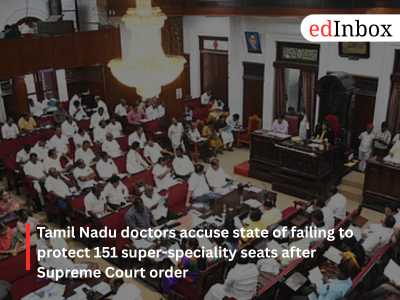
The Tamil Nadu Medical Officers Association (TNMOA) has criticised the Tamil Nadu government after the Supreme Court directed the surrender of 151 vacant DM/MCh super-speciality seats earmarked for in-service government doctors to the All India Quota (AIQ). The association described the outcome as a legal and administrative failure that could adversely affect the state's public healthcare system.
The doctors' body, which had approached the apex court seeking to prevent the transfer of the seats, said the government's handling of the case reflected a lack of commitment to protecting the interests of government doctors and strengthening super-speciality healthcare services in Tamil Nadu.
TNMOA blames state government
In a statement issued after the court's order, the TNMOA expressed "deep anguish, disappointment and strong dissatisfaction" with both the Union and state governments.
The association alleged that the loss of the seats was the result of the Tamil Nadu government's failure to effectively defend its case before the Supreme Court.
"It is entirely the result of the legal and administrative failure of the state government. It reflects not only a failure to protect the rights of government doctors but also a serious lack of commitment towards safeguarding Tamil Nadu's public healthcare system and its future super-speciality services," the association said.
Doctors call it a public health issue
TNMOA State General Secretary Dr M. Akilan said the matter extended far beyond medical admissions.
"This is not merely about reserved seats for government doctors. It is a public health issue," he said, arguing that fewer in-service specialists would ultimately affect healthcare delivery across the state.
According to Akilan, the Tamil Nadu government had appointed senior advocates, including Abhishek Manu Singhvi, to represent it in the contempt proceedings before the Supreme Court. However, he alleged that the senior counsel did not appear during the hearing, leaving the Bench without detailed submissions on behalf of the state.
Association cites earlier court rulings
The TNMOA argued that previous judicial decisions had recognised the state's authority to regulate medical admissions and maintain a separate admission channel for in-service government doctors.
The association also referred to earlier rulings upholding 50 per cent reservation for in-service government doctors in super-speciality courses. It contended that the state should have argued that the 151 vacant seats formed part of Tamil Nadu's exclusive in-service quota and therefore should not have been diverted to the All India Quota.
Doctors also recalled an oral observation made by Justice B.V. Nagarathna during an earlier hearing, when the judge reportedly questioned how government doctors, who continue to perform official duties, could compete with candidates preparing full-time for the NEET Super Speciality examination.
The association maintained that the state failed to build upon this observation with stronger legal arguments during the final hearing.
Supreme Court's direction
In its order, the Supreme Court permitted the Directorate General of Health Services (DGHS) to proceed with the second round of counselling using the existing qualifying percentile.
The court further directed that if the qualifying percentile is lowered after the second round, 50 per cent of the additional seats made available under the revised cut-off should be reverted to Tamil Nadu.
While the order provides some scope for seats to return to the state in subsequent counselling, the TNMOA has maintained that the surrender of the 151 super-speciality seats represents a setback for government doctors and could have long-term implications for the availability of trained specialists in Tamil Nadu's public healthcare system.
Tamil Nadu doctors accuse state of failing to protect 151 super-speciality seats after Supreme Court order
Typography
- Smaller Small Medium Big Bigger
- Default Helvetica Segoe Georgia Times
- Reading Mode