With Class 12 results declared and college admissions underway, students and parents across India face one of the most important decisions of their academic journey—should they choose a government college or a private college? While government institutions are known for affordability and prestige, private colleges often attract students with modern infrastructure, industry-oriented courses and attractive placement claims.
Education experts advise students not to make admission decisions based solely on brand names or marketing campaigns. Instead, factors such as fees, return on investment (ROI), academic quality, placements, infrastructure, faculty, peer group and career goals should be carefully evaluated before paying lakhs in tuition fees.
Fees and Return on Investment (ROI)
One of the biggest differences between government and private colleges is the cost of education.
Government institutions, including central universities, state universities, IITs, NITs and many public colleges, receive government funding, allowing them to charge significantly lower tuition fees. This makes them an affordable option for students from middle- and lower-income families.
Private colleges, on the other hand, often charge several lakhs in tuition, hostel and miscellaneous fees. Before opting for a private institution, students should calculate the Return on Investment (ROI) by comparing the total cost of education with expected placement opportunities and average salary packages after graduation.
Infrastructure and Learning Facilities
Private colleges generally have an advantage in terms of campus infrastructure. Many offer air-conditioned classrooms, modern laboratories, digital libraries, high-speed internet, smart classrooms, updated curricula and well-maintained hostels. Their academic programmes are often revised more frequently to align with changing industry requirements.
In comparison, some government colleges continue to face challenges such as ageing infrastructure, bureaucratic delays and limited resources. However, India's premier public institutions—including IITs, IIMs and leading central universities—provide world-class academic and research facilities comparable to global standards.
Placements and Brand Value
A degree from a reputed government institution continues to carry significant value in the job market. Employers often regard graduates from top public colleges as highly competitive due to rigorous admission processes and academic standards.
Many leading multinational companies actively recruit from premier government institutions. While several Tier-1 private universities also have strong placement records, many other private colleges primarily attract mass recruiters offering comparatively modest salary packages.
Students should review verified placement statistics, median salaries and recruiter profiles rather than relying solely on promotional claims.
Peer Group and Campus Environment
Admission to government colleges is usually based on highly competitive entrance examinations such as JEE, NEET and CUET, creating an academically strong peer group. Studying alongside high-performing students can encourage healthy competition, collaboration and personal growth.
Private colleges often admit students through multiple admission routes, including direct admissions and management quotas, resulting in a more diverse student population. While this offers exposure to varied backgrounds, the academic competitiveness may differ across institutions.
Which College Should You Choose?
If you secure admission to a reputed government college, it is often the better choice due to its lower fees, strong academic reputation and higher ROI. However, if the available government college lacks quality faculty, laboratories or placement support, a well-established private college with proven academic outcomes and industry connections may offer a better learning experience.
Ultimately, a successful career depends not only on the college you attend but also on your skills, internships, networking, continuous learning and professional development. Choosing an institution that aligns with your career goals, financial capacity and academic aspirations is the key to making a smart higher education investment.
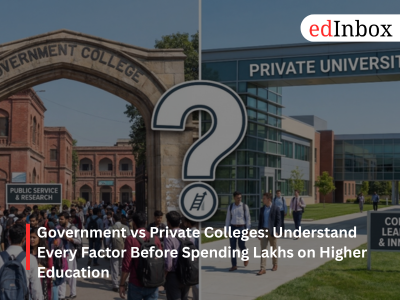
Government vs Private Colleges: Understand Every Factor Before Spending Lakhs on Higher Education
Typography
- Smaller Small Medium Big Bigger
- Default Helvetica Segoe Georgia Times
- Reading Mode