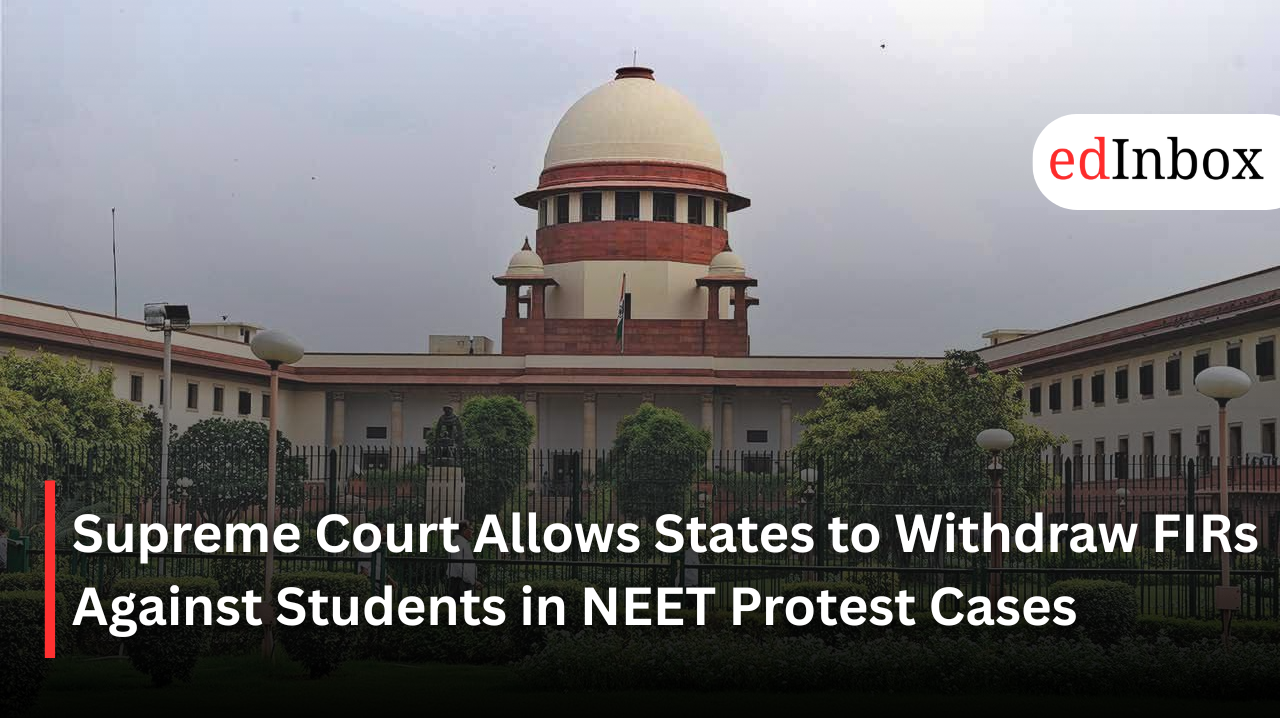
In a significant relief for thousands of students who participated in protests over the alleged NEET paper leak, the Supreme Court has clarified that the governments of Delhi and other states are free to close or withdraw First Information Reports (FIRs) registered against student protesters, provided they do not have criminal antecedents involving grave and heinous offences.
A Bench comprising Surya Kant, Joymalya Bagchi, and V. Mohana made it clear that the phrase "criminal antecedents" should be interpreted narrowly and applies only to individuals involved in serious and heinous crimes. The clarification aims to ensure that students who participated in peaceful demonstrations are not unfairly burdened with criminal cases.
During the hearing, Solicitor General Tushar Mehta, appearing for the Union government, informed the court that the Centre remained committed to not pursuing criminal cases against peaceful student protesters, except in cases involving individuals with serious criminal backgrounds. He stated that FIRs against more than 2,700 people having antecedents related to grave and heinous offences would not be withdrawn.
Senior advocate Gopal Sankaranarayanan, representing the petitioners, raised concerns over alleged police excesses during the protests. He informed the Bench that more than 300 videos documenting the incidents had been submitted before the court. According to him, the footage showed severe police action, including the use of lathis, pellet guns, and tear gas, against demonstrators. He also alleged that even the children of lawyers were assaulted during the protests.
Sankaranarayanan urged the court to direct the Delhi Police Commissioner and the Rapid Action Force (RAF) to investigate the actions of police personnel, particularly those seen in civilian clothing allegedly using excessive force. He argued that accountability was necessary for officers who exceeded their authority while handling the demonstrations.
The Supreme Court reiterated its earlier observations that peaceful protest is a constitutionally protected right and that police excesses or lathi charges cannot be justified merely because a public agitation is taking place. The Bench emphasized that law enforcement agencies must exercise restraint while dealing with peaceful demonstrators and review any allegations of misconduct.
The protests were triggered by allegations surrounding the NEET paper leak and intensified after a large student march towards Parliament on July 20, during which clashes broke out between protesters and security personnel. Police used lathis and tear gas shells to disperse the crowd after demonstrators attempted to breach security barricades.
The matter has now been listed for its next hearing on August 18, when the Supreme Court is expected to further examine issues related to police accountability and the status of criminal cases arising from the NEET protest demonstrations.
Supreme Court Allows States to Withdraw FIRs Against Students in NEET Protest Cases
Typography
- Smaller Small Medium Big Bigger
- Default Helvetica Segoe Georgia Times
- Reading Mode