Artificial Intelligence (AI) is rapidly transforming classrooms, workplaces, and the way students learn. From generating presentations to assisting with coding and research, AI has become an everyday learning tool. However, education experts argue that while technology can enhance learning, it should never replace the human abilities that define meaningful education.
The challenge for schools today is not whether students should use AI, but how they can ensure technology complements independent thinking rather than substituting it.
AI Can Solve Problems, But Humans Must Learn to Think
Technology has made many daily tasks effortless. Just as navigation apps have reduced our need to memorise routes, AI can now answer questions, summarise information, and generate content within seconds.
This convenience raises an important question for educators: If AI provides answers instantly, how will students develop the ability to analyse, question, and solve problems independently?
Experts believe education must move beyond memorising facts and instead cultivate judgement, curiosity, creativity, and critical thinking—qualities that remain uniquely human.
Future-Ready Skills Matter More Than Ever
While technical knowledge continues to be important, employers increasingly value skills that AI cannot easily replicate.
These include:
- Critical thinking and problem-solving
- Creativity and innovation
- Effective communication
- Empathy and emotional intelligence
- Collaboration and teamwork
- Adaptability and resilience
- Ethical decision-making
As workplaces become more automated and interdisciplinary, these competencies will distinguish successful professionals from those who rely solely on technical expertise.
Schools Must Redesign Learning Experiences
Experts say classrooms should encourage students to think independently instead of simply finding the correct answer.
Activities such as classroom discussions, debates, collaborative projects, presentations, creative assignments, and real-world problem-solving exercises help students develop confidence, leadership, and analytical thinking.
Schools are also being encouraged to teach students how to use AI responsibly—leveraging it as a learning assistant while maintaining originality, critical judgement, and academic integrity.
Global Education Systems Are Rethinking AI
Countries around the world are developing policies to balance AI adoption with foundational learning.
For example, Norway has announced that generative AI should not be used by primary school students. The country believes younger learners must first develop strong reading, writing, numeracy, and independent thinking skills before relying on AI tools. Older students are introduced to AI gradually under teacher supervision.
The approach reflects a broader global shift towards integrating AI without compromising essential cognitive development.
Parents and Policymakers Have a Shared Responsibility
Preparing students for an AI-driven future requires collaboration among schools, families, and policymakers.
Rather than resisting AI, experts recommend teaching children to use it responsibly, ethically, and thoughtfully. Students should understand both the capabilities and limitations of AI while continuing to strengthen the human skills that machines cannot replace.
Ultimately, the purpose of education extends beyond producing correct answers. It is about nurturing judgement, creativity, resilience, empathy, communication, and lifelong learning.
As AI continues to evolve, these qualities will remain the foundation of meaningful education, effective leadership, and long-term career success. Schools that prioritise these competencies today will be better equipped to prepare students for tomorrow's rapidly changing world.
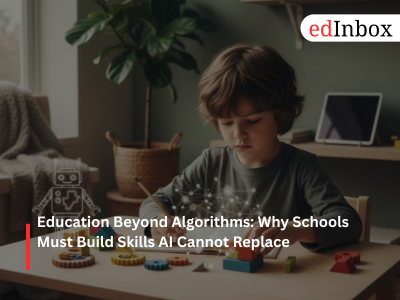
Education Beyond Algorithms: Why Schools Must Build Skills AI Cannot Replace
Typography
- Smaller Small Medium Big Bigger
- Default Helvetica Segoe Georgia Times
- Reading Mode