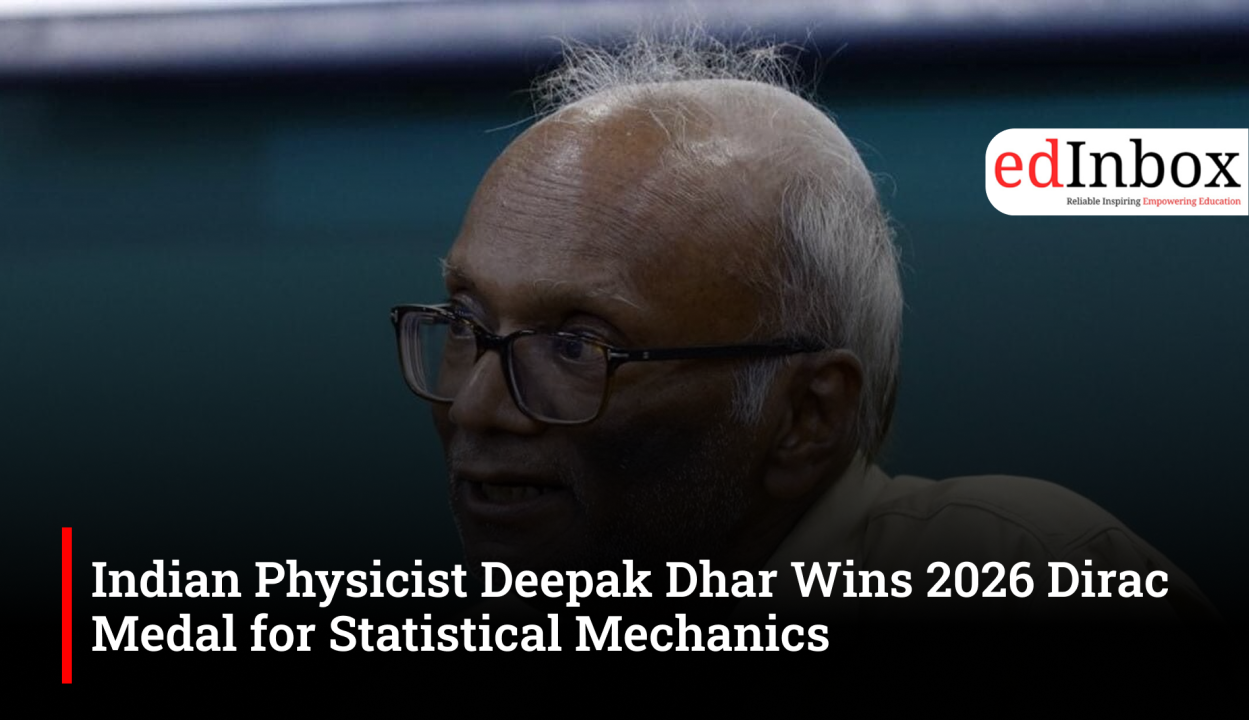
Indian theoretical physicist Professor Deepak Dhar has been awarded the 2026 Dirac Medal by the International Centre for Theoretical Physics (ICTP) for his significant contributions to statistical mechanics.
The prestigious honour places Dhar among an elite group of theoretical physicists recognised for advancing fundamental understanding of complex physical systems. Established in 1985, the Dirac Medal has previously honoured several leading figures in theoretical physics, including Stephen Hawking.
Dhar is one of four physicists selected for the 2026 award in recognition of their contributions to statistical mechanics.
Deepak Dhar's Contribution to Statistical Mechanics
Statistical mechanics is a branch of physics that explains how the collective behaviour of systems containing very large numbers of particles can be understood from the properties and interactions of their individual components.
Dhar has spent decades studying complex physical systems and has made influential contributions to statistical physics.
One of his best-known contributions is Dhar's burning algorithm, developed in the context of sandpile models. The algorithm has become an important tool in research into self-organised criticality and complex systems.
His research has also helped deepen understanding of mathematical structures underlying statistical physical systems.
From Pratapgarh to Caltech
Dhar's scientific journey began in Pratapgarh, Uttar Pradesh, where he was born in 1951.
Growing up in a Hindi-medium environment, Dhar developed an early interest in science. His father encouraged his curiosity and regularly brought home science magazines. A publication titled Understanding Science particularly influenced him.
He studied at Allahabad University before pursuing an MSc at IIT Kanpur.
Dhar subsequently moved to the United States to study at the California Institute of Technology (Caltech). There, he received a Richard Feynman Fellowship and worked closely with legendary physicist Richard Feynman, serving as his teaching assistant.
Dhar completed his PhD from Caltech in 1978.
Why Deepak Dhar Returned to India
After completing his doctorate, Dhar chose to return to India rather than build his long-term career in the United States.
He joined the Tata Institute of Fundamental Research (TIFR) in Mumbai, where he became part of a strong community of theoretical physicists.
He later served as a professor at IISER Pune for nearly eight years, contributing to physics research and teaching students.
Over the following decades, Dhar established himself as one of India's leading researchers in statistical physics.
Deepak Dhar's Major Awards
The 2026 Dirac Medal is the latest in a series of major national and international recognitions for Dhar.
In 2022, he became the first Indian recipient of the Boltzmann Medal, one of the most prestigious honours in statistical physics.
Reflecting on that achievement, Dhar had said: "While I am the first Indian to win the Boltzmann Medal, I am not the first Indian who has done good work in statistical physics."
In 2023, he was awarded the Padma Bhushan, India's third-highest civilian honour.
The Dirac Medal, named after physicist Paul Dirac, is awarded annually by ICTP to recognise outstanding contributions to theoretical physics and mathematics.
The medal has a distinguished history and has been awarded to scientists whose work has had a major influence on modern theoretical physics.
Why Deepak Dhar's Story Matters
Dhar's career represents a remarkable journey from a small town in Uttar Pradesh to some of the world's leading centres of scientific research.
He studied at IIT Kanpur, worked with Richard Feynman at Caltech, completed his PhD in the United States and subsequently returned to India to build his scientific career.
His work demonstrates how fundamental research in statistical mechanics can influence the broader understanding of complex systems, a field increasingly relevant to areas ranging from artificial intelligence and complex networks to other systems involving large-scale collective behaviour.
The 2026 Dirac Medal therefore marks another major milestone in Dhar's career and adds to the growing global recognition of Indian contributions to theoretical physics.
Indian Physicist Deepak Dhar Wins 2026 Dirac Medal for Statistical Mechanics
Typography
- Smaller Small Medium Big Bigger
- Default Helvetica Segoe Georgia Times
- Reading Mode