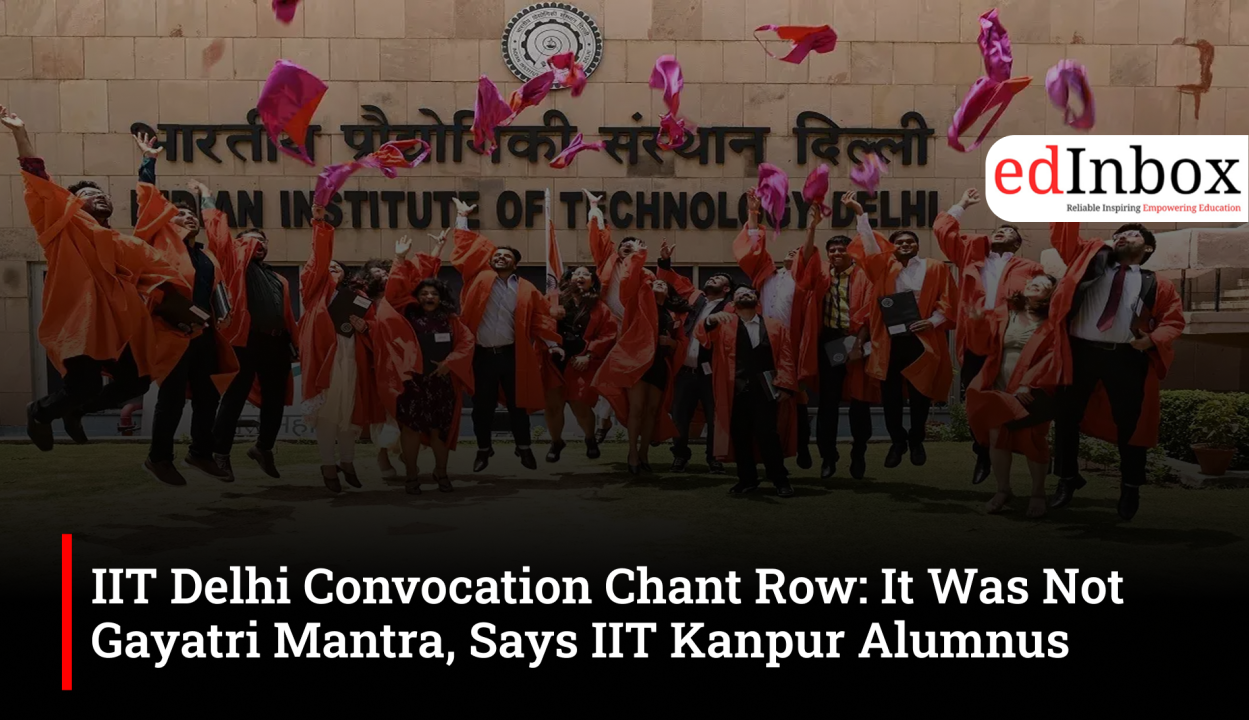
A Sanskrit recitation at the IIT Delhi 57th Convocation has triggered a political and social media debate after Congress spokesperson Shama Mohamed questioned the presence of what she identified as the Gayatri Mantra at an academic ceremony.
However, an IIT Kanpur alumnus, Gyan C Mehta, has disputed the identification, saying the verses recited at the convocation were not the Gayatri Mantra. According to him, the verses are from the Shikshavalli of the Taittiriya Upanishad, a section associated with learning and the traditional teacher-student relationship.
The distinction has shifted the focus of the controversy from whether a religious chant should be part of an academic ceremony to a more basic question: What was actually recited at IIT Delhi?
What Did Shama Mohamed Say?
Mohamed questioned the recitation during the IIT Delhi convocation, arguing that academic institutions should not include religious chants in their ceremonies.
"My cook plays the Gayatri Mantra every day when he enters my kitchen, and I listen to it every day and like it," she said, while questioning why it was played at an IIT convocation.
She argued that educational spaces should remain free from religious slogans and chants associated with any religion.
Her remarks came in the context of Prime Minister Narendra Modi attending the IIT Delhi convocation, adding a political dimension to the discussion.
IIT Kanpur Alumnus Disputes Gayatri Mantra Claim
Gyan C Mehta, identifying himself as a proud IIT Kanpur alumnus, challenged Mohamed's description of the recitation.
"I certainly don't want to pick a fight with your cook, but the fundamental premise of your post is factually incorrect. What is being chanted is not the Gayatri Mantra, not that there is anything wrong with it. As a proud IIT Kanpur alum, it is frustrating to see this," Mehta said.
According to Mehta, the verses belong to the Shikshavalli of the Taittiriya Upanishad.
The recitation includes the prayer, "Tan mam avatu, tad vaktram avatu", invoking protection for both the student and the teacher.
The underlying idea is significant in the traditional teacher-student relationship: before knowledge is imparted, both the person seeking knowledge and the person imparting it are included in the prayer.
What Is Shikshavalli?
The Shikshavalli is a section of the Taittiriya Upanishad that deals extensively with learning, discipline, ethical conduct and the relationship between teacher and student.
Its teachings include values associated with truth, duty, discipline, respect for teachers and responsible conduct.
The verses therefore have a direct connection with education and the completion of a student's formal learning.
IIT Delhi 57th Convocation
IIT Delhi conducted its 57th Convocation on August 8, 2026, with more than 3,000 students and 587 PhD scholars participating in the ceremony.
Prime Minister Narendra Modi addressed the graduating students, emphasising curiosity, questioning established ideas, research, innovation and the role of young graduates in India's development.
His address focused on areas including education, technology, research opportunities and India's semiconductor ambitions.
It was against this academic backdrop that the Sanskrit recitation became a subject of political debate.
Is the Recitation Linked to Samavartana?
The Shikshavalli also has a connection with the broader idea of Samavartana, an ancient Indian ceremony associated with the completion of a student's education and transition towards social responsibilities.
The verses emphasise the responsibilities that accompany education, including truthfulness, ethical conduct, discipline and respect for teachers.
Supporters of including such verses at modern convocations view them as an expression of India's intellectual and educational heritage.
Critics, meanwhile, question whether religiously rooted or traditional invocations should feature at ceremonies held by public educational institutions.
Why the IIT Delhi Chant Controversy Matters
The controversy raises two separate questions.
The first is factual: Was the recitation at IIT Delhi actually the Gayatri Mantra?
The second is broader: Should traditional or religiously rooted verses be included in ceremonies at public educational institutions?
While Mohamed's criticism focuses on the second issue, Mehta's response challenges the factual premise on which her argument was based.
The distinction is important because the Gayatri Mantra and the verses from the Shikshavalli are different texts with different contexts and meanings.
The debate over secularism and traditional practices in India's educational institutions is likely to continue. But in the IIT Delhi case, establishing precisely what was recited remains the first step in understanding the controversy.
IIT Delhi Convocation Chant Row: It Was Not Gayatri Mantra, Says IIT Kanpur Alumnus
Typography
- Smaller Small Medium Big Bigger
- Default Helvetica Segoe Georgia Times
- Reading Mode