Before power could command the world, knowledge had already begun to shape it; education became the vessel through which that knowledge travelled from one generation to another. Education is often presented as the road to a better career, a higher income and a secure future. Its most remarkable strength, however, lies far beyond employment. Education changes how people understand the world. It gives them the ability to read laws, understand history, question information, recognise manipulation and demand accountability. Hence, the idea of education as power has remained relevant across generations.
A person with knowledge is not necessarily powerful. However, an individual who knows how to think, question and apply knowledge can be much more difficult to control. This is where education goes beyond a degree or certificate. It turns into a way of freedom, and allows people to make choices instead of taking things on faith. This is why unaccountable power fears an educated population because education gives people the tools to question authority.
How can education be a source of power?
Knowledge alters the options that are available to a person. When a child learns to read, he or she can gain access to ideas that are beyond the immediate context. A student with an understanding of technology can find opportunities that other generations may not have found. A citizen who knows his/her rights will know when they are being violated. This is what education does to a society — makes it powerful.
Education also provides people with the capacity to analyze information rather than taking everything they read at face value. A learned individual can ask: What is the evidence? Who is making this argument? What is not stated? What are the advantages of this decision? These questions might seem straightforward, but they are the building blocks of thinking and responsible citizenship.
Why is it that the powerful do not like an educated society?
It would be unkind to claim that all rulers and governments are afraid of educated people. Institutions must be strong and accountable, and they should be open to an informed population, as they can be made more transparent and effective through scrutiny. What is it that the power which is insecure and unaccountable fears? Education itself? No, it is people who know and are confident enough to question it.
An educated population is harder to control with misinformation, fear or empty promises. People who understand history are better equipped to recognise patterns that have appeared before. Those who know the law have the right to challenge decisions that are made without justification. Individuals who are able to assess evidence are less likely to believe a claim just because it is made by an authority figure. Education does not teach people to rebel against authority, it teaches them how to comprehend and assess authority.
The best lesson is to ask why
The best classroom is not the one that teaches students the most. It is the one in which students learn to ask better questions. Why is this true? What is the evidence for it? Is there another reason? What if this decision is incorrect?
These questions lie at the heart of science, journalism, law and democracy. The advancement of science requires challenging accepted theories. Journalism requires tough questions. Examination of evidence is the basis of law. Citizens need to evaluate conflicting claims in order to ensure democracy. A student who learns to question respectfully is not being disobedient, they are learning one of the most important skills that education can give them: critical thinking.
Education is a key component of a healthy democracy
Democracy requires more than just voters. It requires informed citizens who can comprehend information, identify misinformation and make informed decisions. This is especially significant in the context of today's world where information can spread around the globe in seconds.
Fake news can be spread through social media, and AI can create convincing text, images and videos. In this context, it is not enough to have access to information. Students should be taught to check sources, identify bias, to distinguish between fact and opinion, and to assess evidence. Education is thus emerging as one of the best lines of defence against misinformation.
Education does not necessarily equal a degree
In modern society, education is often judged by marks, degrees, rankings and placements. While these accomplishments are important, especially in a competitive job market, they don't necessarily tell the whole story. A student can get very good grades without being confident enough to challenge an idea. A graduate can enter a prestigious profession and still remain vulnerable to misinformation. A person may be technically very knowledgeable but not be aware of the ethical implications.
The success of education should therefore not be judged by what a student remembers. It should also be judged on their ability to comprehend, ask questions, analyse and create. Knowledge is truly empowering when it transforms the way that a person views the world and equips them with the power to make informed decisions.
Can education become a tool of control?
The connection between education and power is complex, as education can free people, but it can also shape their beliefs. What students learn is important, but what they don't learn can be important. A classroom may challenge youth to think differently or may give them one interpretation of an issue.
This is why it is important to foster curiosity and intellectual freedom in education. When students are taught only what to believe, education runs the risk of becoming conditioning. When they learn to evaluate ideas, to compare evidence and to draw their own conclusions, education becomes a liberating force. Education is not about teaching students to think for you, it's about teaching students how to think for themselves.
Why universities must protect the freedom to disagree
A good university is not a place where everyone agrees with each other. It should be a place where ideas are challenged by evidence, reasoning and respectful debate. Students should be able to ask questions of their teachers, researchers should be able to challenge accepted ideas, and alternative perspectives should be explored and not simply rejected.
It is not a failure of education when there is disagreement. At times, it's proof that learning is taking place. The seeds of intellectual development can be sown when a person is confronted with an idea that contradicts his or her own beliefs. The aim of higher education should not be to get all students to the same conclusion, but to enable students to make conclusions based on reasoning and evidence.
Education empowers people to change their future
The most intimate form of educational power is the capacity to envision an alternative future. A child from a disadvantaged background can find opportunities that might not have been apparent to them that he or she could discover through education. It can provide communities with knowledge and skills that generate economic and social opportunities. It can also assist people to realize that their current situation does not have to be their future.
Education doesn't just affect one student. Knowledge is transferred from students to families, from families to communities and from one generation to the next. A teacher can impact hundreds of young minds, and one educated person can impact the decisions and aspirations of a whole family. This is the way education slowly starts to become a tool for social change.
The future is for those who can THINK
The world is changing at a rapid pace thanks to artificial intelligence, automation and digital media. Information is now more easily available, but determining what is true is increasingly difficult. Students therefore need more than the ability to memorise information.They must be curious, analytical, adaptable and capable of evaluating the information they encounter.
Students who know all the answers will not necessarily be the ones best equipped for the future. They will be the ones who can ask the right questions, look at evidence, change when necessary and think for themselves. With technology increasingly able to answer questions, perhaps the most important skill will be knowing which questions to ask.
Education is power that creates independent minds
Education can open a mind, a degree can open a career. Knowledge can enable a person to identify injustice, grasp opportunity and challenge misinformation. A falsehood can be challenged by critical thinking and intellectual freedom can help a society not accept authority without question.
So, education is the power, not because education makes people rebellious or against those who govern, but because it makes them independent thinkers. That's why unaccountable power has always been uneasy with an educated society.
Apparently, the best education system is not one that produces citizens who agree with everything they hear. It is one that produces citizens who can ask difficult questions, demand evidence, tolerate disagreement and imagine something better.
Thus, a society that teaches its people to think produces citizens capable of shaping their own future, and this is indeed intimidating to those in power who wish to rule and not serve. So, the question is whether we wish to hone education as power or be honed by those in power.
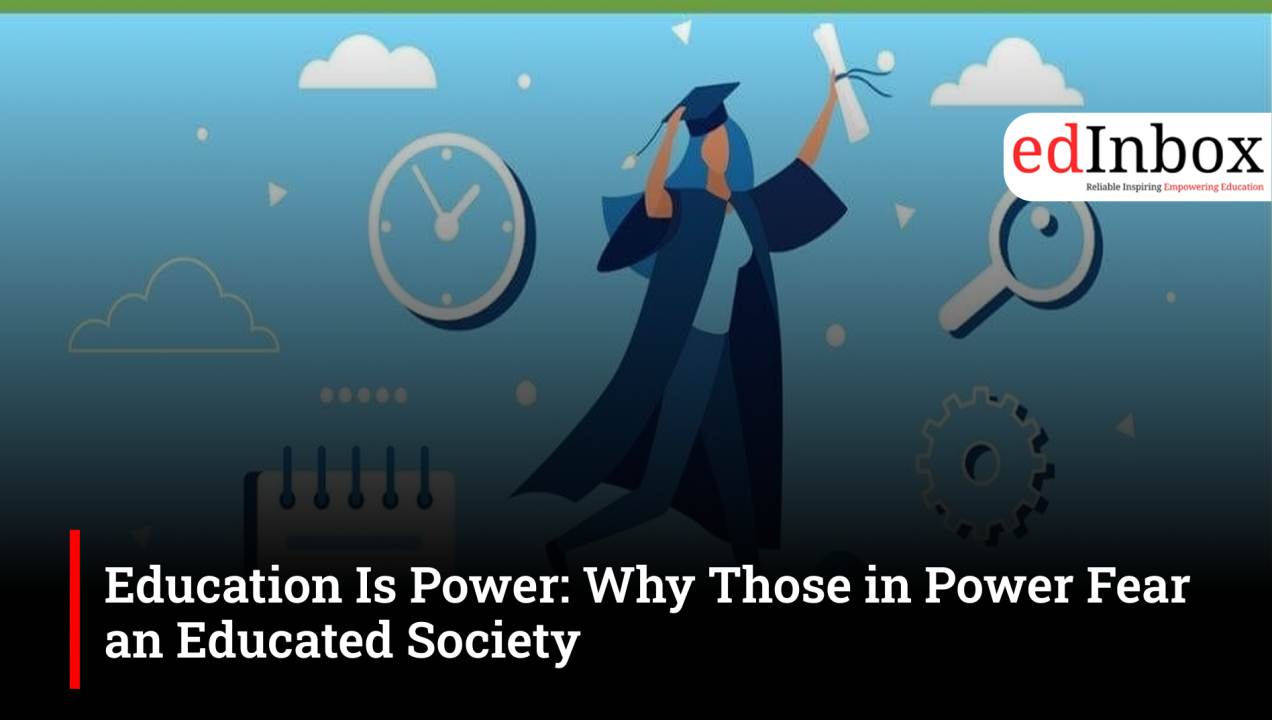
Education Is Power: Why Those in Power Fear an Educated Society
Typography
- Smaller Small Medium Big Bigger
- Default Helvetica Segoe Georgia Times
- Reading Mode