Haridwar Kanwar Yatra is making headlines but not for the good reasons. India knows how to celebrate, worship, travel and come together in numbers that can astonish the world. The more difficult question is, however, whether we have learned how to leave a place better than we found it. The question has come to the fore after this year's Kanwar Yatra in Haridwar.
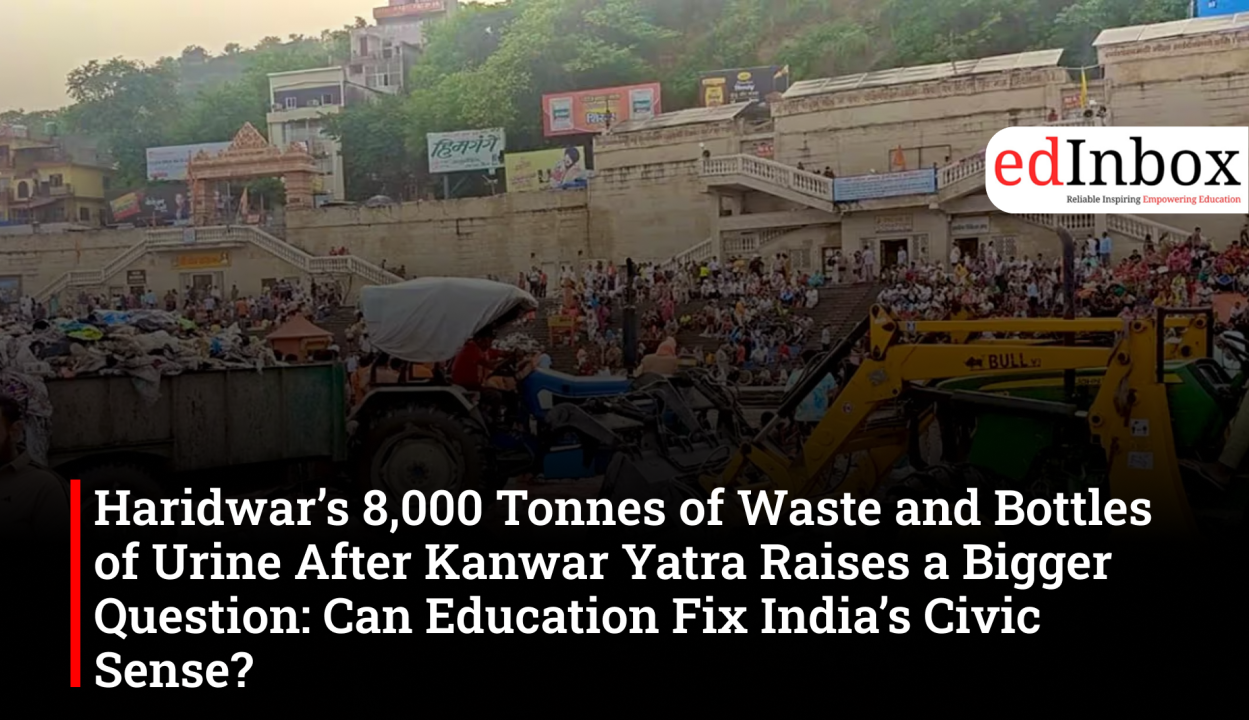
It is estimated that around 4.8 crore Kanwariyas came for Haridwar Kanwar Yatra and nearly 8,000 metric tonnes of waste was reportedly dumped on the ghats, mela grounds, parking areas and Kanwar routes. Sanitation workers at Har-Ki-Pauri found bottles filled with urine in changing compartments; they cleaned Haridwar Ghats with their bare hands picking those up!
The scale of the pilgrimage is extraordinary. So is the scale of the waste. But to say that it's just about littering would be to overlook the bigger picture. The civic issue in India is not garbage, it is the attitude towards everything that is shared.
India Needs Better Infrastructure, But that Alone Is Not Enough
In public discourse, it is an uneasy choice between blaming the citizens and blaming the administration. In fact, both have duties. In a city with millions of people, there is a need for proper sanitation, waste collection, toilets, waste disposal, traffic management, and other infrastructure. It is not fair and not practical to expect a city to prepare for extraordinary crowds without being extraordinary.
However, infrastructure has its limits. No waste-management system can work if people keep dumping waste anywhere. One thousand dustbins are not enough to replace the idea that someone else will take care of the trash after us. Road discipline can't be built by a beautifully constructed road. A riverbank cannot be kept clean just because there are signs on it telling people not to litter. Responsible behaviour can be facilitated by infrastructure. It will not take the place of responsibility.
The Civic Sense India Needs Must Begin in Education
It is at this point that the education system becomes part of a discussion typically led by municipal authorities and policy makers. Education is usually measured by marks, degrees, job and exams. We celebrate students who do well in maths and science, but seldom consider whether we are educating people who know what they are responsible for in the society in which they live. Apparently, being good at math, science, theory is great but true education is when civic sense and common sense roots the individual.
A child can read about environmental pollution in a book and become an adult who throws a plastic bottle on the street. A student can take a great exam on sustainable development and then leave a public area littered with wrappers. Sometimes it's not that they don't have the information; it is the difference between knowing and doing. Civic sense education needs to fill that gap.
Is It Possible To Change The Civic Sense Of India In The Schools?
Schools are not expected to address all social issues, but can shape habits before they become entrenched. Children learn from repetition, observation and example, as well as from books. If cleanliness, public responsibility, respect for shared space and care for the environment are integrated into the school's culture, they are more likely to be part of daily life, not just a lesson.
This is not an attempt to add another chapter to a full curriculum. It involves a change in the values that education places on things. A student should be aware of the importance of waste segregation, the importance of public property, the importance of not dumping waste in the river and the importance of not leaving the street cleaner.
The lesson should not be “Don't litter or you will be fined.” It should read “Keep the place clean for a healthy life.” because seeking obedience is not civic sense, showing them the easiest solution to a bigger problem is civic sense.
The Public Spaces Of India Will Be Passed On To The Next Generation
The children in the classrooms today will be the citizens who will design, govern, manage and live in the cities of India. They will be engineers constructing infrastructure, administrators running public systems, entrepreneurs developing businesses, and voters determining the nature of government.
What kind of India they build will depend partly on what they believe their responsibility to India actually is. And this is where schools play a big role. If young people believe that public spaces are not their spaces, then they will treat them as such. Their relationship with a railway station, road, river, park or heritage site will change if they grow up understanding that it is a shared inheritance and not the government's responsibility to pick up their deliberately thrown trash.
Patriotism doesn't stop at waving a flag. Patriotism is sometimes putting a wrapper in the right bin when nobody's looking.
Religious Gatherings should also teach responsibility
Another aspect of the Haridwar incident needs to be highlighted. Large gatherings of religious people are acts of faith, community and tradition. They connect people from different regions and backgrounds and have a great meaning for millions. That makes them even more of a chance for civic education.
A pilgrimage should not leave a contradiction, where devotion is celebrated and the environment around a sacred river is overrun with waste. Faith and responsibility need not be in competition.In fact, respect for a sacred place should naturally encourage respect for its physical surroundings.
This is true of the Kanwar Yatra and much more. A society's civic maturity is measured by its weddings, festivals, political meetings, concerts, sporting events and public celebrations. The number of people at a gathering is not the only thing that should be measured, but the responsible behavior of the people who are there.
India is Cannot Fine Its way Out of Civic Crisis
There are rules and there are penalties. Enforcement matters. Improved municipal systems are important. However, no country can police every action for a long period of time. Civic sense cannot be solely based on surveillance or punishment in India, where there are too many people, too many public spaces and too many interactions that take place every single day. The sustainable solution has to be cultural. And culture is learned!
That's why education is so important. The classroom could be the most potent long-term civic infrastructure in India. Roads can be repaired. Drainage systems can be improved. Waste-processing plants can be expanded. However, if the entire generation's thinking about public responsibility changes, all those investments can change.
The India We Want to Build Must Also Learn How to Behave
India’s development story is now mostly about infrastructure, technology, economic growth and global ambition. Sure, these things matter. But honestly, development is also hiding in smaller little moments, like whether someone waits their turn, whether they guard a public toilet, whether they sort waste properly, whether they treat a river with respect, whether they walk out of a public space and leave it tidy.
These actions don’t usually hit the headlines, not really. Still, taken together, they say a lot about what a society feels like to live in. So that 8,000 tonnes of waste and urine bottles at har-ki-pauri reported after the Kanwar Yatra should not just turn into yet another line item in some post event clean-up report. It should turn into a real question for India’s education system: Are we teaching children only how to win on their own, or are we teaching them how to share a country in a responsible way?
India will absolutely need better roads, better waste systems, and upgraded infrastructure. But none of it will work well, if we don’t also raise better civic conduct. The India of tomorrow won’t be created only by what infrastructure we manage to leave behind. It will also be shaped by the mindset we leave behind. And that mentality is being formed right now, in our homes, in our schools, and yes, inside our classrooms.
Haridwar’s 8,000 Tonnes of Waste and Bottles of Urine After Kanwar Yatra Raises a Bigger Question: Can Education Fix India’s Civic Sense?
Typography
- Smaller Small Medium Big Bigger
- Default Helvetica Segoe Georgia Times
- Reading Mode