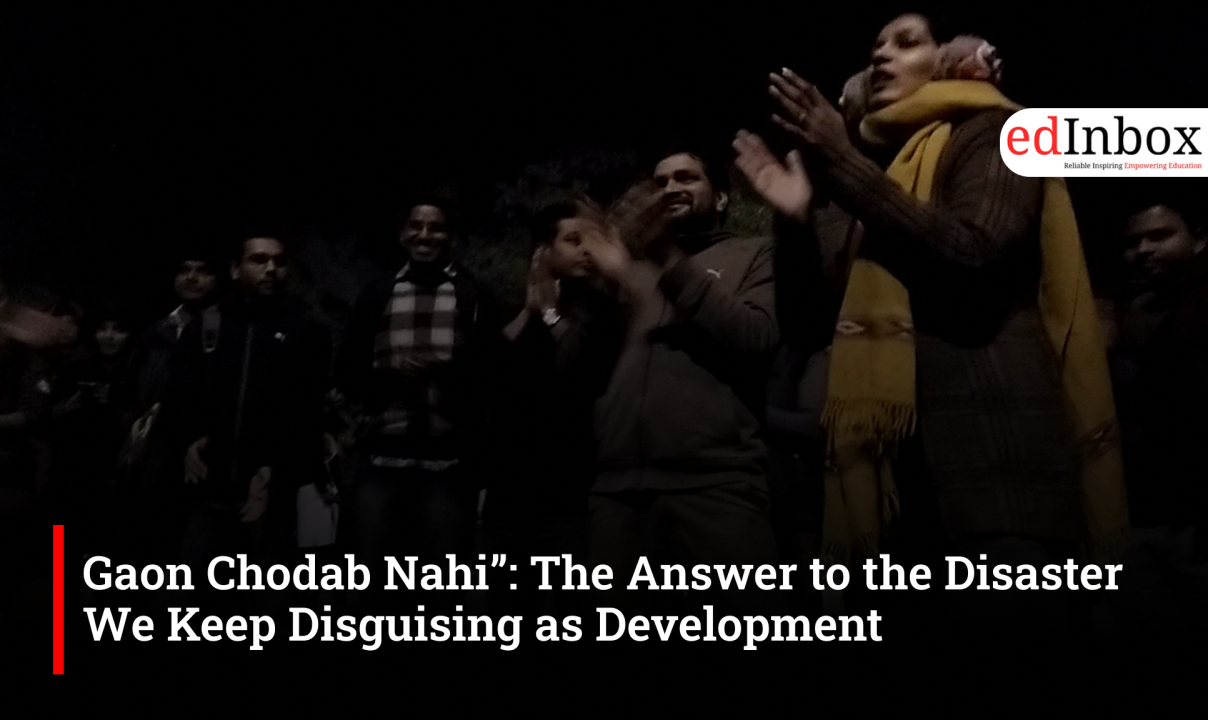
A song is an entertainment but the meaning it hides within is the literature that fuels revolution. There are songs we hear and forget, and then there are songs that follow us long after the music has stopped. “Gaon Chodab Nahi” meaning “We Will Not Leave Our Village”, is one of the latter. The protest song emerged from struggles against displacement and the exploitation of tribal land and forests, and is resonating with a new audience in a time when India is grappling with an increasingly complex development conversation. The words are easy to read, almost insistent on being repeated, but the question under them is not easy: What happens when the cost of development is someone's home?
The song has been associated with Adivasi and anti-displacement movements for decades. It is about communities that are not willing to give up their land, forests, livelihoods and culture for projects that are marketed as progress. The message has spread through people's movements and performances, and now, as clips and recordings spread through social media, it is reaching young Indians who may never have heard the song in its original context. It's important to renew the focus because the generation that shares it is being raised in a nation where the term development is omnipresent, but the effects of development are becoming inescapable.
What is the reason behind the viral success of “Gaon Chodab Nahi”?
The resurgence of “Gaon Chodab Nahi” with the younger generation is not just about finding an old protest song. It's finding an old question at a very contemporary time. Gen Z has been told that development is about bigger cities, more industries, highways, technology, extraction and economic growth. This generation is also experiencing polluted air, disappearing green spaces, stressed rivers, extreme weather and increasing anxiety about what kind of planet will be left for them.
This contradiction adds a new emotional life to the song. The words of a community that refuses to abandon its village can start to feel more like a challenge to the concept of progress than a political slogan. If a forest has to disappear, a community has to relocate and generations of cultural memory have to be broken for a project to be completed, can the project be called successful simply because it produces economic value? The song does not give a technical solution. It does more than that, it makes us ask the question.
The Problem Is Not Development. It is Development Without People.
India needs development. It requires improved roads, industries, electricity, employment, hospitals, technology and infrastructure. It would be neither realistic nor fair to a country with millions of people who still have limited access to opportunity to reject development altogether. However, there is a distinction between opposing development and challenging the nature of development that sees people as a hindrance.
Displacement is more than just a move for communities whose lives are intricately tied to forests and ancestral land. Family history, livelihood, language, rituals, memories and identity can be carried by land. A forest can be a source of food, medicine, work and cultural knowledge. A river can be part of the history of a community. These connections are lost, and compensation can replace a loss of money, but not a loss of belonging.
This is where “Gaon Chodab Nahi” turns into more than a protest song. It gives a human voice to something that official language can make sound strangely harmless. Land acquisition. Rehabilitation. Displacement. Project-affected families. They can be required in policy documents, but they can also make a very personal experience sound administrative.
What is the meaning of “Gaon Chodab Nahi” for young India?
The most compelling aspect of the song is that young people are not simply consuming it as history.. They are reading it in the light of their own problems. The song starts to take on new significance as soon as it reaches the ears of a new generation that is asking questions about climate change, inequality, sustainability and the costs of endless consumption.
What kind of future are we creating when the people who already inhabit the land have to vanish to make room for it?
Not all mining projects, industrial projects, roads and infrastructure developments are destructive. It implies that development should not be assessed solely on the basis of what has been built at the completion of a project. It should also be evaluated on the impact on people, ecosystems and communities on the journey. A nation is not developed just because it has constructed more. It must also question what it has safeguarded.
Art Starts Doing the Work of a Question
This is where the song's political message is not enough. Statistics can't tell the story as well as art can. A report can tell us the number of families displaced. Rehabilitation can be explained in a policy document. The law can be decided by a court. However, a song can evoke the sense of homelessness.
Hence, protest music has always been important. It makes an issue an experience. It makes something happen to people we may never meet and puts it in our emotional world. One day, land is no longer simply land. A forest is more than a natural resource. A village is more than a place on a map. They turn into places where people lived, where they remember a parent, where they learned a song, where they imagine their children growing up. “Gaon Chodab Nahi” brings that feeling to life.
The Song Is Asking India to Rethink Progress
The most uncomfortable question raised by the song is not whether India should develop. It is whether we have become too ready to say that all construction progress is progress. We celebrate what is built, but seldom ask who paid the price for building it. We measure highways in kilometres, industrial projects in investment and cities in economic output. But what about another measure of development: how much human dignity, ecological balance and community life does it retain?
A better model of development would not force India to opt for growth at the expense of its citizens. It would require more responsible, participatory and sustainable growth. Communities should not be seen as barriers because they reside in the area where a project is being proposed. Opposition to progress is not the same as environmental concerns. Indigenous communities should not be asked to continually demonstrate the value of their relationship with their land.
Why Gen Z Is Sharing an Old Song
It's almost like a poetic journey for an old protest song to pass through the phones of a generation that lives in a different kind of India. The technology is new. It's a new platform. The audience is new. However, the wound that the song speaks of is not new.
That may be why it's seeping into the minds of the young. They are starting to realize that the future they are talking about in classrooms, boardrooms and government offices is their future as well. They will inherit the cities we build, the rivers we save or pollute, the forests we save or destroy, and the social inequalities we face or ignore.
The song thus turns into more than a historical record; it turns into a dialogue between generations. The singers of the song decades ago were asking that they not be erased by development. The youth listening today are asking what kind of development they want to pass on to their own children.
“Gaon Chodab Nahi” Is Not Anti-Development. It Is a Call for Better Development.
This may be the difference India most needs. A report can tell us how many families were displaced. A policy document can explain rehabilitation. A court can determine legal rights. But a song can make us feel what losing home means.. The solution is to grow without destroying as the cost of growth.
That's about building infrastructure without harming ecosystems, developing industries without disregarding communities, providing economic opportunity without accepting displacement as a given, and leveraging technology to enhance human life, not just consumption. It means recognising that a village is not empty land waiting for a project. It already has a life in it.
Maybe that's why the song is so strong today. “Gaon Chodab Nahi” is not just a statement of “We will not leave our village.” It asks, “Why do we have to leave it for progress to take place?”
The Art Is Leading the Call for a Better India
The best thing about art is that it doesn't always tell us what to think. Sometimes, it just won't let us quit thinking. A protest song can outlast governments, projects, campaigns and generations because its emotional truth is not dependent on a specific time.
“Gaon Chodab Nahi” is rediscovering that truth among the young listeners. Maybe they're sharing it because they see something in its words that they don't like. Maybe they are starting to realize that development that undermines the conditions of human life can't be forever celebrated as progress. Maybe they're learning what artists have always learned: that a song can be a weapon of resistance, but it can also be a blueprint for imagination.
India needs that imagination. It requires young people who are not against growth, but against the growth that is too expensive; who are not against change, but against the change that is not good enough; who are not against inheriting the country, but against inheriting the country to leave it behind.
After all, “Gaon Chodab Nahi” is not just a matter of not leaving a village. It's about not wanting to live in a world where someone's house, their culture, their forest or their dignity is traded for another person's development.
Maybe that's why an old song is saying so much these days… because the future is a revolution through entertainment!
“Gaon Chodab Nahi”: The Answer to the Disaster We Keep Disguising as Development
Typography
- Smaller Small Medium Big Bigger
- Default Helvetica Segoe Georgia Times
- Reading Mode