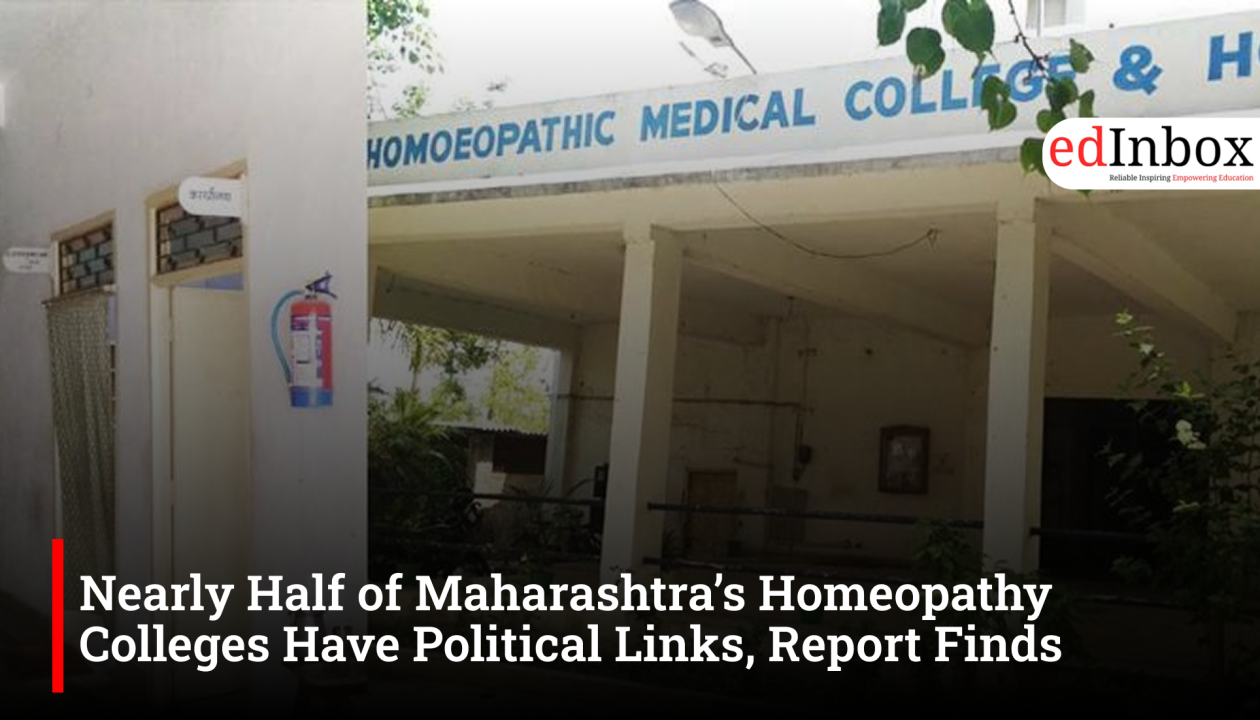
Nearly half of Maharashtra’s private homeopathy medical colleges are reportedly linked to political figures or politically connected trusts, raising questions about the regulation, quality of education and economics of the state’s AYUSH medical education sector.
Of the 72 private homeopathy colleges in Maharashtra, at least 34, or about 47%, are established or run by trusts and societies with political connections cutting across party lines. Together, these institutions account for nearly 3,000 seats, representing around half of the state’s total homeopathy undergraduate intake.
According to the latest data released by the National Commission for Homeopathy (NCH), the state had 74 homeopathy medical colleges as of August 3, 2026, including two government institutions. The colleges have a combined undergraduate intake capacity of 6,248 seats. One institution offers only postgraduate courses. Three new colleges were added in 2026, including two private colleges and a government college in Kolhapur, each with an intake of 100 seats.
The number of homeopathy colleges in Maharashtra has risen sharply from 59 in 2021, when they offered 4,645 undergraduate seats. However, the number of seats has increased by less than 140 despite the addition of 15 colleges.
One reason is that several institutions have either failed to receive permission for their full intake or have had their permitted seats reduced. Deficiencies cited in such cases have included inadequate infrastructure, absent or "ghost" faculty, forged documents and other regulatory violations.
For many students, homeopathy becomes an alternative after they fail to secure an affordable MBBS seat. With more than 22 lakh candidates appearing for NEET UG and just over 1.2 lakh MBBS seats, competition for medical education remains intense. Students who cannot secure government MBBS seats because of their NEET scores or afford expensive private medical colleges often turn to homeopathy and other AYUSH courses.
The economics of private homeopathy education also provides an incentive to keep seats filled. Annual tuition fees in Maharashtra generally range between Rs 1 lakh and Rs 2.25 lakh. At an average fee of Rs 1.5 lakh, a college with 80 students in a batch could collect around Rs 1.2 crore annually from tuition alone. Across four batches, this could amount to approximately Rs 4.8 crore, excluding hostel, examination and other charges.
Private colleges have also repeatedly sought reductions in the NEET UG qualifying percentile to address vacant seats. After NEET became mandatory for AYUSH admissions in 2018, the qualifying threshold has been reduced on occasions to improve admissions. In 2021-22, the AYUSH Ministry lowered the qualifying percentile by five percentage points across categories.
The debate has also intensified over whether homeopathy graduates should be permitted to prescribe allopathic medicines under limited conditions. Supporters argue that such provisions could expand employment opportunities, while sections of the allopathic medical community oppose the move, citing differences in training and patient safety.
Critics say the recurring proposals could also make homeopathy courses more attractive and help colleges maintain admissions. A senior Indian Medical Association member and former Maharashtra Medical Council office-bearer alleged that political pressure has contributed to the continuation of substandard institutions instead of stricter action against them.
The concerns underline the need for transparent regulation, strict enforcement of infrastructure and faculty requirements, and greater scrutiny of political influence in medical education.
Nearly Half of Maharashtra’s Homeopathy Colleges Have Political Links, Report Finds
Typography
- Smaller Small Medium Big Bigger
- Default Helvetica Segoe Georgia Times
- Reading Mode