For decades, the decision of an Indian student to study abroad was often associated with brain drain—the permanent migration of highly skilled talent to countries such as the US, UK, Canada and Australia.
That narrative may be changing.
A recent CFA Institute survey indicates that around 70% of Indian graduates are planning or considering studying abroad. However, many of these students do not view overseas education as a permanent exit from India. Instead, they see international education as a way to gain specialised knowledge, global exposure and professional experience before returning to build their careers in India.
The trend points towards a growing phenomenon known as brain circulation, where talent moves across countries, gains skills and experience and eventually returns to contribute to its home economy.
Why Indian Students Continue to Choose Overseas Education
The demand for study abroad programmes remains strong among Indian students.
International universities attract students looking for advanced degrees, specialised courses, research opportunities and exposure to global academic and professional networks.
Popular areas include engineering, finance, data science, business, technology and public policy.
For many students, the objective is increasingly less about permanently relocating and more about gaining access to experiences that can strengthen their career prospects.
Studying Abroad Is Becoming a Career Strategy
An overseas degree is increasingly being viewed as a career investment rather than simply a pathway to migration.
Students can gain exposure to different education systems, workplaces and professional cultures. They can also develop skills such as adaptability, independent problem-solving and working in multicultural environments.
These experiences can later become valuable when they return to India's expanding employment market.
Why More Graduates May Return to India
India's changing economic landscape is influencing how graduates view their long-term career prospects.
Growth across technology, finance, startups, consulting and digital businesses is creating new opportunities for highly skilled professionals.
As a result, some graduates increasingly see India not simply as the country they leave for education, but as the place where they can eventually build their careers.
This represents a shift from the traditional assumption that studying abroad automatically leads to permanent settlement overseas.
Brain Drain vs Brain Circulation
The distinction between brain drain and brain circulation is important.
Brain drain describes the permanent departure of skilled professionals from their home country. Brain circulation, on the other hand, involves a more dynamic cycle:
Study abroad → gain international exposure → acquire skills and experience → return home → contribute to the domestic economy.
Under this model, international mobility can potentially benefit both the individual and the home country.
Returning graduates may bring knowledge of international markets, new technologies, professional practices and global networks that can be applied in India.
The Financial and Practical Calculation
The decision to study abroad is also becoming increasingly practical.
Students and families have to consider tuition fees, living expenses, visa rules, employment opportunities, immigration policies and changing job markets before choosing a destination.
Uncertainty around long-term residency and employment in some countries can also influence students' decisions about where they eventually want to build their careers.
At the same time, India's economic growth can make returning home a more attractive option.
For some families, the question is therefore changing from “How can we settle abroad?” to “How can an international education strengthen the student's career in India?”
India's Overseas Students May Become a Global Talent Network
If the trend continues, Indian students studying abroad could increasingly form a global talent network rather than representing a one-way flow of skilled workers out of the country.
Some may stay overseas, while others may return immediately after their education or after gaining international work experience.
This mobility can create connections between Indian professionals and global institutions, companies and research communities.
A Generation That Studies Globally and Builds Locally
The growing interest in overseas education does not necessarily signal that Indian graduates want to leave the country permanently.
Instead, the emerging pattern suggests that many students view international education as a way to learn globally and apply that knowledge locally.
The CFA Institute findings add to a broader conversation around India's changing relationship with global talent. If students leave to acquire skills and return with greater expertise and international exposure, the story is no longer simply about brain drain.
It is about brain circulation—and potentially, brain return.
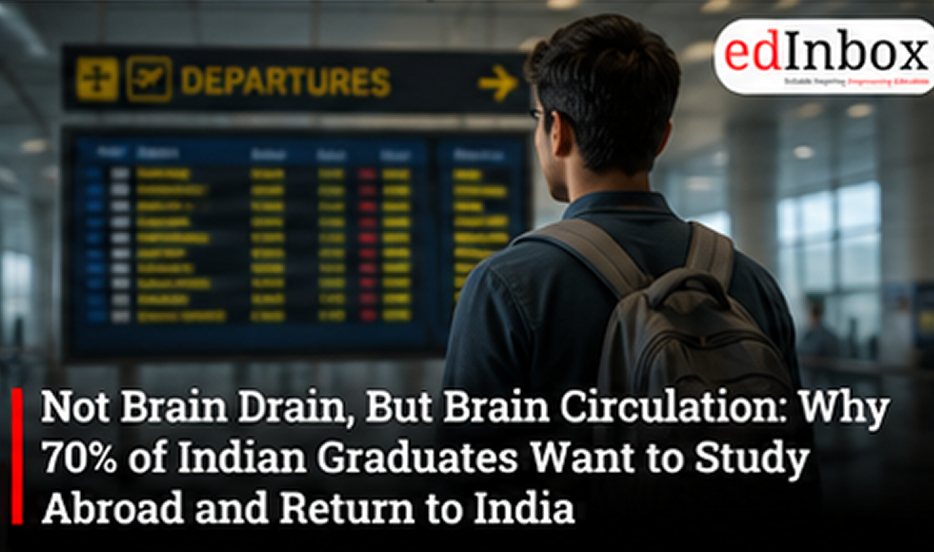
Not Brain Drain, But Brain Circulation: Why 70% of Indian Graduates Want to Study Abroad and Return to India
Typography
- Smaller Small Medium Big Bigger
- Default Helvetica Segoe Georgia Times
- Reading Mode