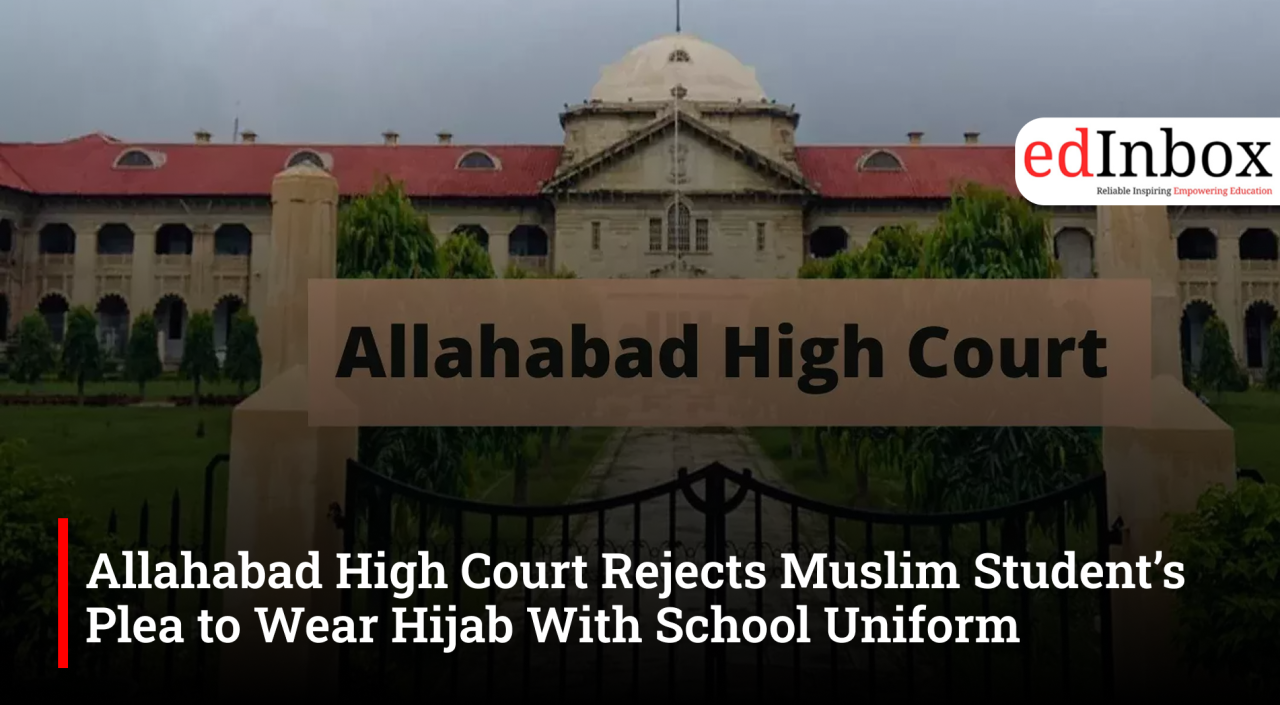
The Allahabad High Court has rejected a Muslim student's request to wear a hijab with her prescribed school uniform, stating that she had failed to prove that wearing a headscarf is an essential religious practice that is protected by Article 25 of the Constitution. The judgment was passed on August 21, 2026, in Prayagraj.
The Division Bench of Justices J.J. Munir and Indrajeet Shukla ruled that a uniform dress code can be imposed by a school if it is non-discriminatory and for the purpose of maintaining discipline and institutional identity.
Why did the Allahabad High Court turn down the hijab plea?
The case was of a minor student of Tagore Public School, Attarsuiya, Prayagraj who had passed out Class X and wanted to join Class XI of the same school. The student had requested to keep wearing a headscarf with the school uniform. She told the court that she had been wearing the headscarf since Class VI and had been permitted to do so by the school earlier, reports said.
The court's finding was specifically that the material before it did not establish wearing a headscarf inside the classroom as an essential part of religion for a Muslim woman. It stated that a claim under Article 25 could not be accepted on assertion without adequate factual and legal basis.
What did the court rule on school uniform rules?
If the dress code is uniform, bonafide and non-discriminatory, the selection of the prescribed uniform is mainly in the domain of the school, the Allahabad High Court said.
The court noted that school uniforms can serve purposes including discipline, equality among students and institutional identity. It also noted that a uniform policy can create a religion neutral atmosphere if it is applied to all students, regardless of their faith.
The decision does not bar Muslim students from wearing hijab in all schools in India. The judgment was about the student's request to wear a headscarf in violation of the school's uniform policy in the case.
Was the student's previous permission to wear hijab relevant?
The court did not accept the claim that the student had a prior right to wear a headscarf, which would have meant that the right was ongoing. The judgment pointed out that the school might have permitted the headscarf for a number of reasons, such as not enforcing its dress code or being courteous. The court said that the previous practice did not bar the school from enforcing its uniform policy later.
What was the verdict of the Allahabad HC in the Karnataka hijab case?
The Allahabad High Court also referred to earlier rulings on the issue of hijab and school uniform, such as the Full Bench decision of the Karnataka High Court in 2022. In the context that the Karnataka court had considered, the ruling had been that wearing hijab was not an essential religious practice in Islam. The Allahabad High Court called the Karnataka judgment "persuasive" and said it had "no reason to take a different view". The court also observed that the Supreme Court has yet to give a final authoritative verdict in the larger controversy after the split verdict in the Karnataka-related proceedings.
What is the implication of the Allahabad High Court hijab verdict?
The judgment has immediate consequences: the student is no longer able to claim the right to wear the headscarf with the school uniform in the context of this case. The decision addresses two questions: did the petitioner create a constitutional right to wear the headscarf as a religious practice, and was the school allowed to impose its uniform policy? The court answered both the questions against the petitioner on the material before it.
The Allahabad High Court's ruling joins a series of High Court rulings on the issue of religious attire and school dress codes, and the larger constitutional issue will be left to the Supreme Court to decide.
Allahabad High Court Rejects Muslim Student’s Plea to Wear Hijab With School Uniform
Typography
- Smaller Small Medium Big Bigger
- Default Helvetica Segoe Georgia Times
- Reading Mode