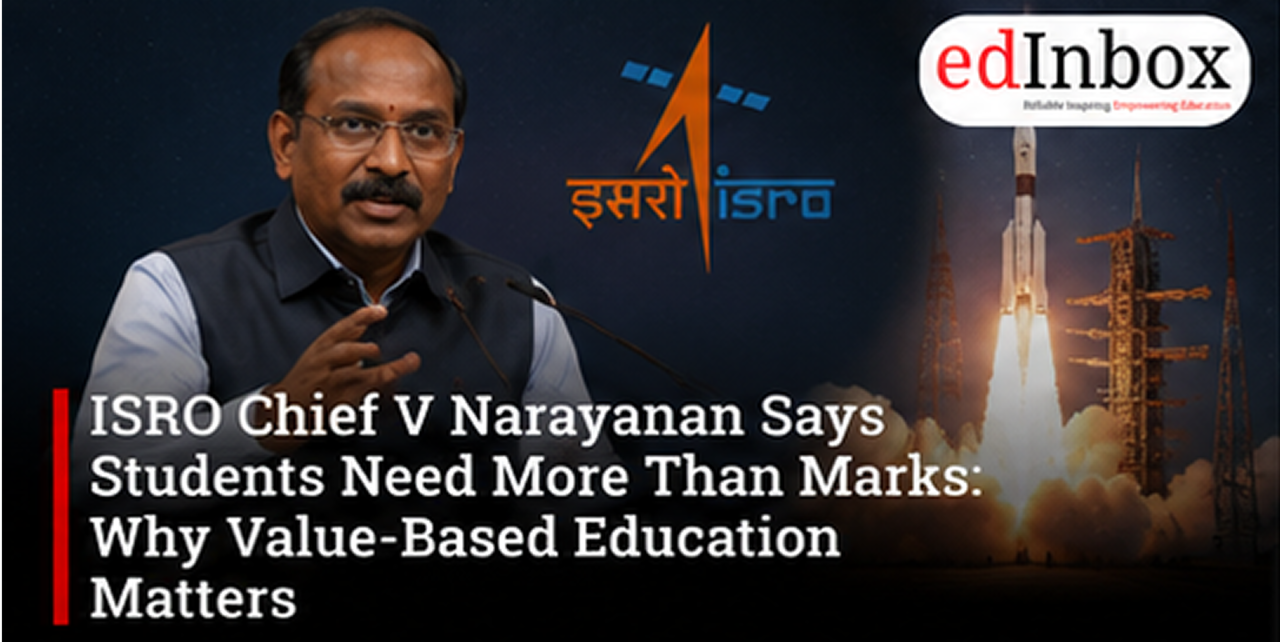
ISRO Chairman V Narayanan has urged India's education system to move beyond marks and rote learning, arguing that schools must focus equally on values, empathy, personality development and intellectual growth.
Speaking at a meeting of the High Level Expert Committee and New Syllabus Design Committee organised by the Tamil Nadu government, Narayanan said academic achievement alone cannot define a student's development.
“There are two types of education,” Narayanan said, referring to intellectual and value-based learning. While studying subjects such as Mathematics and Science and scoring well is important, he stressed that students must also learn to respect parents and teachers, respect others and develop tolerance.
“The book alone is not important. It is the overall personality development that is important,” he said.
Why Students Need More Than Marks
Narayanan's comments come at a time when employers increasingly value skills that cannot be measured through examination scores alone.
The World Economic Forum's Future of Jobs Report 2025 identifies analytical thinking as the most important core skill for employers. Other highly valued skills include resilience, flexibility, agility, leadership and social influence.
These abilities are closely linked to the broader idea of holistic education.
Analytical thinking develops when students question, debate and solve problems rather than simply memorising information. Similarly, resilience helps young people cope with failure and uncertainty, while teamwork, empathy and communication are essential for effective collaboration.
This means that academic excellence and personality development do not have to compete with each other. Instead, schools can prepare students for both examinations and the changing world of work.
Self-Control, Empathy Can Shape Careers
The importance of these qualities extends beyond employability.
Research cited by the OECD shows that personality traits such as emotional stability, sociability and conscientiousness are associated with employment and well-being outcomes.
According to the OECD's Skills that Matter for Success and Well-being in Adulthood, higher emotional stability and extraversion are associated with greater likelihood of employment. The findings also indicate that personality traits can have a significant influence on job satisfaction.
Emotional stability, for instance, can help individuals manage workplace pressure, while empathy and sociability can improve communication and relationships.
In other words, marks may demonstrate what a student knows, but emotional and social skills can influence how effectively that knowledge is applied.
ISRO Chief's Message Aligns With NEP 2020
Narayanan's emphasis on personality development also reflects the broader philosophy of National Education Policy (NEP) 2020, which calls for education that develops cognitive, social, emotional and ethical capabilities.
The policy seeks to move away from an education system focused exclusively on examination performance and towards holistic development.
The approach is also reflected in initiatives such as the CBSE Holistic Progress Card, which seeks to assess students across multiple dimensions rather than limiting evaluation to academic marks.
Narayanan Shares His Own Education Journey
The ISRO chief also challenged the perception that a student's future is determined primarily by the school they attend.
Narayanan, who studied at a government school in Tamil Nadu, said that how a student learns and grows is more important than the label attached to the institution.
His message is particularly relevant in an education environment where examination scores, school rankings and competitive entrance tests often dominate discussions about student success.
The larger question, therefore, is whether India's schools can create students who are not merely good at answering questions in examinations, but are also capable of thinking independently, showing empathy, handling failure, working with others and contributing responsibly to society.
For Narayanan, the answer lies in ensuring that value-based education stands alongside academic excellence—not beneath it.
ISRO Chief V Narayanan Says Students Need More Than Marks: Why Value-Based Education Matters
Typography
- Smaller Small Medium Big Bigger
- Default Helvetica Segoe Georgia Times
- Reading Mode