Indian students and technology professionals hoping to build careers in the United States could face significantly higher immigration costs as the US Department of Homeland Security (DHS) moves ahead with proposals for new fees for the H-1B work visa and F-1 Optional Practical Training (OPT) programme.
The proposals are still under review, and the exact fee amounts have not been announced. However, immigration law firm Fragomen has said the DHS could consider an OPT fee of up to $100,000, while a separate proposal is being examined for certain H-1B petitions.
The development could have a major impact on Indians, who accounted for 71% of H-1B petitions approved in fiscal year 2024, according to US Citizenship and Immigration Services (USCIS) data.
What New H-1B and OPT Fees Are Being Considered?
According to Fragomen, the DHS has initiated the regulatory process for new fees covering the two immigration programmes.
A proposed rule concerning an OPT fee was sent to the Office of Management and Budget (OMB) for review on August 20. A separate proposal covering fees for certain H-1B petitions was received by the OMB and cleared its review on August 19.
The proposals remain confidential, meaning no new fee has been officially confirmed.
Fragomen has cited reports that DHS could consider an OPT fee of as much as $100,000. The potential H-1B fee may also be linked to the administration's earlier attempt to impose a $100,000 payment requirement.
What Happened to the Earlier $100,000 H-1B Fee?
The Trump administration introduced a one-time $100,000 payment requirement for certain new H-1B petitions in September 2025.
The measure primarily affected petitions involving beneficiaries outside the US or cases requiring consular notification. Existing H-1B workers and many extension and change-of-status applications were generally not covered.
However, the policy was later struck down by a federal court.
A Massachusetts federal district court vacated the measure on June 8, ruling that the administration had exceeded its authority and that the payment amounted to an unlawful tax.
The government appealed, but the First Circuit Court of Appeals declined to stay the lower court's order in July. As a result, USCIS cannot currently collect the $100,000 payment under that policy.
The latest DHS proposal could represent an attempt to introduce an H-1B-related charge through a different regulatory mechanism.
How Much Does an H-1B Visa Cost Now?
Even without the disputed $100,000 payment, hiring an H-1B worker involves several government charges.
Depending on the petition and employer, these can include the H-1B registration fee, Form I-129 filing fee, ACWIA training fee, fraud-prevention fee and asylum programme fee.
Some employers with at least 50 US employees and where more than half their workforce holds H-1B or L-1 status can also face an additional $4,000 fee.
Premium processing and immigration legal fees can further increase the overall cost.
For Indian professionals, an important point is that most mandatory H-1B petition costs are generally paid by the employer, rather than the individual worker.
Why Indian Students Could Feel the Impact
The proposed OPT fee could be more significant for international students because OPT is an individual application.
Many Indian students enter the US on an F-1 student visa, complete their degrees and then use OPT to gain temporary work experience related to their studies. STEM graduates may also qualify for an additional STEM OPT extension before potentially moving to H-1B status.
The current USCIS filing fee for Form I-765, used for employment authorisation including OPT, is $470 for online applications and $520 for paper applications.
A substantial increase would therefore directly raise the financial burden on international students.
Reports of a possible $100,000 OPT charge have consequently triggered concern among students. However, the figure remains only a reported possibility and is not a confirmed DHS fee.
Why Indians Could Be Disproportionately Affected
The proposed fees would not be based specifically on nationality. They would apply according to the relevant immigration category and circumstances of an application.
However, Indians could experience a disproportionate impact because of their dominant presence in the H-1B programme.
For Indian students already studying in the US, the potential changes are particularly important because the F-1 → OPT → H-1B pathway is a common route into professional employment.
Any major increase in OPT costs or changes to H-1B fees and eligibility could therefore affect thousands of Indian students, technology workers and US employers that depend on skilled foreign professionals.
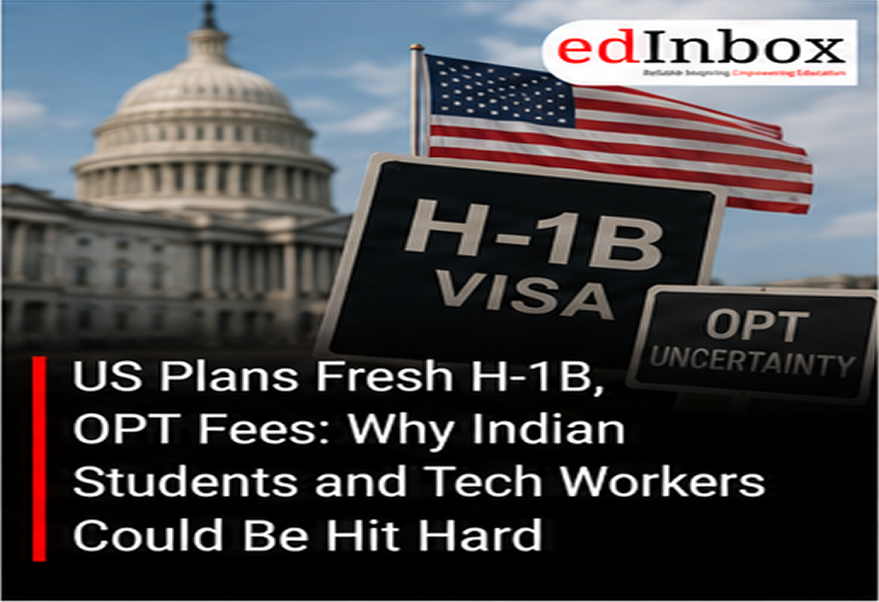
US Plans Fresh H-1B, OPT Fees: Why Indian Students and Tech Workers Could Be Hit Hard
Typography
- Smaller Small Medium Big Bigger
- Default Helvetica Segoe Georgia Times
- Reading Mode