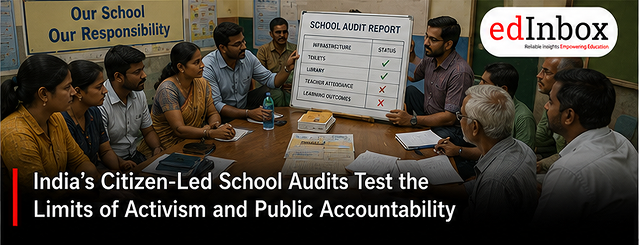
The Cockroach Janta Party (CJP), which gained national attention through protests over India's entrance examination controversy, has launched a campaign to inspect government schools and demand accountability over infrastructure and basic facilities.
A new citizen-led campaign to inspect government schools across India is raising important questions about public accountability, activism, student privacy and the limits of citizen participation in educational oversight.
The student-led activist movement known as the Cockroach Janta Party (CJP) has launched a nationwide initiative encouraging parents, students and volunteers to visit government schools and document the condition of basic facilities.
The campaign, launched on August 15, India's Independence Day, aims to inspect toilets, drinking water, electricity, classroom furniture and school buildings.
CJP has said the information collected through these visits will be used to demand improvements from government authorities.
CJP Plans to Audit 100 Rural Government Schools
The organisation has initially set a target of auditing 100 rural government schools over two months.
It has also proposed recognising village leaders who take significant steps to improve educational infrastructure in their communities.
Unlike CJP's earlier campaign, which relied heavily on public protests and demonstrations, the school audit initiative requires sustained local participation.
Volunteers are expected to document conditions, interact with local communities and follow up with government officials regarding the issues identified during school visits.
The campaign faces a massive challenge given the scale of India's government school system.
India has more than one million government schools, according to Education Ministry data. These institutions account for nearly 70% of schools in the country, although they educate less than half of India's approximately 247 million schoolchildren.
Different States Respond Differently to School Audits
The campaign has already faced different responses from state authorities.
Some administrations have reportedly initiated their own inspections after concerns about school infrastructure were raised. Others, however, have objected to activists entering schools without permission.
Authorities in Maharashtra and Rajasthan have raised concerns about school visits conducted without official approval.
In one instance, police action was reportedly initiated against CJP volunteers following a complaint by school authorities after activists entered school premises to conduct an inspection.
Rajasthan has also imposed restrictions on outsiders entering government schools and on filming, conducting interviews and documenting activities inside educational institutions.
CJP volunteers have claimed that some members were attacked while conducting school inspections in the state.
CJP spokesperson Ashutosh Ranka said the movement would continue its campaign despite resistance.
"We are not afraid. We are seeking accountability from the government," he said.
Government Schools Are Not Open Spaces, Officials Say
Authorities have argued that government schools cannot be treated as unrestricted public spaces, particularly because children are present on campus.
Questions have also been raised about the safety of students, disruption to teaching and the protection of children's privacy during filming and interviews.
In Uttar Pradesh, Chief Minister Yogi Adityanath has directed officials to conduct on-the-spot inspections of school facilities and has called for action against what the government described as misleading videos related to schools and colleges.
CJP has argued that such restrictions could weaken public scrutiny of publicly funded institutions.
Vinita Gursahani Singh, managing trustee of the citizen empowerment initiative We, The People, said citizens have a legitimate right to seek information but must follow established legal procedures.
She pointed out that citizens can seek information and inspect public institutions through processes available under the Right to Information framework, subject to appropriate permissions and safeguards.
Can Activists Act as School Inspectors?
The campaign has also sparked debate over whether citizen volunteers can effectively assess school infrastructure and safety conditions.
Critics have questioned whether volunteers possess the technical expertise needed to identify structural or safety risks and how allegations circulated on social media are independently verified.
Education advocate Mohandas Pai supported greater youth involvement in improving school education but criticised the idea of large groups entering schools without permission.
Pai argued that schools must remain safe and secure spaces for children.
He suggested that CJP could instead send smaller teams, obtain permission from authorities, collect systematic information and publish regular evidence-based reports.
CJP spokesperson Saurav Das, however, has argued that conventional channels have often failed to produce meaningful improvements and that citizens must have a stronger role in demanding accountability.
Privacy and Accountability Remain Key Concerns
The campaign has also generated debate over student privacy and consent, particularly when activists film classrooms or interact directly with children.
Kavita Srivastava, president of the People's Union for Civil Liberties (PUCL) Rajasthan, has argued that concerns about privacy should not be used to prevent legitimate scrutiny of government schools.
Supporters of the campaign believe public monitoring can help identify neglected infrastructure and force authorities to respond more quickly.
Activist Amrita Johri said CJP's earlier movement gained support because it addressed widespread concerns about accountability in India's examination system.
She said citizen-led audits could play a similar role in education, provided the campaign develops strong systems for volunteer training, documentation and follow-up.
The debate surrounding CJP's school audit campaign highlights a larger question for India's education system: How can citizens hold publicly funded institutions accountable while ensuring that schools remain safe, private and uninterrupted learning spaces for children?
As the campaign expands across states, its success may depend not only on the problems it uncovers but also on whether activists, communities and governments can find a framework that balances transparency with student safety and institutional responsibility.
India’s Citizen-Led School Audits Test the Limits of Activism and Public Accountability
Typography
- Smaller Small Medium Big Bigger
- Default Helvetica Segoe Georgia Times
- Reading Mode