Twinkle Khanna has mixed food, history and her trademark humour in a joke that has landed in the middle of India's continuing debate over how the Mughals are taught in school. In her new Mrs Funnybones piece, dated August 30, she leaned into satire. She mentioned Maharashtra FDA Commissioner Tukaram Mundhe and his food-safety checks.
She then joked that she once found a very old packet of Shahi Masala in her kitchen. In her words, it had gone past its date “around the same time as the Mughal Empire”.The joke then took an unexpected turn towards history books, with Khanna saying that those who want the Mughals erased from history should first start with their lunch.
What did Twinkle Khanna exactly say?
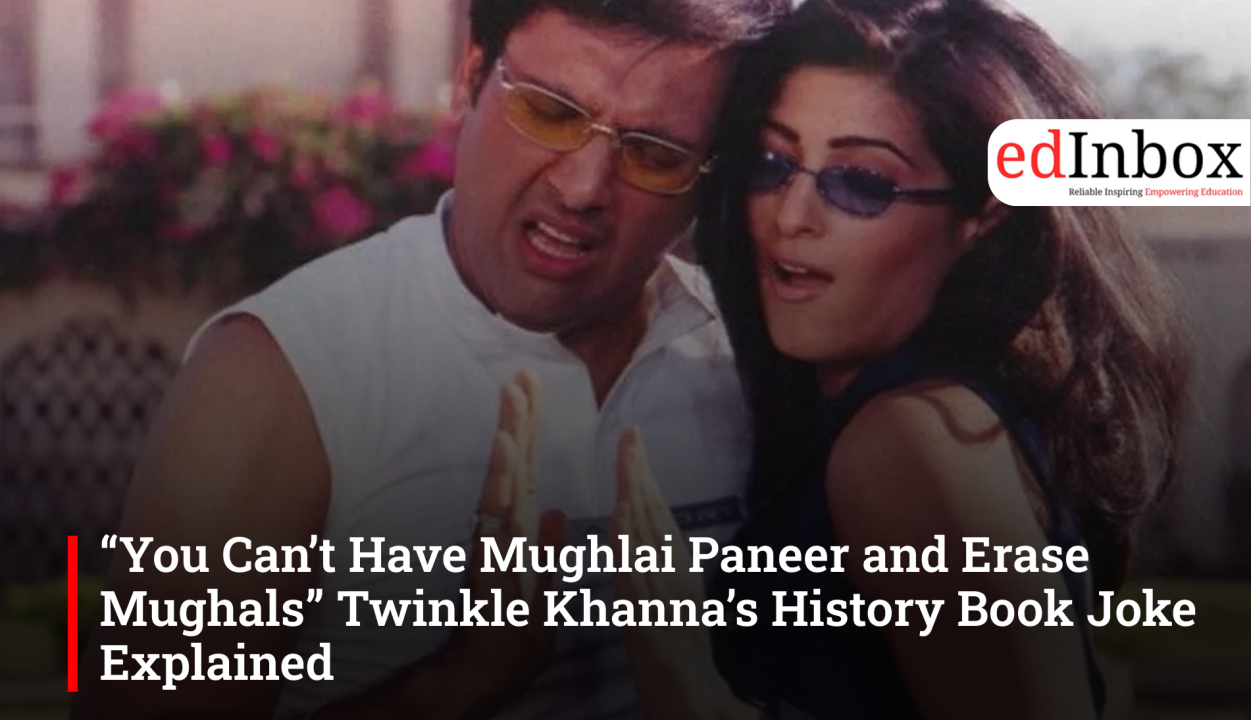
Khanna, in her new Mrs Funnybones piece, wrote that anyone pushing to “erase the Mughals from our history books” should start with lunch. She said they should give up koftas, kormas, and kebabs. She also brought up Mughlai paneer. Her point was that people cannot really enjoy it and still try to remove the Mughals’ mark from history.
She framed the whole thing as jokes, not as a serious fact claim. The line was part of a bigger funny column about food-safety raids. It should not be read as saying those dishes were only “invented by the Mughals”.
Her column read: "In the good old days, when I went to melas rather than acting in one, buddhi ke baal used to be a fluorescent pink. Now, it is the colour of my roots between touch-ups, finally living up to its name. The disappearance of pink dye is due to FDA commissioner Tukaram Mundhe. Hundreds of restaurants have fallen like dominoes in his wake, including Domino’s. Where Mundhe goes, mundis roll."
"Inspired by Mr Mundhe, I conduct a raid on my kitchen. I find a packet of Shahi Masala that expired around the same time as the Mughal Empire. Those who want to erase the Mughals from our history books should first start with lunch. Give up your koftas, kormas, kebabs. You can’t have your Mughlai paneer, real or analogue, and eat it too," she said.
Why did Twinkle Khanna mention history books in a food safety column?
The bit about Mughal history caught attention. People in India have argued about how it should show up in school lessons. In 2023, NCERT adjusted parts of the school syllabus.
In 2023, NCERT removed the Class 12 history chapter Kings and Chronicles: The Mughal Courts during its textbook rationalisation exercise. The chapter dealt with Mughal court culture, administration and historical sources, including texts such as the Akbarnama and Badshah Nama.
The change led to debate over how Mughal history should be represented in school education. However, saying that “Mughal history was removed from NCERT books” is too broad. The treatment of the subject has varied across classes and has changed again with the introduction of new textbooks under the National Curriculum Framework for School Education 2023.
NCERT has since introduced new textbooks for Classes 6 to 8 from the 2025–26 academic session under the NCF-SE 2023 and NEP 2020. The Ministry of Education has said the older Class 6–8 textbooks affected by the earlier rationalisation exercise are no longer in use. Students should therefore check the latest textbook and syllabus for their class rather than rely on older reports about what was removed.
What connection Mughal history has to Indian food?
This is where Khanna's joke connects history with something students experience every day. One of the many ways cultures influence each other is through food. Indian food has never been a one-dynasty, one-community creation, and many aspects of Mughal-period history – court culture, architecture, art, literature, and cuisine – are connected.
Many of the dishes that are considered Mughlai today have evolved and been influenced by various factors. Food culture was also exported from the royal kitchen to the community and to various parts of the country. Recipes were modified based on local foods and preferences.
Hence, students need to be careful in turning Khanna's joke into a history fact. She was joking about the contradiction between wanting Mughal influence removed from history and continuing to enjoy foods associated with Mughlai cuisine. It was not a history lesson, but a satirical argument. And that is exactly what became a debatable topic and went viral.
Twinkle Khanna's joke goes beyond paneer
Khanna's column was mainly about food-safety inspections, not an academic discussion about Mughal history. She also wrote about making paneer at home with her mother, Dimple Kapadia, amid concerns around fake or analogue paneer, and continued the humour around Mundhe's inspections.
Her history-books line, however, has been catching a great deal of attention because of a question that goes beyond food: Can a society separate historical influence from its everyday culture?
But the answer is not as simple as a joke. History can be studied critically without glorifying the period. Simultaneously, not everything in the textbook is removed from the cultural field once it is dropped from one textbook.
To students, the one thing that might be most valuable is one they've heard before: read history with proof, understand the context and don't take a viral quote as a textbook fact. Khanna's line may have started with a packet of expired masala, but it has opened another conversation about how India remembers its past, and how that past continues to appear in everyday life, right down to what is served at lunch.
“You Can’t Have Mughlai Paneer and Erase Mughals” Twinkle Khanna’s History Book Joke Explained
Typography
- Smaller Small Medium Big Bigger
- Default Helvetica Segoe Georgia Times
- Reading Mode