
Located in Goa is the peaceful island of Santo Estêvão, or St Estevam famous for its okra. The people affectionately referred to it as Juvem, but because of its legendary produce, it had another name—the ‘isle of vegetables’: Shakecho Juvo, famous for ‘long pale-green seven-ridged ladyfingers.’
“This dream of ours was quite eccentric at that time, and a very ambitious dream to have,” remembers Dr. Luis Dias, Miguel’s great-grandson. With a nascent Medical School in Goa, Miguel’s ambitions forced him to leave Portuguese-occupied Goa in order to study in either Bombay or Lisbon. But all this cost money—and money is exactly what the Dias family did not have.
"Many sacrifices had to be made for my great-grandfather to travel to Lisbon to study. The payment for all this was a watermelon offered by all his family when he returned because they were so poor," says Dr. Luis.
Goa's First Native ‘General’
With assistance from his brother João Vicente Santana Dias, Miguel went on to join the Faculty of Medicine at University of Lisbon, where he emerged with excellence in 1882. However, this excellence was achieved through a struggle since Miguel could not afford textbooks, most of which were in French, a language he had to study first before copying all the textbook knowledge in medical books by hand, which is a family asset to this day in the Dias family, despite being on different sides of the earth.
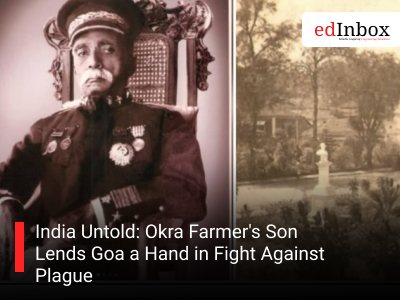
After excelling in education, Miguel got stationed in Mozambique, where primitive medical facilities compelled him to conduct life-saving surgeries with very basic tools. In 1888, he returned to Goa, which was far behind British India in terms of medical facilities. He took up the position of Director of Health Services and received the military designation ‘General’ – this being the highest title in the Portuguese medical service, with Miguel being the first and only Goan to have achieved this feat.
The Man Who Helped Save Humanity from the Plague
As an advisor to and director of a medical school, Dr. Miguel gained respect not only as a physician but as a surgeon. He conducted many first-of-its-kind surgeries, such as the first appendectomy in the state without using antibiotics, anesthetics, or aseptic methods. "This is right before antibiotics, so if you opened up this area, you have a higher chance of getting an infection," says Dr. Luis.
His most exemplary performance was during the Bubonic Plague in 1908. Through intensive sanitation drives, advanced medical programs, and an intolerance of social class divisions in treatment, he radically transformed the face of public health in Goa. His groundbreaking work earned him honorific Portuguese awards such as the highly esteemed Cavaleiro, Official e Comendador da Real Ordem Militar de S. Bento de Aviz.
Dr. Miguel was equally important in halting the shut-down of the Medical School of Goa because of a scathing inspection report in 1897. Where official records attribute this honor to Miguel Bombarda, historical records suggest that he is actually the first to have put forth arguments in:
“The Medical Surgical School of Nova Goa… collaborates in satisfying requirements of African colonization at a minimal cost to the treasury… this school has proved not only advantageous in Portuguese India but to the other colonies as well…”
Although he lived in a time of social division, Dr. Miguel, a Christian of humble background, made a name through merit alone. He advocated European vaccination practices despite native beliefs that vaccinations were a way of polluting one’s body.
"A Goiano jornalista e militante do anti colonialismo, o jornalista Luiz de Menezes Bragança, assim o definiu: ‘Foi um grande “He remained always the same – simple, ingenuous, unaffected before the great and small…” Dr. Luis gives other examples from his own family: when Miguel talked at a felicitation function not of himself but of his father; or when he stood up for a vegetable vendor being harassed, shouting from his balcony, "I am a bhendekar too, come to me first."
As a final desire of this great man, when Dr. Miguel departed this life on 26th July 1936, he was buried not in Panjim, where he had established such a successful career, but in the very village he loved so much. Even today, a statue erected in commemoration of this dedicated man remains in Panjim, complete with medals representing the eradication of the plague and a complete overhaul of the medical system in Goa, all thanks to this man.
India Untold: Okra Farmer's Son Lends Goa a Hand in Fight Against Plague
Typography
- Smaller Small Medium Big Bigger
- Default Helvetica Segoe Georgia Times
- Reading Mode